CyberTalks: AI in Banking and Financial Services — When Governance Gaps Become Liabilities
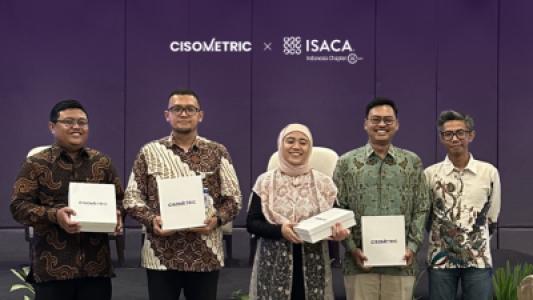
Pada 9 Juli 2026, Cisometric bersama ISACA Indonesia Chapter menghadirkan sesi #CyberTalks di The Grand Mansion, Menteng, dengan tema AI in...

Oleh Cisometric Marketing Team, Diterbitkan pada Desember 14, 2025
Artificial Intelligence (AI) is no longer an experiment at the edge of the business. It is now embedded in customer service, fraud detection, recruitment, content production, and decision-making across industries.
But as AI systems become more powerful and more autonomous, how do we make sure AI is not only powerful, but also trustworthy?
This is where AI governance matters. It provides the rules, structures, and oversight needed to ensure AI is used responsibly, without slowing down innovation for your business.
AI governance refers to the frameworks, policies, standards, and oversight mechanisms that ensure AI is developed and deployed in a safe, ethical, and compliant way (IBM, 2024; Diligent, 2025).
In practice, AI governance (Informatica, 2024):
Because AI systems are built and trained by humans, they inherit human errors and biases. AI governance introduces structure and accountability so that AI does not become something that is powerful but unaccountable (IBM, 2024).
For many organizations, the conversation has already moved beyond “Should we use AI?” to “How do we use AI safely?” AI governance provides that missing link.
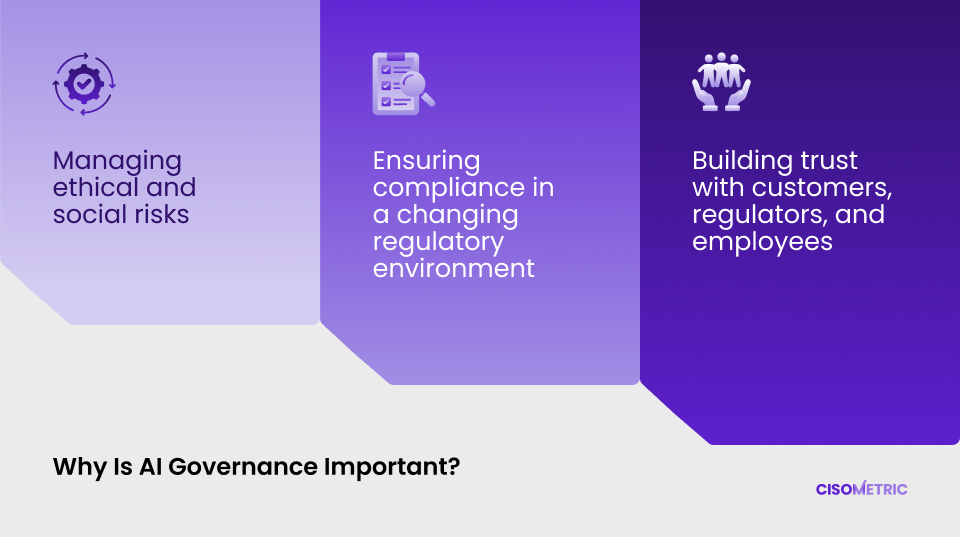
1. Managing ethical and social risks
Well-known examples like discriminatory recruitment algorithms and biased judicial risk-scoring tools show how AI can reinforce existing inequalities when left unchecked (IBM, 2024; Informatica, 2024).
Without governance, AI may:
These risks are not only ethical problems; they also represent legal, reputational, and business risks.
2. Ensuring compliance in a changing regulatory environment
Regulators worldwide are moving quickly. The EU AI Act introduces a risk-based regime with stringent requirements for “high-risk” AI systems, including transparency, human oversight, and documentation obligations (IBM, 2024). Other jurisdictions, including Canada, China, Singapore, and India, are building their own AI governance and risk management frameworks to address issues such as bias, data protection, and AI safety (IBM, 2024; Diligent, 2025).
But this acceleration is not only happening abroad.
Indonesia is entering a regulatory shift of its own. The government, through the Ministry of Communication and Digital (Komdigi), has begun preparing two major instruments: a National AI Ethics Guideline and a National AI Roadmap, both targeted to become a Presidential Regulation (Antara News, 2025).
In parallel, several sectors already have early governance requirements. For example, the OJK’s Artificial Intelligence Governance for Indonesian Banks sets a baseline for responsible AI development, documentation, and model oversight in the financial sector (OJK, 2025). The Indonesian Press Council has also issued rules for AI use to ensure transparency and protect journalistic integrity.
AI governance will soon be a compliance obligation in Indonesia, not just a best practice.
Organizations that do not prepare now face:
In short, Indonesia is still early in its AI regulatory journey, but compliance expectations will rise quickly, and organizations that build governance capabilities now will be far better positioned when mandatory rules take effect.
3. Building trust with customers, regulators, and employees
According to Microsoft and LinkedIn’s 2024 Work Trend Index, a majority of business leaders see AI as critical to competitiveness, but many admit they lack a clear strategy to adopt it responsibly (Diligent, 2025).
Strong AI governance:
Trust becomes a differentiator in markets where AI use is becoming commoditized.
Across different frameworks, five recurring pillars emerge (IBM, 2024; Diligent, 2025; Informatica, 2024; IT Governance Indonesia, 2025):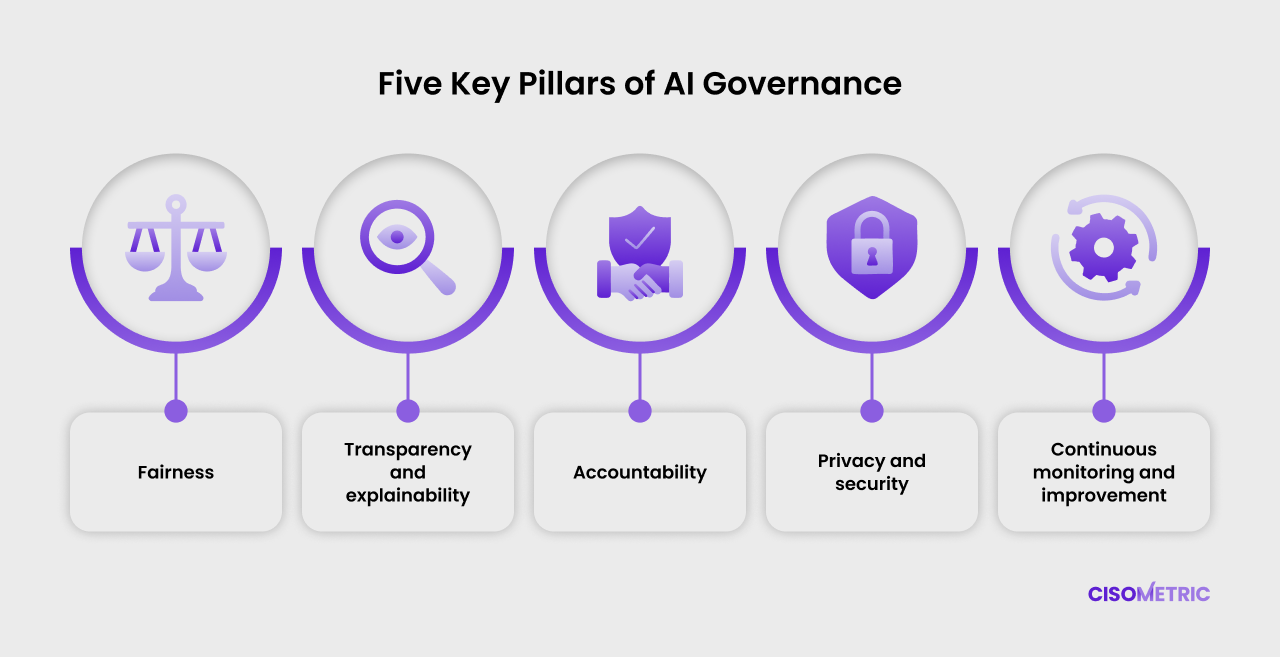
1. Fairness
AI systems should be designed and monitored to prevent unfair discrimination.
This includes:
2. Transparency and explainability
AI must be understandable. It must not make decisions in ways that are hidden or difficult to evaluate, especially in high-stakes areas such as finance, hiring, healthcare, and law enforcement.
Organizations need:
3. Accountability
AI does not remove responsibility from humans. AI ggovernance must clarify:
4. Privacy and security
Because AI is powered by data, it is inseparable from data protection and cybersecurity.
AI governance must ensure:
Also read: Comparing Indonesia’s PDP Law with GDPR and U.S. Privacy Rules
5. Continuous monitoring and improvement
AI models evolve over time due to new data, new patterns, and new user behavior.
A mature AI governance program includes:
Regardless of regulatory timelines, organizations can (and should) start now. Below is a practical roadmap adapted from global best practices (IBM, 2024; Diligent, 2025; Informatica, 2024; IT Governance Indonesia, 2025):
1. Establish leadership commitment and clear ownership
2. Build an AI inventory and risk map
3. Define internal AI principles and policies
4. Integrate AI governance with data governance and cybersecurity
5. Implement monitoring, testing, and audit
6. Strengthen AI literacy and ethical culture
7. Prepare incident response for AI-related issues
AI is now a core part of digital infrastructure, decision-making, and service delivery. That shift comes with responsibility.
AI governance exists to ensure that powerful systems remain aligned with human values, legal obligations, and business integrity.
For Indonesian organizations, this is a strategic moment:
Organizations that invest early in AI governance will not only reduce risk, but also build trust, resilience, and competitive advantage in an AI-driven economy.
For more updates on AI, digital scams, cybersecurity insights, and expert tips, follow our social media:
LinkedIn: Cisometric
Instagram: @cisometric
Youtube: @Cisometric
Reference:
AI governance: What it is & how to implement it
AI Governance: What It Is and Why It Matters
Membangun AI Governance yang Etis di Indonesia 2026
Wamen Komdigi: Dua regulasi tengah disiapkan sikapi perkembangan AI
Pada 9 Juli 2026, Cisometric bersama ISACA Indonesia Chapter menghadirkan sesi #CyberTalks di The Grand Mansion, Menteng, dengan tema AI in...

Negara tersebut memposisikan hal ini sebagai undang-undang AI komprehensif pertama di dunia yang diberlakukan secara penuh di tingkat nasion...

Recently experts found 2 Chrome Extensions on the Chrome Web Store that are designed to steal Chat GPT and Deep Seek AI chat history. Fortun...
Cari Artikel Berdasarkan Kategori
Kami menggunakan cookie untuk meningkatkan pengalaman menjelajah, menganalisis lalu lintas situs, dan menyajikan konten yang relevan. Pilih cookie mana yang Anda izinkan. Kebijakan Privasi