Ancaman Berbasis AI: Apa yang Berubah dan Apa yang Tetap Relevan bagi SOC?
Bagaimana ancaman berbasis AI mengubah operasional SOC? Simak perkembangan terbaru dan kapabilitas deteksi, investigasi, serta respons yang...

Oleh Cisometric Marketing Team, Diterbitkan pada Januari 20, 2026
AI tools like ChatGPT and DeepSeek have become part of daily work routines, used for brainstorming, coding, drafting emails, even discussing sensitive business strategies. But what if those conversations were quietly copied and sent to someone else?
That is exactly what cybersecurity researchers uncovered in early 2026.
Two Chrome extensions available on the Chrome Web Store were found stealing users’ AI chat histories, impacting more than 900,000 users before they were finally taken down (The Hacker News, 2026; SecurityWeek, 2026).
Furthermore, at least one of these extensions had previously received a “Featured” badge, making it appear legitimate and trustworthy.
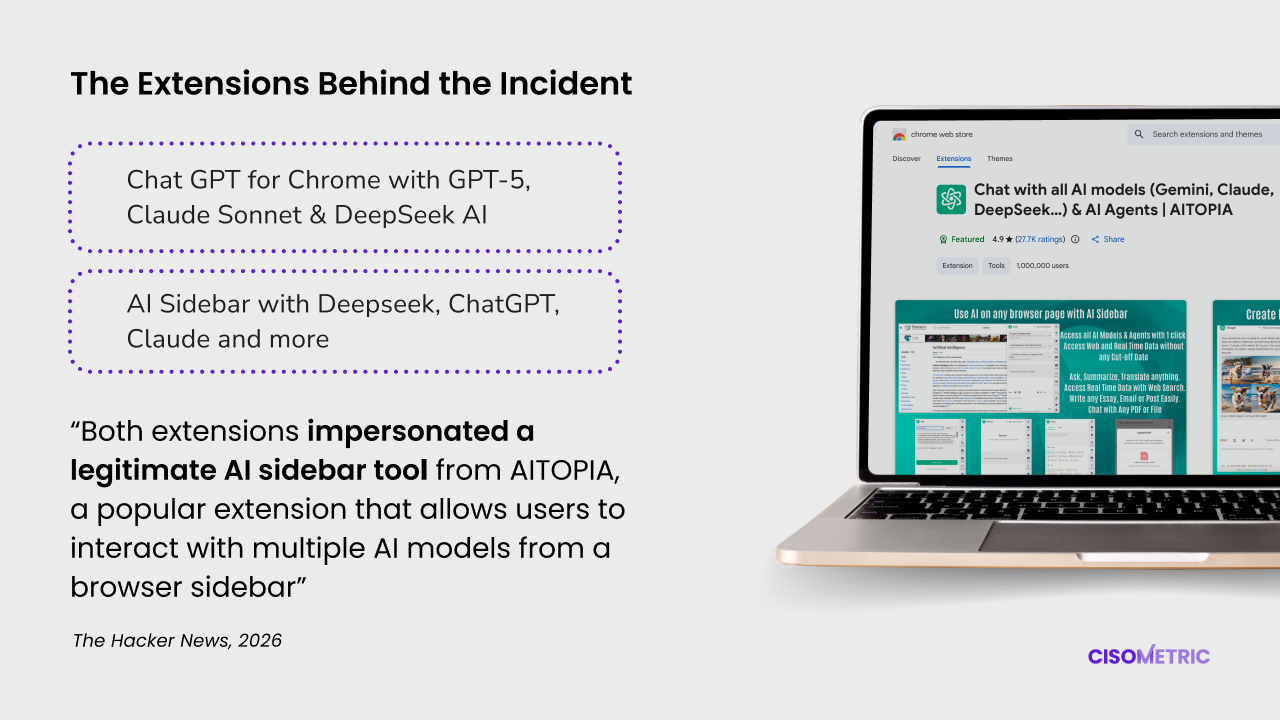
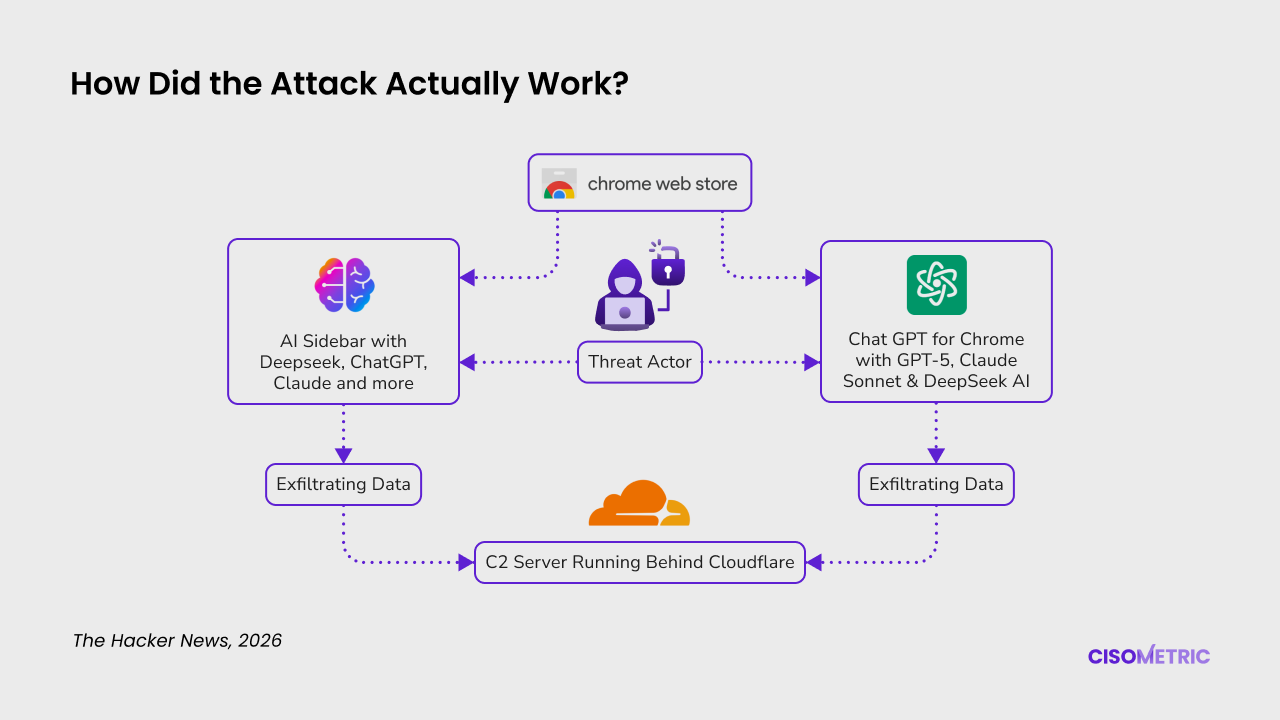
The malicious extensions were listed under the names:
Both extensions impersonated a legitimate AI sidebar tool from AITOPIA, a popular extension that allows users to interact with multiple AI models from a browser sidebar (The Hacker News, 2026).
On the surface, everything looked normal. In reality, hidden code inside the extensions was quietly collecting far more than users expected.
This was not a traditional malware attack with obvious warning signs. Instead, it relied on trust, convenience, and permissions.
Once installed, the extensions requested access under the pretext of collecting “anonymous analytics data” to improve user experience. When users agreed, the extensions began:
To make detection harder, the stolen data was encoded before being exfiltrated to remote command-and-control (C2) servers (The Hacker News, 2026).
In other words, anything typed into AI tools could be copied and sent elsewhere, without users realizing it.
At first glance, leaked AI chats may not sound as serious as leaked passwords or credit card numbers. But in a business context, the risks are far greater.
Cybersecurity researchers warn that the stolen data could be weaponized for:
Exposing internal strategies, source code, or product plans.
Using real conversations to craft convincing scams.
Turning internal company data into a commodity.
For organizations, the biggest concern is employees may have unknowingly exposed intellectual property, confidential documents, legal discussions, or customer information simply by using AI tools in their browser (SecurityWeek, 2026).
This incident reinforces a growing reality that AI conversations are becoming a high-value data target.
Security researchers have started calling this technique “prompt poaching”, which is the practice of harvesting AI prompts and responses through browser extensions.
What makes this trend particularly worrying is that it doesn’t only involve obviously malicious tools. Some legitimate extensions have also begun collecting AI interaction data under broad or vague privacy policies (The Hacker News, 2026).
What Should Users and Organizations Do Now?
If you or your team installed either of the affected extensions, they should be removed immediately. While the extensions have already been taken down from the Chrome Web Store, removing them helps prevent any further data leakage.
More importantly, this case offers several lessons for businesses:
AI tools are powerful productivity boosters, but this incident is a reminder that security often breaks at the convenience layer.
As AI becomes deeply embedded in daily workflows, attackers are adapting just as quickly. Organizations that rely on AI must start treating AI interactions as sensitive data, because attackers already do.
Also read: Governing AI in Practice: A Practical Guide to AI Audits
This is where proactive security visibility becomes critical. With AI-related risks expanding beyond traditional endpoints, businesses need continuous monitoring, threat detection, and incident response capabilities that can identify suspicious behaviors early, before data is silently exfiltrated.
At Cisometric, we help organizations strengthen their security posture through our next-generation Security Operations Center (SOC), combining threat intelligence, monitoring, and incident response to detect emerging attack vectors, including those targeting modern tools like AI platforms and browser-based workflows.
Also read: How Cisometric’s SOC Protected Businesses from Hundreds of Cyber Threats
Schedule a free consultation with our experts today, click here.
For more updates on digital scams, cybersecurity insights, and expert tips, follow our social media:
LinkedIn: Cisometric
Instagram: @cisometric
Youtube: @Cisometric
Reference:
Two Chrome Extensions Caught Stealing ChatGPT and DeepSeek Chats from 900,000 Users
Chrome Extensions With 900,000 Downloads Caught Stealing AI Chats
Bagaimana ancaman berbasis AI mengubah operasional SOC? Simak perkembangan terbaru dan kapabilitas deteksi, investigasi, serta respons yang...

Panduan teknis CTI: 3 tingkatan CTI, klasifikasi stealer logs vs combolists, Scattered Spider help desk bypass, IMDS cloud, dan kepatuhan UU...

Panduan teknis membedah batas ukur MTTD dan MTTR, blindspot validasi triage analis, risiko under-classification SLA, dan kapasitas respons a...
Cari Artikel Berdasarkan Kategori
Kami menggunakan cookie untuk meningkatkan pengalaman menjelajah, menganalisis lalu lintas situs, dan menyajikan konten yang relevan. Pilih cookie mana yang Anda izinkan. Kebijakan Privasi