
Cisometric AI Governance: Helping Organizations Manage AI Risk with Confidence
AI Governance refers to the processes, standards, policies, and controls that help ensure AI systems are developed and used safely, ethicall...
Oleh Cisometric Marketing Team, Diterbitkan pada September 15, 2025
In 2025, data is power and currency. When data is in the wrong hands, it can become a serious vulnerability.
From health records to social media behavior, every digital breadcrumb we leave behind is collected, processed, and sometimes shared across borders. But what happens when that data leaves Indonesia?
Who’s protecting it? Can we trust foreign jurisdictions with our personal information?
As Indonesia enters major digital trade agreements, particularly with the U.S., and continues to attract global tech investment, these are no longer abstract questions. They’re urgent.
Also read: Tariff Trade: Our Personal Information as a Trade Offer?
Let’s explore how Indonesia’s Personal Data Protection Law (UU PDP) compares to the European Union’s GDPR and U.S. data protection frameworks, and what this means for businesses and citizens alike.
Indonesia is no stranger to data leaks. From the eHAC app to MyPertamina and even KPU data, millions of Indonesians have had their information exposed in recent years (CNN Indonesia, 2025). These incidents pushed the government to finally adopt a comprehensive data protection framework.
That’s where Undang-Undang No. 27 Tahun 2022 tentang Pelindungan Data Pribadi (UU PDP) comes in. Enacted in 2022 and fully enforced since October 17, 2024, it is Indonesia’s first unified law on personal data protection, bringing us closer to international standards like Europe’s GDPR (Abhitech, 2025).
What does that mean for businesses?
UU PDP is heavily inspired by the GDPR, with similar structures and principles around data subject rights, consent, and enforcement.
General Data Protection Regulation (GDPR) is widely considered the gold standard in data privacy, binding across the EU, with global influence.
Meanwhile, the U.S. remains a major destination for cross-border data flows, especially since Indonesia recently included data provisions in a bilateral trade agreement with the U.S. But the U.S. doesn’t have a single comprehensive federal privacy law.
This brings us to a bigger question:
If your data ends up in the U.S., is it as protected as it would be under Indonesian or EU law?
Every data protection law starts with its foundation: how it’s structured, who it covers, and who’s in charge of enforcing it. This “regulatory DNA” tells us a lot about how seriously a country treats privacy, and how much trust citizens (and businesses) can put in the system.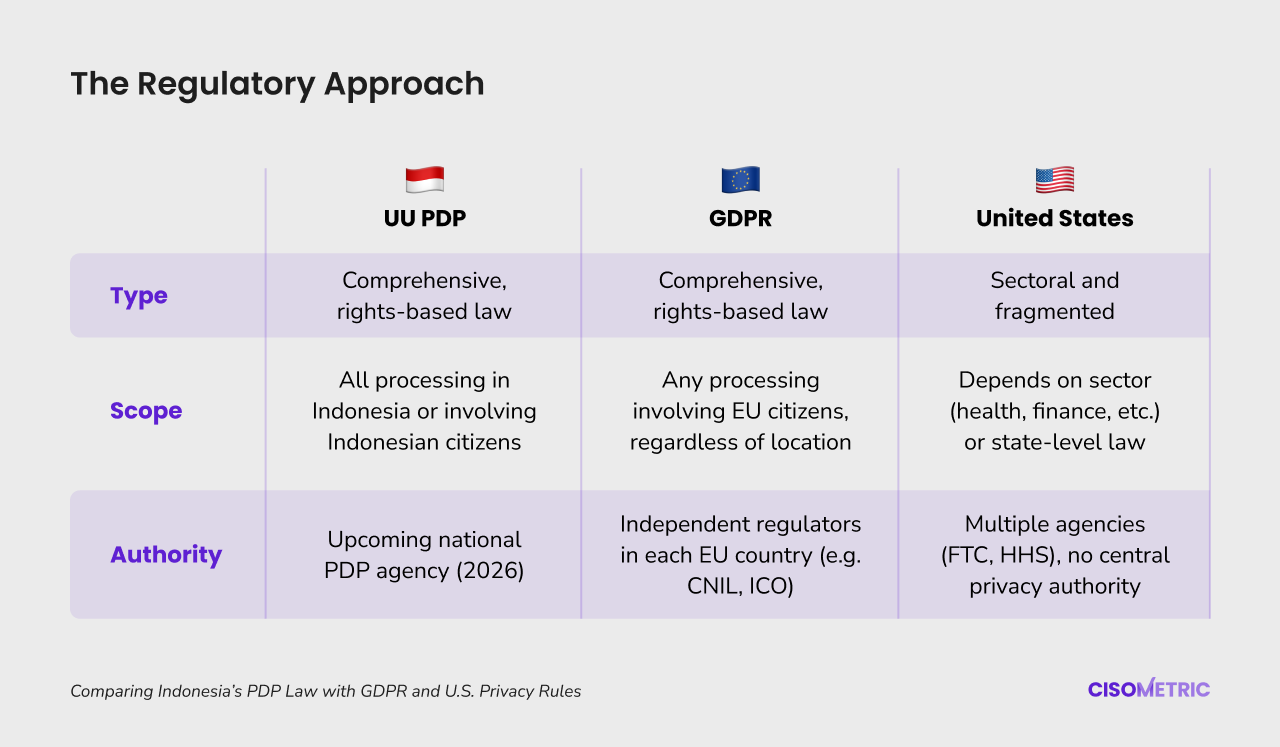
The U.S. is the only one without a unified national framework, raising concerns over consistent protection, especially when it comes to surveillance laws like FISA 702 and Executive Order 12333, which allow mass data collection without sufficient legal remedies for foreigners (Court of Justice of the European Union, Schrems II, 2020).
At the heart of any data protection law are its guiding principles that determine how organizations are supposed to collect, process, and secure personal data. These principles are what separate a law that truly protects individuals from one that mainly serves business interests.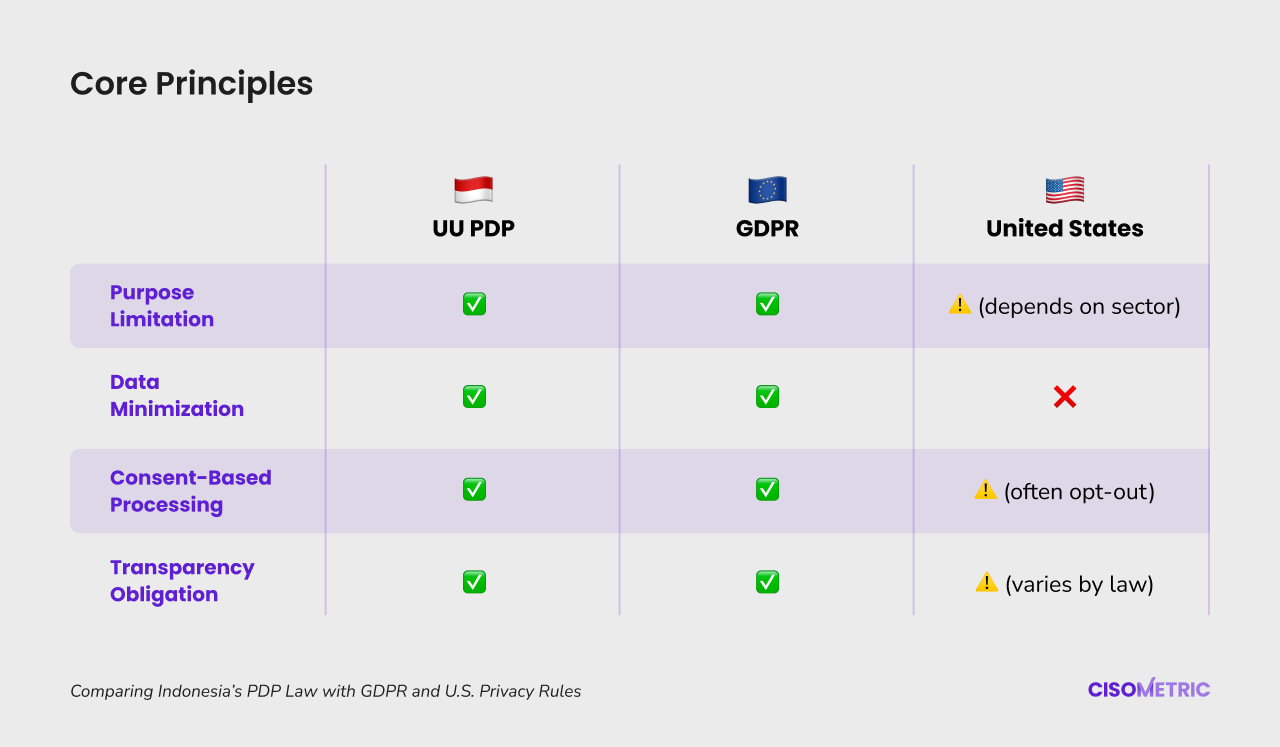
While both the UU PDP and GDPR emphasize individual rights and consent, the U.S. model is market-driven, meaning that unless a sector is specifically regulated (like health or finance), data can often be used without explicit permission (CNN Indonesia, 2025; HukumOnline, 2025).
Beyond frameworks and principles, the real question is: what control do individuals actually have over their own data?
Can you see what data a company holds about you? Can you ask them to correct or delete it? Can you say no to processing altogether? These are the kinds of rights that determine whether a law protects people, or just regulates businesses.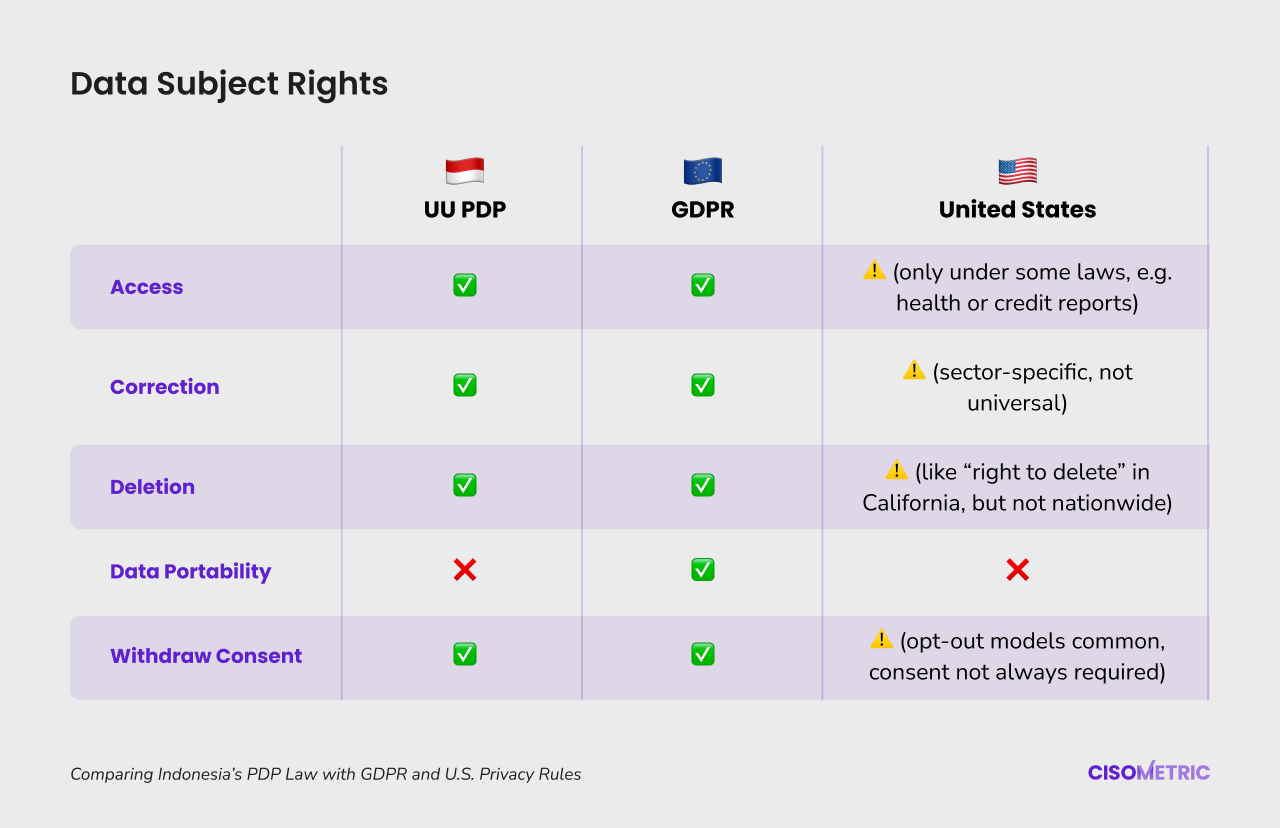
In practice, GDPR still leads in offering full-spectrum rights. However, UU PDP’s rights are well aligned, just not always fully enforced yet.
In contrast, U.S. citizens in California enjoy similar rights under California Consumer Privacy Act (CCPA), but most Americans don’t. And foreign citizens? Even fewer protections.
In the U.S., there’s no single federal law guaranteeing these rights to all citizens, let alone foreign data subjects. Instead, rights depend on which sectoral law applies:
That’s why EU courts (Schrems II, 2020) and legal observers (HukumOnline, 2025) argue the U.S. doesn’t provide adequate protection compared to GDPR or UU PDP.
Enforcement is where theory meets reality: how high are the fines, who can be prosecuted, and how consistently do regulators take action?
This is often the biggest gap between countries. GDPR is known for its billion-euro fines, the U.S. leans heavily on class-action lawsuits, while Indonesia is still building up its enforcement machinery.
Here’s how the three compare when it comes to punishments and practical enforcement power: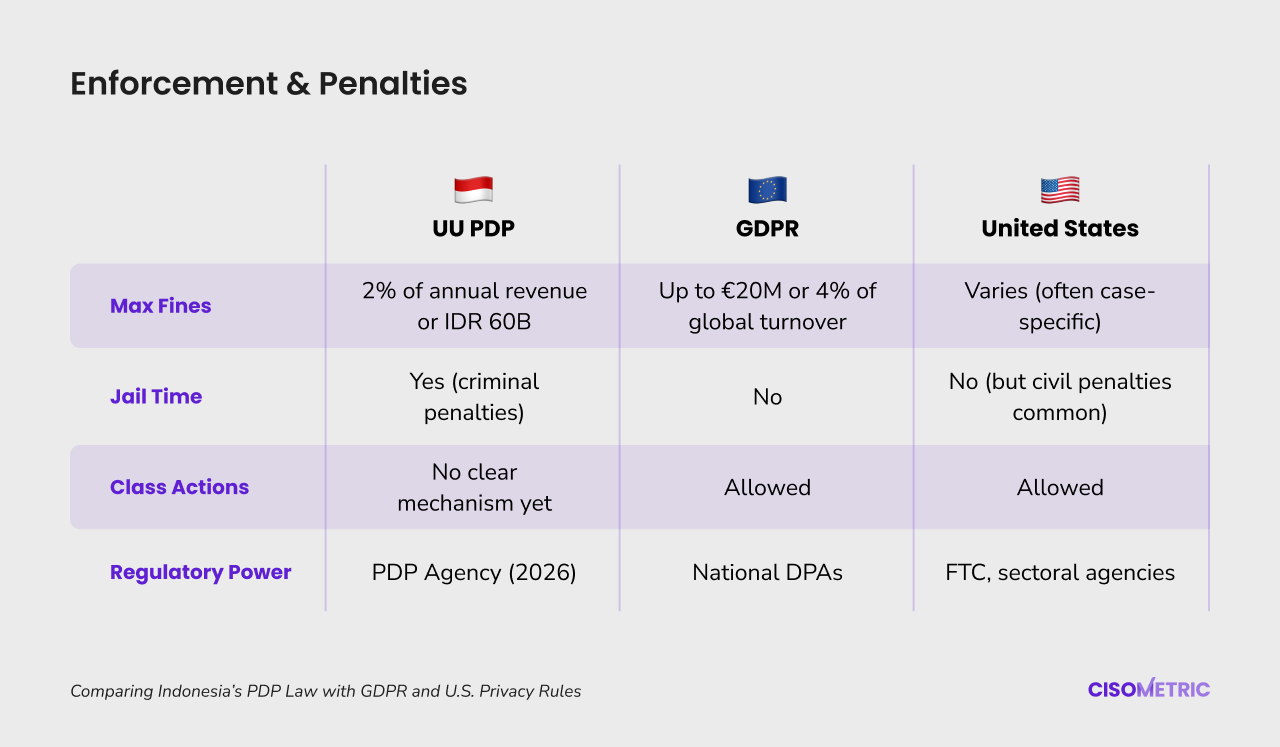
Indonesia has strong de jure penalties, but experts warn that its de facto enforcement still lags behind.
“De jure, Indonesia has stronger privacy laws than the U.S. But de facto? The U.S. still leads in institutional readiness and response.” — Alfons Tanujaya, Vaksin.com (CNN Indonesia, 2025)
UU PDP is still relatively new, with many elements pending:
This makes it risky for Indonesia to rush into data transfer agreements with countries like the U.S., which is still not recognized by the EU as having an “adequate” level of data protection (HukumOnline, 2025).
In comparison, countries like Japan and South Korea took more than 2 years to be granted adequacy status by the EU (Channel News Asia, 2024).
Data transfer is also geopolitical.
The Schrems I & II cases invalidated the EU–U.S. “Safe Harbor” and “Privacy Shield” frameworks, because U.S. laws allowed mass surveillance without sufficient redress.
This means that if Indonesia sends data to the U.S. now (without a robust adequacy test, an operational PDP agency, or binding contracts) it risks violating its own law and citizens' rights (HukumOnline, 2025).
Conclusion
The GDPR remains the global benchmark because it’s rigorous, rights-based, and consistently enforced across the EU. The U.S., on the other hand, continues to operate on a patchwork, sectoral model with significant gaps, especially around surveillance and remedies for foreign citizens (Schrems II, 2020; HukumOnline, 2025).
Indonesia’s UU PDP sits in the middle. On paper, it looks closer to the GDPR: comprehensive, rooted in fundamental rights, and designed to unify previously fragmented rules. But in practice, its enforcement still resembles the U.S. situation with strong de jure, weaker de facto. The pending RPP PDP and the not-yet-operational PDP Agency also mean that we’re still in transition.
So what does this mean for businesses and citizens?
That’s why the next two years will be critical. Indonesia must close its implementation gaps, businesses must prepare for compliance by 2026, and regulators must prove that the law isn’t just symbolic.
In a world where data equals power, the question is no longer whether to protect it, but how consistently we can do so. For Indonesia, this is a chance to prove that we can strike the right balance between trade, innovation, and citizens’ digital rights.
Want more insights like this? Follow Cisometric to stay updated on cybersecurity, data protection, and the evolving global standards that shape our digital future.
LinkedIn: Cisometric
Instagram: @cisometric
Youtube: @Cisometric
Reference:
Perbandingan Standar Perlindungan Data di AS dan RI, Mana Lebih Baik?
AI Governance refers to the processes, standards, policies, and controls that help ensure AI systems are developed and used safely, ethicall...

In August 2025, a young woman from Makassar known publicly as NR reported her ex-husband to the police on allegations of sexual violence. As...

For many organizations operating in Indonesia, especially those classified as Public Electronic System Providers (Public ESPs), the answer t...
Cari Artikel Berdasarkan Kategori
Kami menggunakan cookie untuk meningkatkan pengalaman menjelajah, menganalisis lalu lintas situs, dan menyajikan konten yang relevan. Pilih cookie mana yang Anda izinkan. Kebijakan Privasi