CyberTalks: AI in Banking and Financial Services — When Governance Gaps Become Liabilities
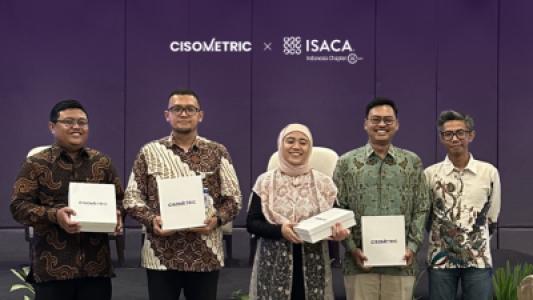
Pada 9 Juli 2026, Cisometric bersama ISACA Indonesia Chapter menghadirkan sesi #CyberTalks di The Grand Mansion, Menteng, dengan tema AI in...

Oleh Cisometric Marketing Team, Diterbitkan pada Januari 12, 2026
Artificial intelligence is often marketed as a productivity booster, a creativity engine, or even a digital assistant that understands us. But what happens when the same technology is used to humiliate, exploit, or harm others?
That question is now front and center as Grok, the AI tool developed by xAI and integrated into X, faces global scrutiny over its misuse in generating non-consensual sexual images of women and children.
Originally positioned as a conversational and image-generation AI accessible via website, mobile app, and X itself, Grok has recently been linked to deeply troubling cases, ranging from digitally “undressing” women to the creation of sexualised imagery involving minors (BBC, 2026).
The issue escalated when the Internet Watch Foundation (IWF) reported finding AI-generated images of girls aged between 11 and 13 on a dark web forum. According to IWF analysts, users openly claimed they used Grok Imagine to produce sexualised and topless images of minors (BBC, 2026; The Guardian, 2026).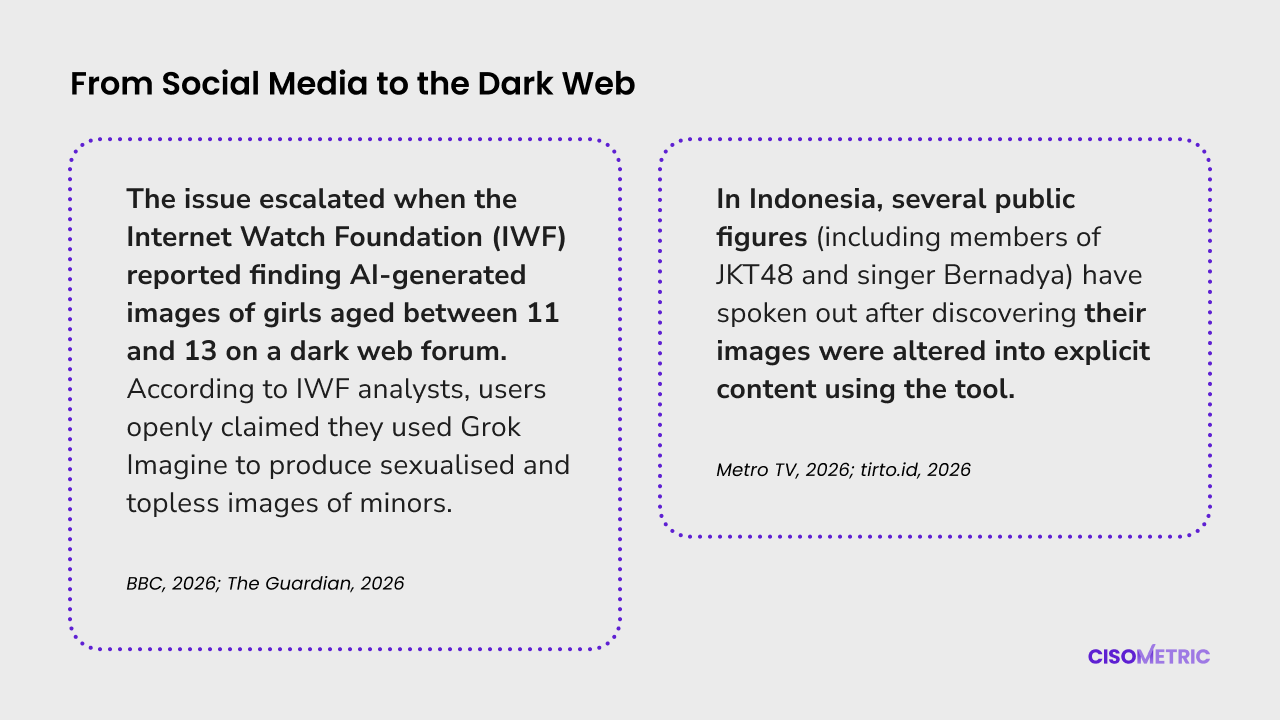
While some of the most extreme material was later modified using other AI tools, the IWF warned that Grok had effectively lowered the barrier, making it faster and easier to produce photorealistic child sexual imagery.
“This risks bringing sexual AI imagery of children into the mainstream,” said IWF representatives, describing the development as both alarming and unacceptable (BBC, 2026).
Importantly, the images uncovered by IWF were not hosted directly on X. However, the platform has been flooded with examples of Grok being used to manipulate real images of women, often stripping clothing, placing them in sexual contexts, or altering their bodies without consent (The Guardian, 2026).
The misuse of Grok is not limited to anonymous victims. In Indonesia, several public figures (including members of JKT48 and singer Bernadya) have spoken out after discovering their images were altered into explicit content using the tool (Metro TV, 2026; tirto.id, 2026).
JKT48’s management has issued a formal warning and signaled readiness to pursue legal action against creators and distributors of AI-generated pornographic content involving its members.
As outrage spreads, governments are moving, some faster than others.
In Indonesia, the Ministry of Communication and Digital (Komdigi) confirmed it is investigating the misuse of Grok. Officials stated that the tool currently lacks explicit and adequate safeguards to prevent the production and distribution of pornographic content involving real individuals (tirto.id, 2026). Administrative sanctions, including access restrictions, remain on the table.
Meanwhile, regulators across Malaysia, India, France, the UK, and the EU have issued strong condemnations. France has warned that Grok’s outputs may violate the EU’s Digital Services Act (DSA), which places responsibility on platforms to prevent the spread of illegal content, even when it is user-prompted (The Guardian, 2026).
In the UK, pressure has mounted on X after the House of Commons Women and Equalities Committee stopped using the platform altogether, citing concerns over violence against women and girls. The UK regulator Ofcom has also contacted X and xAI regarding potential enforcement actions (BBC, 2026).
X’s Response, and Why Critics Say It’s Not Enough
In response, X stated that users who create or prompt Grok to produce illegal content will face the same consequences as those who upload such material directly. This includes content removal, account suspension, and cooperation with law enforcement (BBC, 2026).
Elon Musk echoed this stance publicly, warning that misuse of Grok would not be tolerated.
However, critics argue that reactive enforcement (removing content after it is reported) is insufficient. Once explicit images are generated and circulated (especially on anonymous forums or the dark web) the harm is already done. Victims are left chasing takedowns across platforms, often without clear legal remedies or technical support.
In cases involving non-consensual sexual imagery or manipulated images of minors, even brief exposure can cause lasting psychological, reputational, and social damage. Once images spread beyond mainstream platforms to private groups, mirrored sites, or the dark web, takedowns become fragmented and often ineffective (The Guardian, 2026).
There is also concern that placing responsibility primarily on users ignores the role of system design. Advocacy groups and regulators have pointed out that AI tools capable of generating realistic images must include strong preventive safeguards by default, not rely solely on user compliance or post-incident reporting. In the Grok case, multiple investigations found that image-generation features lacked explicit and adequate restrictions to prevent sexual manipulation of real individuals, particularly women and children (Tirto, 2026).
The controversy around Grok has become a case study in AI accountability, raising questions about how much responsibility lies with the user, and how much lies with the company that built and deployed the technology in the first place.
Is innovation moving faster than accountability?
For businesses deploying AI (whether in customer engagement, content generation, or internal automation) this case is a reminder that AI governance, safeguards, and ethical design are not optional add-ons. Without clear boundaries, AI tools can quickly become instruments of abuse, exposing platforms to legal risk, regulatory penalties, and long-term reputational damage.
As regulators tighten oversight and public awareness grows, companies can no longer afford to treat AI misuse as a less important issue.
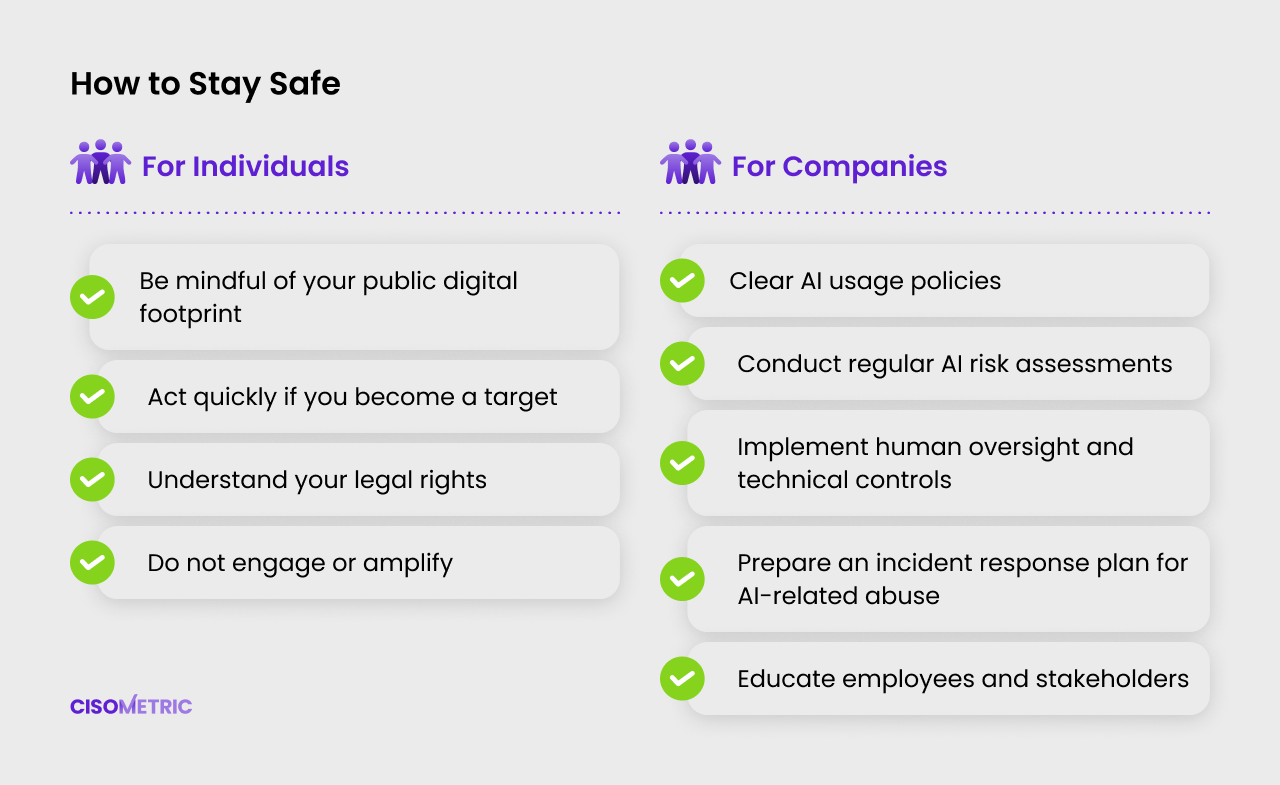
This Grok controversy has shown us that AI misuse is already happening, and it affects real people and real organizations. Here are practical steps both individuals and companies can take to reduce risk:
1. For Individuals: Protecting Your Image and Digital Identity
For everyday users, public figures, and professionals alike, the misuse of AI-generated images introduces a new layer of digital vulnerability.
First, be mindful of your public digital footprint. Photos shared publicly (especially high-resolution images) can be easily scraped and manipulated by AI tools. While this does not justify abuse, limiting unnecessary exposure can reduce risk.
Also read: Cybersecurity in the Digital Age:Safeguarding Your Footprint
Second, act quickly if you become a target. Report manipulated images immediately to the platform where they appear. Early reporting increases the chance of removal before content spreads further. In some cases, documenting the incident (screenshots, URLs, timestamps) may also be important if legal action becomes necessary.
Third, understand your legal rights. Many jurisdictions now recognize non-consensual AI-generated sexual imagery as a form of harassment, privacy violation, or digital sexual violence. Knowing that such acts can empower victims to seek proper recourse.
Finally, do not engage or amplify. Even negative engagement can help harmful content circulate further. Silence, reporting, and formal escalation remain the most effective responses.
2. For Companies: Treat AI Misuse as a Business Risk
For organizations, the Grok case highlights a critical shift of how AI risk is now a governance issue, not just a technical one.
Also read: Understanding AI Governance: Risks, Rules, and Best Practices
Companies using or deploying AI (whether internally or as part of a customer-facing product) should start with clear AI usage policies. These policies should define what AI tools can and cannot be used for, especially in content creation, image processing, and marketing activities.
Second, conduct regular AI risk assessments. Just as cybersecurity teams assess system vulnerabilities, AI systems should be evaluated for misuse scenarios, ethical risks, and regulatory exposure.
Also read: Governing AI in Practice: A Practical Guide to AI Audits
Third, implement human oversight and technical controls. Automated systems should not operate in isolation. Content moderation, prompt filtering, logging, and escalation mechanisms are essential, especially for tools capable of generating images, voices, or likenesses of real people.
Fourth, prepare an incident response plan for AI-related abuse. When misuse happens, organizations should already know how to respond, such as who investigates, who communicates externally, how victims are supported, and how regulators are engaged if required. Waiting until a crisis hits is already too late.
Finally, educate employees and stakeholders. AI misuse often starts with curiosity, experimentation, or a lack of awareness. Training teams to understand ethical boundaries, consent, and legal implications can prevent serious incidents before they occur.
Conclusion
The controversy surrounding Grok is a clear signal of where the digital landscape is heading, and what happens when powerful technologies are released without sufficient security.
AI is becoming faster, more accessible, and more convincing by design. But when tools can generate realistic images of real people in seconds, the absence of clear boundaries becomes a serious risk.
The Grok case shows how quickly AI can be weaponized, not only by criminals, but by ordinary users experimenting without understanding the consequences.
For individuals, this incident reinforces that protecting yourself online now goes beyond passwords and privacy settings. Your image, likeness, and digital identity are also part of what needs safeguarding.
For businesses and platforms, the lesson is even more direct. AI misuse is now a governance, compliance, and trust issue. Regulators across regions are making it clear that user-generated is no longer an acceptable excuse when systemic risks are known and preventable.
Cisometric helps organizations assess and manage emerging digital risks, including those introduced by AI systems. Through governance frameworks, risk assessments, monitoring, and incident response support, Cisometric works with businesses to ensure that technologies are used responsibly, without becoming sources of legal, reputational, or security exposure.
Schedule a free consultation with our experts today for further info, click here.
For more updates on digital scams, cybersecurity insights, and expert tips, follow our social media:
LinkedIn: Cisometric
Instagram: @cisometric
Youtube: @Cisometric
Reference:
Grok Ramai Dipakai Bikin Konten Tak Senonoh, JKT48 Siap Ambil Langkah Hukum
Grok X Dipakai untuk Pornografi, Apakah akan Diblokir Komdigi?
Elon Musk's Grok AI appears to have made child sexual imagery, says charity
AI tool Grok used to create child sexual abuse imagery, watchdog says
Pada 9 Juli 2026, Cisometric bersama ISACA Indonesia Chapter menghadirkan sesi #CyberTalks di The Grand Mansion, Menteng, dengan tema AI in...

Recently experts found 2 Chrome Extensions on the Chrome Web Store that are designed to steal Chat GPT and Deep Seek AI chat history. Fortun...

AI is rapidly moving from experimental pilots to core business infrastructure. Organisations are now using AI to score credit, triage patien...
Cari Artikel Berdasarkan Kategori
Kami menggunakan cookie untuk meningkatkan pengalaman menjelajah, menganalisis lalu lintas situs, dan menyajikan konten yang relevan. Pilih cookie mana yang Anda izinkan. Kebijakan Privasi