
Ancaman Berbasis AI: Apa yang Berubah dan Apa yang Tetap Relevan bagi SOC?
Bagaimana ancaman berbasis AI mengubah operasional SOC? Simak perkembangan terbaru dan kapabilitas deteksi, investigasi, serta respons yang...

Oleh Cisometric Marketing Team, Diterbitkan pada September 5, 2025
When you think of cyberattacks, you probably picture banks, fintech startups, maybe even hospitals (industries holding mountains of sensitive data). But lately? Hackers are strutting down a new kind of runway. And their latest victims aren’t government agencies or cryptocurrency exchanges, they’re the world’s most prestigious luxury brands.
This might sound unexpected, after all, luxury houses are often seen as bastions of tradition and exclusivity, not high-tech targets. But in today’s data-driven economy, prestige doesn’t make you untouchable. In fact, it can make you even more attractive to cybercriminals. Customer records in the luxury sector are detailed profiles of high-net-worth individuals, complete with purchase histories, lifestyle indicators, and valuable personal identifiers.
And in the last few months, we’ve seen just how tempting that prize is. In July 2025, Louis Vuitton confirmed a multi-country cyberattack that exposed customer data from South Korea, Turkey, the UK, Italy, and Sweden (CPO Magazine, 2025). Within weeks, its LVMH siblings Dior and Tiffany also disclosed breaches. Other major names like Cartier, The North Face, Adidas, Victoria’s Secret, Marks & Spencer, and Harrods, have all also been caught in the same wave (BBC, 2025; The Record, 2025).
It is clear: high-end retail is now high-value prey.
The cyberattacks on luxury retail this year have been a string of high-profile hits, one after another, shaking some of the world’s most exclusive brands. Instead of focusing on a single company, it’s clear we’re looking at a coordinated trend targeting the entire sector.
Below is a breakdown of the major cases that have made headlines in 2025:
These two incidents alone would be alarming enough, but the pattern extends deeper into the LVMH family:
The breaches didn’t stop at fashion houses. Sportswear giants and high-street retailers also found themselves in the line:
Taken together, these cases are truly concerning: luxury retail has become a coordinated target for sophisticated cybercrime campaigns. The diversity of brands hit (from haute couture to outdoor gear) also suggests that attackers are after valuable customer data, supply chain access, and the kind of brand leverage that can pressure companies into quick settlements.
However, this wave of attacks comes right after major UK retailers like Marks & Spencer, Harrods, and the Co-op were hit (BBC, 2025). So this suggests that hackers are running targeted campaigns across the retail sector, luxury or not.
And if your company holds customer data? You’re on the menu.
Luxury brands have money, influence, and customers who spend big. The combination of high-value transactions, prestigious clientele, and brand reputation creates a perfect storm of opportunity for attackers.
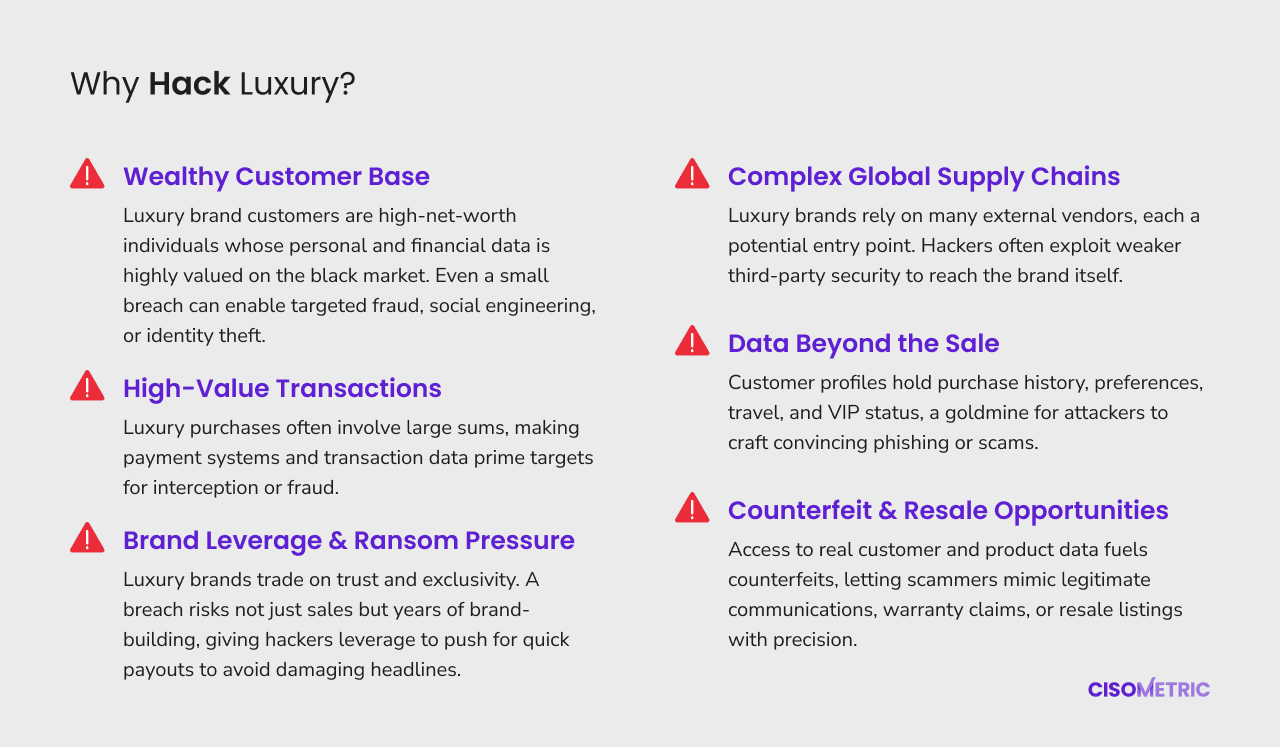
Here’s why they’re prime targets:
The typical luxury brand customer is a high-net-worth individual (executives, public figures, investors) whose personal and financial data carries a premium on the black market. Even a limited breach can give attackers enough information to launch targeted fraud, social engineering, or identity theft campaigns.
Purchases often involve large sums, whether it’s a handbag worth millions of rupiahs, a six-figure jewellery piece, or bespoke services. This makes payment systems and transaction data especially appealing for those looking to intercept or reroute funds.
Luxury houses trade on trust and exclusivity. A public breach risks not just sales but decades of brand-building. Hackers know this, and some use it as leverage, counting on the fact that a brand may be willing to pay or negotiate quickly to avoid negative headlines.
From artisan workshops to logistics providers and event partners, luxury brands work with dozens (sometimes hundreds) of external vendors. Each connection is a potential entry point, and attackers often exploit the weaker security of third parties to reach the main brand.
Also read: How Supply-Chain Cyber Attacks Can Take Down Your Business
Customer profiles can include purchase history, personal preferences, event attendance, travel patterns, and VIP program status. For an attacker, that’s a goldmine for making believable phishing or scam campaigns.
Also read: Phishing: New Methods and How to Stay Safe
Access to genuine customer and product data can supercharge counterfeit operations, allowing scammers to mimic legitimate communications, warranty claims, or resale listings with alarming accuracy.
In several of these cases (like Dior’s) the breach wasn’t discovered for months. That long “dwell time” gave attackers more opportunity to move through systems, gather sensitive data, and remain undetected. This is exactly where a Security Operations Center (SOC) proves its value.
A next-generation SOC isn’t just a passive monitoring room. It’s an active, always-on defense hub. With the right capabilities, it can:
In other words, a SOC hunts for threats proactively. If these brands had 24/7 threat hunting, anomaly detection, and supply chain visibility in place, the outcome might have been very different. Detection could have happened much sooner, reducing both the scale of the breach and the potential damage to customer trust.
The wave of cyberattacks against luxury brands is a signal for all retailers. Here’s how to strengthen your defenses:
1. Audit Your Supply Chain Security
2. Partner with a Cybersecurity Vendor or Use a Security Operations Center (SOC)
3. Encrypt and Segment Customer Data
4. Educate Your Employees on Cyber Threats
Also read: Phishing: New Methods and How to Stay Safe
The luxury retail industry has long been seen as timeless, iconic, and untouchable. But in today’s digital era, no amount of legacy or brand equity can shield a business from cyber threats. The events of 2025 have shown us that even the most prestigious names in fashion and retail are not immune, their status makes them even more attractive targets.
For retailers, this is a real concern you need to start taking action for. Whether you're a global fashion house or a fast-growing local brand, cybersecurity can no longer be treated as a backend issue. It needs to be embedded into the core of your operations, from supply chain oversight to customer data protection.
And you don’t have to do it alone.
With the rising sophistication of cybercrime, partnering with a trusted cybersecurity provider can make all the difference. Cisometric’s Security Operations Center (SOC) offers real-time detection, rapid incident response, and intelligent threat hunting designed to protect retail businesses from evolving digital risks. Click here for more info.
Or book a free consultation with our SOC team today, click here.
For more updates on digital scams, cybersecurity insights, and expert tips, follow our social media:
LinkedIn: Cisometric
Instagram: @cisometric
Youtube: @Cisometric
Reference:
Luxury Brand Louis Vuitton Suffers a Multi-Country Cyber Attack that Leaked Personal Data
Louis Vuitton says customers in Turkey, South Korea and UK impacted by data breaches
Dior, a Louis Vuitton Brand, Alerts Customers Following Cyber Attack
The Battle Against Cybercrime in High-End Retail
First M&S, now Dior: Cyber attacks put fashion on high alert
North Face and Cartier customer data stolen in cyber attacks
Bagaimana ancaman berbasis AI mengubah operasional SOC? Simak perkembangan terbaru dan kapabilitas deteksi, investigasi, serta respons yang...

Panduan teknis CTI: 3 tingkatan CTI, klasifikasi stealer logs vs combolists, Scattered Spider help desk bypass, IMDS cloud, dan kepatuhan UU...

Panduan teknis membedah batas ukur MTTD dan MTTR, blindspot validasi triage analis, risiko under-classification SLA, dan kapasitas respons a...
Cari Artikel Berdasarkan Kategori
Kami menggunakan cookie untuk meningkatkan pengalaman menjelajah, menganalisis lalu lintas situs, dan menyajikan konten yang relevan. Pilih cookie mana yang Anda izinkan. Kebijakan Privasi