
By Patricia A. Pramono • Studio 1080, Published on December 24, 2025
TABLE OF CONTENTS
Every interaction in the digital world, such as opening an application, browsing a website, or completing an online transaction, creates data. Some of this data is shared intentionally. Much of it is not.
The information generated automatically as a byproduct of digital activity is known as digital exhaust. While largely invisible to users, this data accumulates continuously and, when aggregated, can reveal far more than most people expect.
As organizations increasingly rely on digital systems, understanding digital exhaust is imperative.
What Is Digital Exhaust?
Digital exhaust refers to data generated passively through everyday digital interactions, often without explicit awareness or intent.
It originates from two primary sources:
1. Direct digital activities, such as:
- Web browsing history and search queries
- Social media interactions
- Online purchases and transaction records
- Email and messaging activity
- Location data from mobile devices
2. Passive data collection, including:
- Cookies and tracking technologies
- Application usage patterns
- Device metadata (IP address, device ID, operating system)
- Sensor data from smartphones
- Timestamps and behavioral interaction data
The term exhaust reflects how the data is produced as a side effect of normal operations, similar to how exhaust is produced when a vehicle is running. Just as a car produces exhaust fumes as a side effect of moving from point A to point B, digital exhaust is the unintended data generated as a side effect of an online action, like from visiting a website to read an article.
Users typically do not intend to generate this information, it is created automatically by digital systems (VanishID, 2025).
For a long time, companies viewed this log data as industrial waste, stored only for technical troubleshooting or discarded entirely. However, data scientists realized this "waste" data can over time form detailed behavioral profiles that can reveal habits, preferences, routines, and operational patterns of an individual or business.
Digital Exhaust vs. Digital Footprint
Although often used interchangeably, digital exhaust and digital footprint describe different aspects of online data generation.
Digital footprint refers to the broader record of an individual’s or organization’s online presence. It includes both intentional and unintentional data creation, such as social media profiles, online registrations, published content, and transaction histories.
Digital exhaust is more specific. It focuses on data generated unintentionally, the background metadata and behavioral signals that users may not realize they are producing.
In many cases, digital exhaust is more revealing because it reflects actual behavior rather than curated or intentional sharing (myITforum, 2025).
Concerns of Digital Exhaust
Digital exhaust is not inherently harmful. However, when collected at scale and combined across systems, it introduces meaningful risks.
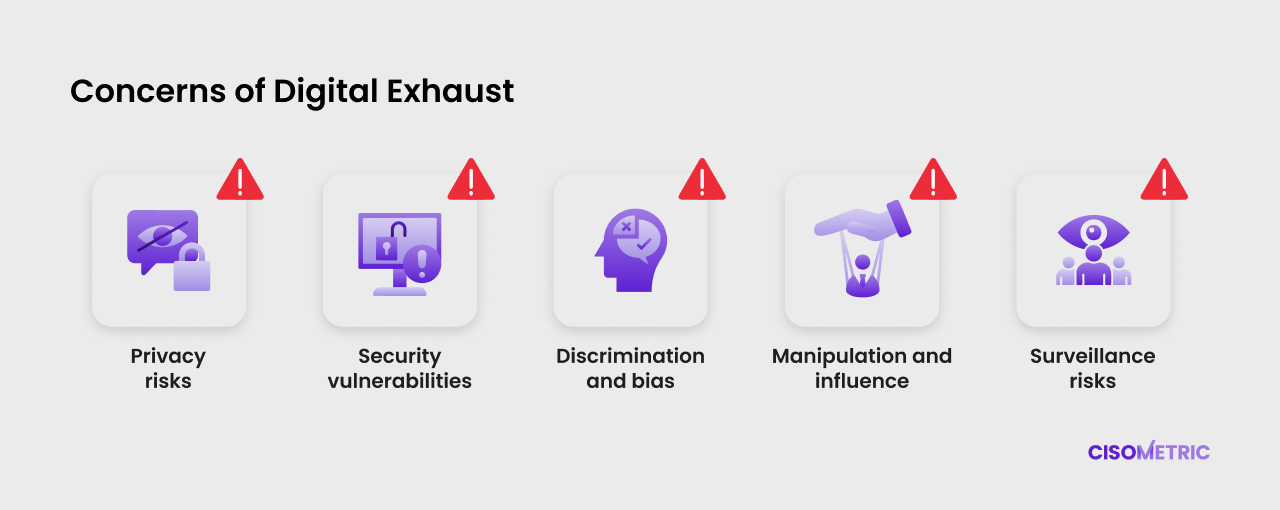
Digital exhaust can expose sensitive insights into daily routines, relationships, financial behavior, and personal preferences, often without explicit user consent.
This happens when passive data such as location signals, browsing patterns, device metadata, and interaction timestamps are collected and combined across platforms. Over time, these data points can reveal where someone regularly goes, who they frequently interact with, what they spend money on, and even predictable habits in their daily life (International Security Buyer, 2025).
2. Security vulnerabilities
When multiple data points are aggregated, they can be exploited for identity theft, account compromise, and highly targeted cyber scams.
3. Discrimination and bias
Algorithmic profiling based on behavioral data may influence decisions related to employment, insurance, credit, or housing.
This occurs when automated systems use patterns from digital exhaust (such as online activity, purchase behavior, location history, etc.) to assess individuals. These assessments can shape eligibility, pricing, or risk scores, often without transparency into how decisions are made or meaningful recourse for those affected.
4. Manipulation and influence
Behavioral data supports targeted advertising, psychological profiling, and social engineering, increasing the effectiveness of influence operations.
5. Surveillance risks
At scale, digital exhaust enables extensive monitoring by corporations or governments, particularly in environments with limited oversight or regulation (International Security Buyer, 2025).
The core issue is not individual data points, but the cumulative effect of continuous, passive data collection.
Despite these risks, digital exhaust should not be viewed solely as a liability.
When managed responsibly, digital exhaust can deliver significant value, particularly for organizations seeking deeper operational insight. The challenge lies in establishing appropriate governance, security controls, and ethical boundaries.
The Business Value of Digital Exhaust
From a business perspective, digital exhaust generated by users has become one of the most valuable sources of insight.
Unlike surveys or direct feedback, digital exhaust reflects real behavior, not stated intent. When collected transparently and used ethically, it allows organizations to make more informed decisions across customer experience, product development, and risk management.
1. Hyper-Personalization and Customer Experience
User behavior data (such as browsing patterns, session duration, and interaction frequency) helps businesses tailor content, recommendations, and user journeys. This enables more relevant experiences without requiring users to explicitly provide feedback.
Industry examples:
- Retail & E-commerce: Personalized product recommendations and dynamic pricing
- Media & Entertainment: Content discovery based on viewing or listening behavior
- Travel & Hospitality: Customized offers based on search and booking patterns
2. Product Development and Innovation
Digital exhaust highlights how users actually interact with products. Drop-off points, repeated actions, and feature usage patterns help teams identify what works, what doesn’t, and where friction exists.
Industry examples:
- Technology & SaaS: Feature optimization based on usage telemetry
- Healthcare Apps: Improving usability of patient-facing digital services
- Education Platforms: Refining learning flows based on engagement data
3. Risk Management and Fraud Detection
Behavioral signals such as unusual login times, device changes, or abnormal transaction patterns help organizations detect anomalies early. Digital exhaust plays a critical role in identifying fraud, abuse, or account compromise before significant damage occurs.
Industry examples:
- Financial Services: Fraud detection and transaction monitoring
- Fintech & Payments: Identifying synthetic identities or account misuse
- Telecommunications: Preventing subscription fraud and SIM abuse
4. Operational and Strategic Decision-Making
Aggregated user data helps organizations anticipate demand, allocate resources, and adapt strategies in near real time, turning passive signals into actionable intelligence.
However, this value comes with responsibility.
The growing visibility enabled by digital exhaust must be balanced with privacy, trust, and ethical data use (Forbes, 2021).
Organizations that fail to establish clear governance, consent mechanisms, and security controls risk eroding user trust and exposing themselves to regulatory and reputational consequences.
How to Minimize Digital Exhaust
Digital exhaust cannot be eliminated entirely. However, both individuals and organizations can reduce unnecessary exposure through controls.
For individuals:
- Regularly review application permissions
- Disable unnecessary tracking and ad personalization
- Use privacy-focused browsers and search tools
- Avoid linking accounts across platforms
- Be selective in sharing personal information
For organizations:
- Apply data minimization principles
- Establish clear retention and deletion policies for logs and telemetry
- Monitor access patterns for anomalies
- Secure digital exhaust data as sensitive information
- Build employee awareness around passive data exposure
The objective is not to limit digital activity, but to reduce unmanaged and unnecessary data accumulation.
Conclusion
Digital exhaust is an unavoidable byproduct of modern digital life. Every interaction leaves a trace digitally.
For individuals, awareness is the first safeguard. For organizations, responsible data governance is foundational to security, compliance, and trust.
For more updates on digital scams, cybersecurity insights, and expert tips, follow our social media:
LinkedIn: Cisometric
Instagram: @cisometric
Youtube: @Cisometric