By Patricia A. Pramono • Studio 1080, Published on November 11, 2025
TABLE OF CONTENTS
For some time, Indonesians have questioned the safety of their personal data stored in the government’s online tax platform, Coretax. Reports of data breaches and system vulnerabilities have sparked one crucial question, is our information really safe?
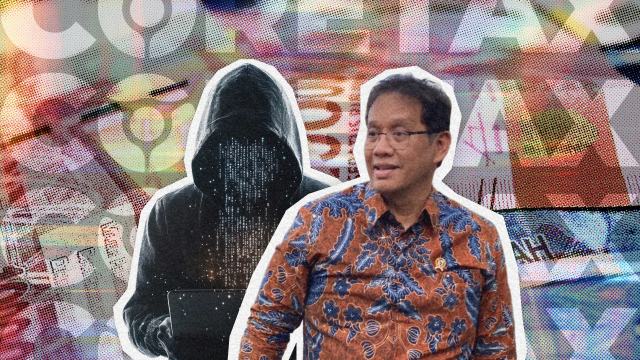
Now, the Ministry of Finance seems ready to answer that question, in quite an unexpected way. Minister Purbaya Yudhi Sadewa recently announced that his team is working with ethical hackers to help identify and fix security flaws in Coretax (DDTC News, 2025; Tempo, 2025).
Understanding the Ministry’s Decision to Work with Hackers
At first glance, the move sounds risky. The word hacker itself often triggers fear, associated with data theft, cybercrime, and system breaches. But this time, the hackers are on the government’s side.
These are ethical hackers, or white-hat hackers, which are cybersecurity experts who simulate real cyberattacks to uncover vulnerabilities before the criminals do. It’s a practice that has long been adopted by major tech companies and global institutions to strengthen their defense systems (Telkom University, 2025).
In simple terms, they’re the good guys, using hacking skills for protection instead of exploitation.
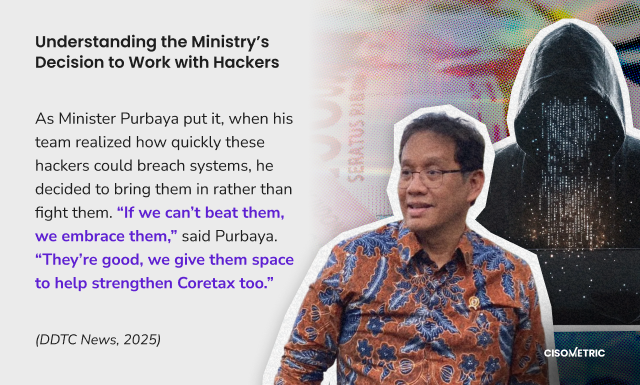
As Minister Purbaya put it, when his team realized how quickly these hackers could breach systems, he decided to bring them in rather than fight them. “If we can’t beat them, we embrace them,” said Purbaya. “They’re good, we give them space to help strengthen Coretax too.” (DDTC News, 2025)
Inside Coretax’s Cybersecurity Fix
Coretax, short for Core Tax Administration System, was launched in early 2025 to modernize Indonesia’s tax administration and integrate all taxpayer services under one digital roof.
But shortly after its rollout, it faced technical issues and even reports of data leaks (IKPI, 2025).
To address this, the Ministry of Finance brought in local cybersecurity experts and top-ranked ethical hackers to stress-test and reinforce the system’s security architecture. The results were promising.
Purbaya claimed Coretax’s cybersecurity rating jumped from “30 out of 100” to an A+, thanks to these local experts and ethical hackers (IKPI, 2025).
“We hired local specialists, not just government technocrats but independent cybersecurity experts,” he said. “Now, Coretax’s security is almost perfect, from grade D to A+.”
This marks a big step forward not only for the system itself but also for Indonesia’s broader digital infrastructure. The project’s success could reshape how other ministries and agencies approach cybersecurity in the future (Tempo, 2025).
Fixing Coretax Still Needs More Time
Despite these improvements, Purbaya admitted that the work is far from over. According to Bloomberg Technoz (2025), his team has resolved issues in the upper and middle layers of the system, but challenges remain in the programming and operational layers.
One of the main obstacles is access to Coretax’s source code, which is still under contract with the original vendor, LG. Because of this, the ministry can’t yet fully control or optimize the system.
“We still don’t have access to some parts under contract with LG,” said Purbaya. “Once we get that by December, we can move faster. Hopefully by February 2026, everything will be stable.” (DDTC News, 2025)
This dependency highlights a recurring problem in government IT projects (vendor lock-in) where ownership and control over the technology remain outside the government’s hands.
What This Means for Indonesia’s Cyber Future
Hiring hackers reflects a much-needed shift in mindset. In a country that has experienced multiple high-profile data breaches, the Ministry of Finance’s decision signals a growing issue.
“Data security isn’t just about technology, it’s about public trust,” Purbaya emphasized (IKPI, 2025).
If this initiative succeeds, Purbaya plans to recommend similar collaborations to other ministries and even the banking sector, potentially setting a new precedent for how government institutions handle cybersecurity (Tempo, 2025).
For both public and private organizations, this marks a reminder that strong cybersecurity isn’t built after an incident, it’s built ahead of one. In today’s digital age, proactive defense is the only sustainable defense.
Working with ethical hackers, security analysts, and trusted cybersecurity partners to identify vulnerabilities before attackers do isn’t a weakness, it’s a sign of maturity.
Conclusion
This Coretax initiative is more than just a system fix, it’s a case study in evolving digital governance. As cyber threats become more complex, governments and businesses alike will need to rethink how they build resilience. Sometimes, that means redefining what a “hacker” really is, as an ally.
Cybersecurity doesn’t start with technology, it starts with awareness. If your organization wants to take a proactive step toward stronger data protection, our experts at Cisometric are here to help.
Book a free consultation with our experts today, click here.
For more updates on digital scams, cybersecurity insights, and expert tips, follow our social media:
LinkedIn: Cisometric
Instagram: @cisometric
Youtube: @Cisometric
Reference:
Purbaya Klaim Keamanan Coretax Kini “A+”: Hacker Lokal Ikut Uji Ketahanan Sistem Pajak
Purbaya Berencana Gandeng Hacker untuk Perbaiki Coretax
Purbaya Akan Minta Kementerian Pakai Hacker untuk Keamanan Data
Hacker Lokal Level Internasional Perbaiki Sistem Pajak Coretax
What is Ethical Hacking and How to Become an Ethical Hacker?