
By Patricia A. Pramono • Studio 1080, Published on November 14, 2025
TABLE OF CONTENTS
When people hear the word hacker most people still imagine someone trying to steal money, leak data, or disrupt systems. But in 2025, the image is more nuanced, because a lot of hackers are actually hired by companies, sign NDAs, follow strict rules, and submit neat reports afterward.
These are ethical hackers, or white hat hackers, and they exist because cyberattacks won’t slow down (BBC, 2025).
Many regulators, enterprises, and even government agencies now intentionally invite professionals to hack their systems first, so they can fix the weaknesses before real attackers find them. It’s a proactive model and it’s way cheaper than recovering from ransomware or data theft (Channel News Asia, 2025).
Also read: What Businesses Can Learn from Asahi’s Ransomware Shutdown ; Inside Allianz Life’s Massive Data Breach
What Is an Ethical Hacker?
An ethical hacker is a cybersecurity professional who uses the same techniques as malicious hackers, but with permission and a purpose. They conduct simulated attacks on systems, applications, or networks to identify vulnerabilities that could be exploited (Imperva, 2024).
According to Telkom University (2024), ethical hacking is a legal and authorized process aimed at finding and addressing security flaws within an organization’s infrastructure. It allows companies to strengthen and repair their systems before damage occurs.
While the techniques are similar to traditional hacking, the difference lies in the intent, the authorization, and the accountability involved.
Also read: Purbaya’s Bold Move: Ethical Hackers Join Coretax Security Team
Why Ethical Hackers Matter for Businesses
Cybercriminals today are organized, well-funded, and increasingly sophisticated. Companies, regardless of size or industry, can no longer rely solely on passive defense mechanisms. Ethical hackers help organizations identify risks that automated tools or conventional security systems might overlook.
According to the EC-Council (2024), certified ethical hackers are employed across sectors such as finance, healthcare, energy, and government, all of which handle sensitive data and are frequent targets of cyberattacks.
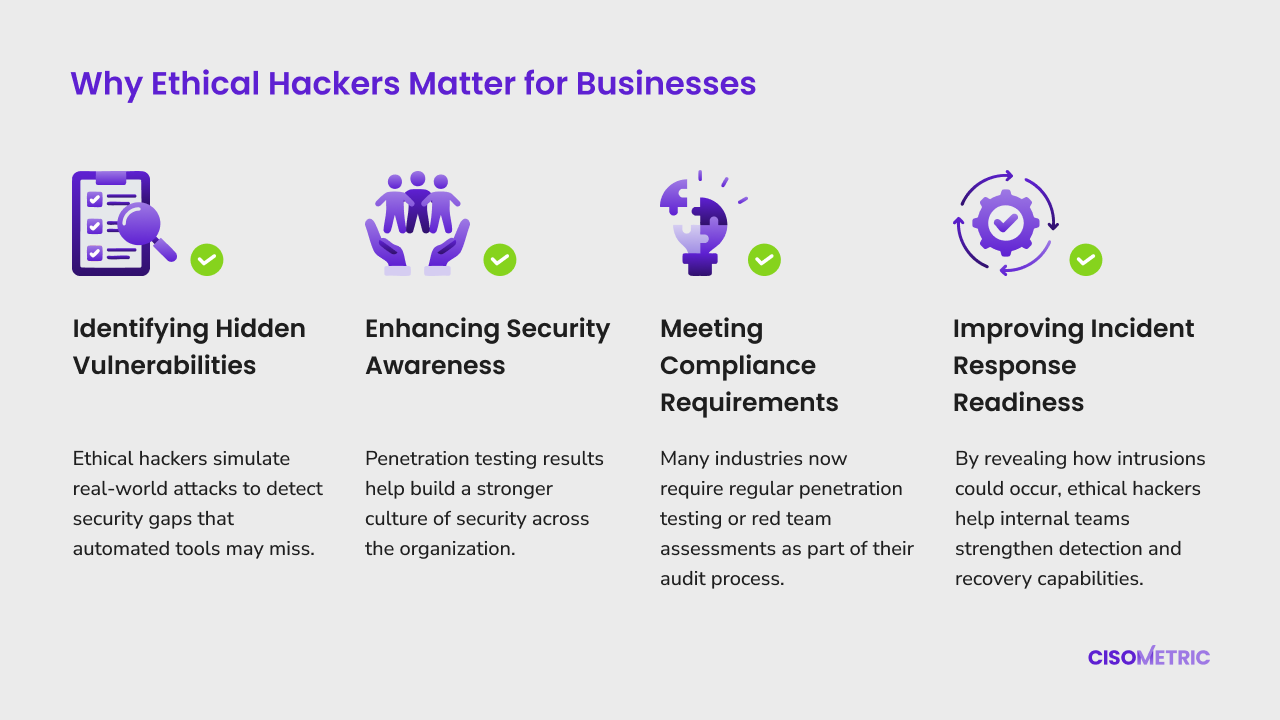
The key contributions of ethical hackers to businesses include:
1. Identifying Hidden Vulnerabilities
Ethical hackers simulate real-world attacks to detect security gaps that automated tools may miss.
2. Enhancing Security Awareness
Penetration testing results help build a stronger culture of security across the organization.
3. Meeting Compliance Requirements
Many industries now require regular penetration testing or red team assessments as part of their audit process.
Also read: What Your Business Needs To Achieve Cybersecurity Compliance
4. Improving Incident Response Readiness
By revealing how intrusions could occur, ethical hackers help internal teams strengthen detection and recovery capabilities.
Through these efforts, ethical hackers turn cybersecurity from a reactive function into a proactive business strategy.
Rules and Ethics in Ethical Hacking
Ethical hacking operates under strict professional and legal boundaries. Because there is a fine line between testing and intrusion, every action must be authorized, documented, and reported (Imperva, 2024).
Key ethical principles include:
1. Valid Permission
Ethical hackers must obtain explicit authorization from the system owner before conducting any testing (EC-Council, 2024).
2. Defined Scope
Testing boundaries must be clearly established, specifying which systems and applications can be accessed.
3. Avoiding Disruption
Tests should not interfere with business operations or compromise data integrity.
4. Confidentiality
All sensitive information encountered during testing must be kept secure and private.
5. Responsible Reporting
All findings must be accurately documented and presented along with clear mitigation recommendations.
These principles ensure that ethical hacking remains safe, constructive, and aligned with an organization’s overall cybersecurity objectives.
Key Activities in Ethical Hacking
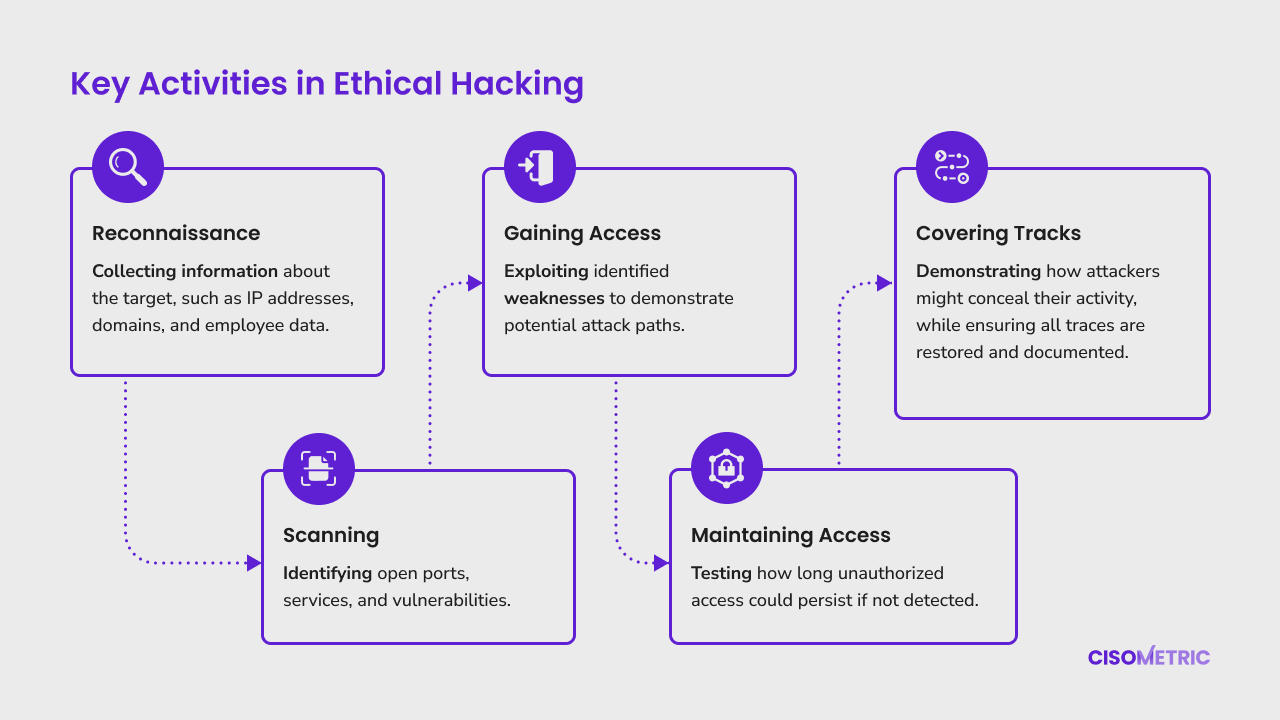
Ethical hackers follow structured methodologies that replicate the behavior of malicious attackers. EC-Council (2024) outlines a five-phase process widely used in the field:
1. Reconnaissance
Collecting information about the target, such as IP addresses, domains, and employee data.
2. Scanning
Identifying open ports, services, and vulnerabilities.
3. Gaining Access
Exploiting identified weaknesses to demonstrate potential attack paths.
4. Maintaining Access
Testing how long unauthorized access could persist if not detected.
5. Covering Tracks
Demonstrating how attackers might conceal their activity, while ensuring all traces are restored and documented.
This process allows organizations to view their security posture from an attacker’s perspective and prioritize improvements effectively.
In some cases, ethical hackers also conduct social engineering assessments, testing employee awareness through controlled phishing or QR code-based simulations. These exercises are particularly relevant in Indonesia, where many breaches originate from human error rather than technical flaws (Channel News Asia, 2025).
Also read: Cybersecurity Weakest Link: The Human Factor
Certifications in Ethical Hacking
Since ethical hacking involves high levels of trust and responsibility, certification is an essential benchmark. It ensures that a professional has the technical expertise, ethical foundation, and legal understanding required to perform the role effectively.
Prominent certifications include:
- Certified Ethical Hacker (CEH)
The most recognized credential worldwide, covering tools, techniques, and regulatory standards (EC-Council, 2024).
- EC-Council Certified Security Analyst (ECSA)
Focuses on advanced analysis, reporting, and real-world assessment techniques.
- Certified Network Defender (CND)
Concentrates on defensive security and network protection.
- Offensive Security Certified Professional (OSCP)
Emphasizes practical, hands-on penetration testing skills.
Certification is vital for ensuring credibility and accountability, helping employers distinguish trained ethical professionals from unauthorized actors (Imperva, 2024).
Conclusion
Ethical hackers are a crucial part of the modern cybersecurity ecosystem. Their work complements, rather than replaces, continuous monitoring and detection systems.
While a Security Operations Center (SOC) focuses on real-time threat detection and incident response, ethical hackers identify weaknesses before those threats can be exploited. Together, they form a more resilient cybersecurity framework that is both preventive and responsive.
Also read: How Cisometric’s SOC Protected Businesses from Hundreds of Cyber Threats
With our current digital environment, the most secure organizations are not those that have never faced attacks, but those that continuously test and strengthen their defenses. Ethical hackers help organizations do exactly that, by finding vulnerabilities early, improving system resilience, and enhancing response readiness.
As cyber threats evolve and automation accelerates attack methods, proactive testing is now a business necessity.
For companies seeking to elevate their cybersecurity maturity, engaging certified ethical hackers through trusted partners such as Cisometric can provide the assurance, visibility, and expertise needed to safeguard digital operations effectively.
Schedule a free consultation with our experts today, click here.
For more updates on digital scams, cybersecurity insights, and expert tips, follow our social media:
LinkedIn: Cisometric
Instagram: @cisometric
Youtube: @Cisometric
Reference:
What is Ethical Hacking and How to Become an Ethical Hacker?