By Patricia A. Pramono • Studio 1080, Published on September 11, 2025
TABLE OF CONTENTS
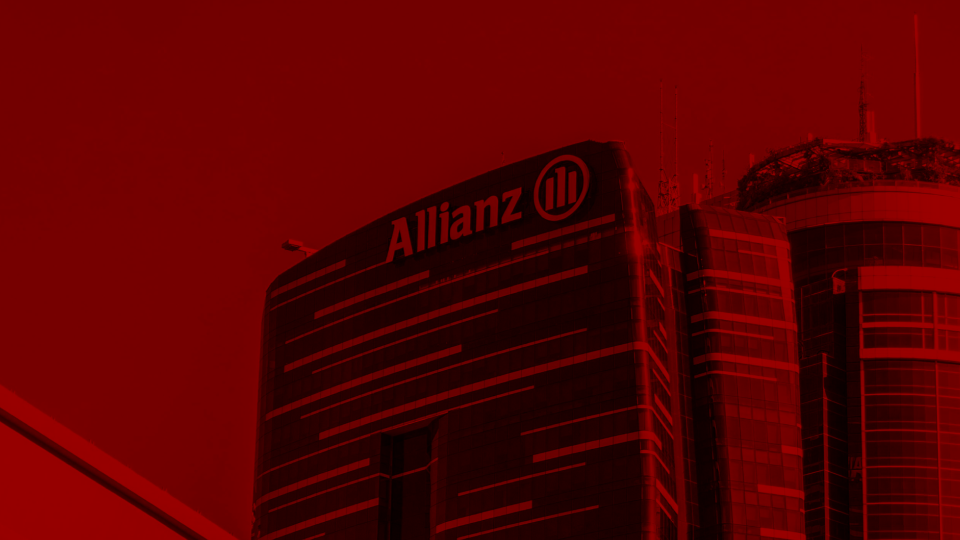
On July 16, 2025, Allianz Life Insurance Company of North America confirmed what no business ever wants to announce: a massive data breach affecting over 1.1 million customers (AP News, 2025; Forbes, 2025).
Allianz’s own systems weren’t directly hacked. Instead, attackers slipped in through the backdoor of a cloud-based customer relationship management (CRM) system provided by a vendor. It wasn’t a sophisticated zero-day exploit or an elaborate malware campaign. It was social engineering where a hacker pretended to be IT support, tricking employees into granting access to Allianz’s Salesforce CRM (Forbes, 2025).
Also read: Stay Safe: An Employee’s Guide to Avoiding Phishing Attacks
This is what we call a supply chain attack. And it’s becoming one of the most dangerous threats businesses face today.
About the Attack
As aforementioned, this past July, Allianz Life experienced a significant data breach after a hacker gained unauthorized access to a third-party, cloud-based CRM system used by the company (AP News, 2025). This said platform, reported to be Salesforce, was hacked through social engineering tactics.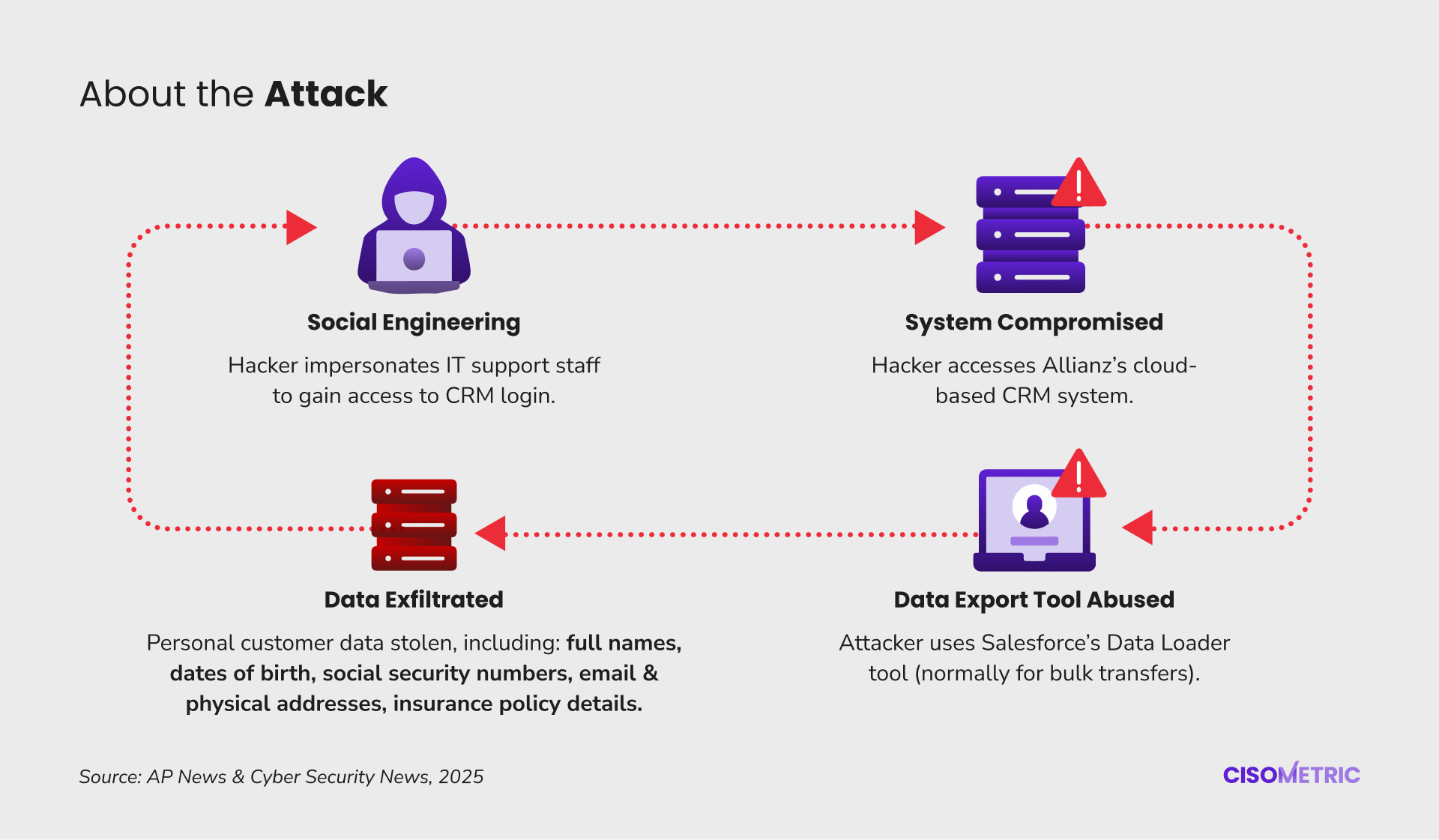
Once access was granted, the attacker used Salesforce's Data Loader tool, which is typically used for transferring large volumes of data, to exfiltrate customer information. The compromised data included (Cyber Security News, 2025):
- Full names
- Dates of birth
- Social security numbers
- Physical and email addresses
- Contact numbers
- Insurance policy information
- Possibly other sensitive financial data
The breach impacted the majority of Allianz Life’s 1.4 million U.S.-based customers, along with certain financial professionals and employees.
Importantly, Allianz Life clarified that the breach affected only the third-party system and not their internal network or core policy systems. The incident was discovered the following day, and authorities including the FBI and the Maine Attorney General’s Office were promptly notified. Impacted individuals were offered 24 months of identity theft protection and credit monitoring (Channel News Asia, 2025; Kontan, 2025).
As of now, Allianz Life has stated that this breach is limited to its U.S. operations and does not impact customers or systems in other regions, including Indonesia.
Understanding the Risks Behind Supply Chain Attacks
Imagine it this way: you lock your front door, install cameras, and put in alarms, having your home fully guarded against strangers. However, an intruder successfully walks in with a key your cleaning service left unguarded. That’s the essence of a supply chain attack.
Attackers look for the weakest link (and sometimes this could be vendors, cloud providers, contractors) and anyone with access. In Allianz’s case, the vendor’s CRM became that weak link.
Gartner projects that by 2025, 45% of global organizations will experience a supply chain attack, which is triple the number in 2021 (Forbes, 2025).
So whether you’re a company that uses third-party services or a vendor who serves high-risk clients, that’s where Vendor Due Diligence (VDD) becomes essential, for both sides. Whether you're evaluating a service provider, or you are the provider, understanding and validating security readiness is imperative.
- Companies must ensure their vendors meet cybersecurity and compliance standards
- Vendors must prove they’re not the weakest link in someone else’s chain
Also read: Why Vendor Due Diligence is Important
Why Compliance Is Your Real Defense
Supply chain attacks like Allianz’s reveal gaps in technical controls, but they also highlight a bigger issue: many organizations are still treating cybersecurity and regulatory compliance as separate conversations.
Business compliance is the foundation that everything else should be built on. It’s what turns good security intentions into actual standards, enforceable practices, and measurable protection, not just within your company, but across your entire ecosystem.
Whether you're securing internal systems, managing sensitive customer data, working with third-party vendors, or even if you’re a vendor handling sensitive client data, regulatory compliance is what keeps your entire ecosystem accountable and secure. Your ability to withstand threats increasingly depends on how well you meet regulatory expectations. It sets the standard for how you manage risk, both internally and externally.
For Indonesian businesses, especially in sectors like fintech, banking, and insurance, this includes frameworks such as:
- OJK (Otoritas Jasa Keuangan)
- Bank Indonesia (BI)
- ISO 27001 / 27701
- PCI DSS
- And the increasingly enforced UU PDP (Indonesia’s Personal Data Protection Law)
Also read: ISO 27701 Certification: Enhancing Data Privacy and Enabling PDP Compliance for Businesses
In other words, compliance is what anchors trust, resilience, and long-term continuity in your business. It defines how prepared you are.
Falling short in this area doesn’t only lead to fines or formal warnings. It also risks exposing sensitive data, damaging reputation, and disrupting your core operations.
Need Help?
These cyber threat risks don’t disappear on their own and waiting until something breaks is often too late. At Cisometric, we help organizations strengthen their compliance and security posture before they lead to real-world damage.
Through our Regulatory & Compliance Audit assistance, we help businesses:
- Assess readiness for OJK, BI, ISO, and other frameworks
- Evaluate vendor ecosystems and IT governance practices
- Identify blind spots in data protection and security controls
- Ensure their cybersecurity maturity aligns with legal and business requirements
For further info, please check our Compliance, Risk, and Audit Services, click here.
Because meeting the bare minimum isn’t enough anymore. To build long-term trust, businesses need to show they take security and compliance seriously, everywhere, not just internally.
If you’re unsure whether your business or your vendors meet today’s standards, our team can help. Let’s talk about what compliance should really look like for your organization.
Get in touch with our team and book a meeting with us, click here.
For more updates on digital scams, cybersecurity insights, and expert tips, follow our social media:
LinkedIn: Cisometric
Instagram: @cisometric
Youtube: @Cisometric
Allianz Data Breach Exposes Vulnerabilities Affecting Everyone
Allianz Life confirms data breach affecting majority of 1.4M US customers
Allianz Life US Diretas, Sebagian Data Pribadi Nasabah di AS Dicuri (Ada Klarifikasi)
Allianz Life Insurance Data Breach – 1.4 Million Customers’ Data at Risk