
By Patricia A. Pramono • Studio 1080, Published on October 20, 2025
TABLE OF CONTENTS
Congratulations! You’ve been selected as a Top 100 Cybersecurity Leader.” It feels good. It looks great on LinkedIn. And sometimes, it comes with a price.
Across industries (and increasingly in cybersecurity) “predatory” or “vanity” awards offer prestige for a fee: pay for a winner’s package, a magazine feature, a gala table, sometimes even the trophy itself. The problem is that it’s commoditizing credibility (Global Good Awards, 2025).
At first glance, these awards seem harmless, another way to showcase success. But beneath the plaques and certificates lies a deeper issue: they blur the line between genuine achievement and purchased recognition. In a field built on trust, accuracy, and integrity, that’s a dangerous blur.
What starts as flattery can quickly evolve into misinformation. A “Top Cybersecurity Company” badge may look impressive on a website, but for clients, regulators, and even job seekers, it can create a false sense of assurance, one that isn’t backed by real performance or peer review. And in an industry where security depends on credibility, illusions can cost more than money; they can cost trust.
At Cisometric, we’ve seen how this trend muddies the waters for buyers, partners, and the public. Our CEO, Hana Abriyansyah, said it plainly, “Recognition in cybersecurity should be earned, not transacted, and should reflect measurable outcomes, independent assessments, and peer validation.”
What Are Predatory Awards or Vanity Awards?
A predatory award, also known as a vanity award, is an “honor” you can buy. It’s not earned through performance, peer review, or industry impact, it’s secured through payment.
According to the Global Good Awards (2025), a vanity award is an award scheme in which the recipient purchases the award and/or marketing services to give the false appearance of a legitimate honor.
In other words, you’re not being recognized because you’re the best, you’re being recognized because you paid for the privilege.
These awards often disguise themselves under grand titles, such as:
- Best Global Cybersecurity Firm of the Year
- Top 50 Visionary Tech Leaders
- Outstanding Innovation in AI Security
They sound impressive, but dig a little deeper and you’ll often find the same pattern like vague judging criteria, no mention of who the judges are, and a payment link waiting for you right after the “Congratulations” email.
Some organizers even go as far as promising that your “win” will appear in a global publication with millions of readers, except the publication barely exists beyond its own website and a few social media bots (Philstar Global, 2025).
These schemes aren’t unique to cybersecurity, but their effects hit harder in this sector. As aforementioned, cybersecurity is an industry where credibility is currency, and being associated with a questionable award can do so much harm. It doesn’t just mislead audiences, it devalues real expertise.
What’s worse, vanity awards tend to prey on individuals and organizations genuinely trying to build their reputation. For a small firm or an early-stage startup, an email offering “instant global recognition” for a few thousand dollars can sound like an opportunity. But the truth is, no legitimate recognition will ever ask you to pay to prove your worth.
How Vanity Awards Damage Trust in Cybersecurity
When trust can be bought, it distorts how people judge competence and credibility: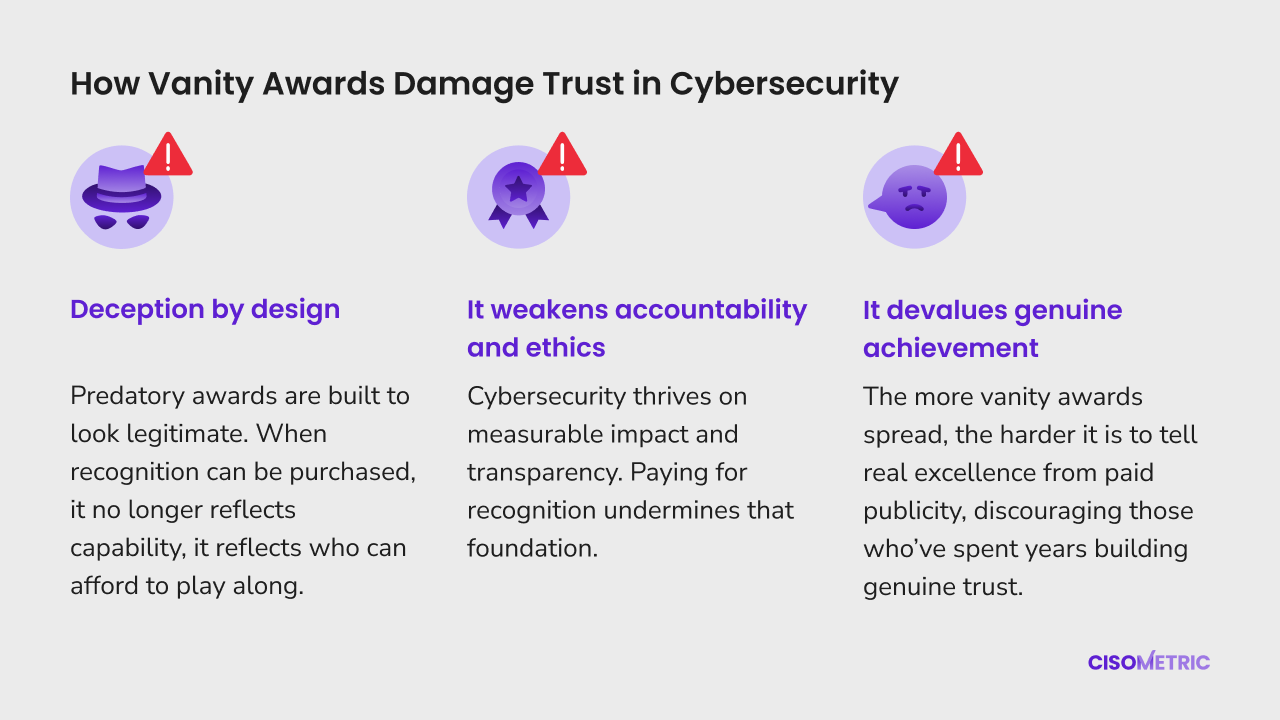
1. Deception by design
Predatory awards are built to look legitimate. Their entire model relies on blurring the line between merit and marketing. When recognition can be purchased, it no longer reflects capability, it reflects who can afford to play along.
2. It weakens accountability and ethics
Cybersecurity thrives on measurable impact and transparency. Paying for recognition undermines that foundation. It encourages professionals and organizations to chase visibility over verifiability. When everyone can be a “winner,” true innovation and integrity get buried under self-funded recognition. Regulators like the ACCC have warned that such misleading claims, even if unintentional, can fall under deceptive advertising (SWS Lawyers, 2024).
3. It devalues genuine achievement
The more vanity awards circulate, the harder it becomes to distinguish real excellence from paid publicity. Legitimate recognitions (earned through independent assessments, certifications, and community contributions) lose visibility. For professionals who’ve worked years to build trust, that’s not just unfair; it’s disheartening.
Why Do Individuals and Businesses Pay for These Awards?
Even though the flaws are increasingly visible, vanity or pay-to-win awards still find participants, both individuals and companies. The reasons usually include:
1. The pressure to look credible quickly
In competitive industries, visibility often translates to trust. Startups or small firms, especially in cybersecurity, may feel that earning a badge or “Top Company” title helps them look established and attract clients or investors faster. For professionals, adding an “award” to a LinkedIn headline can seem like a shortcut to recognition.
2. Marketing and PR value
Awards offer easy material for press releases, social media, and website highlights. While short-term visibility can look appealing, the long-term risk lies in promoting a title that could later be questioned or exposed.
3. Peer and market pressure
When competitors or peers start displaying multiple “awards,” others feel the need to keep up. This creates a cycle where recognition becomes a branding tool instead of a reflection of impact or innovation.
4. Lack of awareness
Not all participants realize they are engaging in a vanity award. The offers are often packaged professionally, with convincing language and claims.
For organizations and professionals, the takeaway is not to reject all recognition, but to understand what’s behind it. Genuine awards exist, such as those with clear criteria, transparent judges, and no financial strings attached.
Stay Safe: How to Tell If an Award Is Predatory
Before accepting or promoting an award, it’s important to verify its legitimacy. These points can help you identify whether an award is credible or potentially predatory:
1. Who are the judges and are their bios public?
If the names or backgrounds of the judging panel aren’t listed, that’s a red flag.
2. The criteria are not publicly available
A credible award clearly outlines how participants are assessed. If you can’t find any mention of evaluation methods or scoring, it’s likely not based on merit.
3. How many entries, finalists, and winners are there?
If every nominee seems to win, or there are hundreds of “awardees” per cycle, it’s usually a pay-to-win scheme, not a competitive process.
4. There is a fee to receive the award
Reputable awards may charge a reasonable entry fee, but they never require payment to claim the prize or to use the award logo.
5. The organizer lacks a proven track record
Always check the award’s background, previous winners, and the credibility of the organizing body. Be cautious if the organization has little to no online presence outside its own website.
6. Is there an appeal or feedback process?
Credible programs allow feedback or appeals. Vanity awards don’t, because there’s nothing to evaluate.
7. Is the publication or exposure real?
Ask for proof of distribution or readership. If their “4 million global readers” can’t be verified, it’s probably a misleading claim.
8. Has the organizer faced complaints or rulings?
Check for past cases from regulators like the ASA (UK) or BBB (US). For example, AI Global Media once faced an upheld ASA complaint for misleading award claims (ASA, 2018).
9. The award is linked to excessive marketing offers
If accepting the award requires purchasing “promotion packages,” “media features,” or event tickets, it’s likely a business model rather than a recognition program.
Conclusion
In cybersecurity, an industry where trust defines every decision, recognition means little if it isn’t backed by evidence, peer validation, and measurable results. Vanity awards may look impressive, but they offer no credibility, no assurance, and no real value to clients or the public.
For professionals and organizations, the challenge is not about rejecting recognition altogether, but about raising the standard for what counts as meaningful recognition. Transparency, accountability, and demonstrated impact will always speak louder than a paid trophy.
At Cisometric, we believe that credibility is built over time through real outcomes, not transactions. Whether you’re a business owner, an IT leader, or a cybersecurity professional, your reputation should come from the work you do and the difference it makes.
Because in cybersecurity, trust is the only award that truly matters.
For more updates on digital scams, cybersecurity insights, and expert tips, follow our social media:
LinkedIn: Cisometric
Instagram: @cisometric
Youtube: @Cisometric
Reference:
What are ‘vanity awards’ and why you should NEVER enter them?
How vanity awards feed the ego economy