As 2025 draws to a close, online scams have become more sophisticated, targeted, and difficult to detect.
With more people shopping, working, and communicating online, scammers adapted their methods to look more convincing, more personal, and harder to detect.
Throughout the year, reports from regulators and media consistently showed the same pattern that scams no longer rely on technical hacking alone. Instead, they focus on manipulating trust, urgency, and emotion.
This article summarizes the most common scams that shaped 2025, based on reported cases, and highlights what individuals and organizations should be more aware of as we move into 2026.
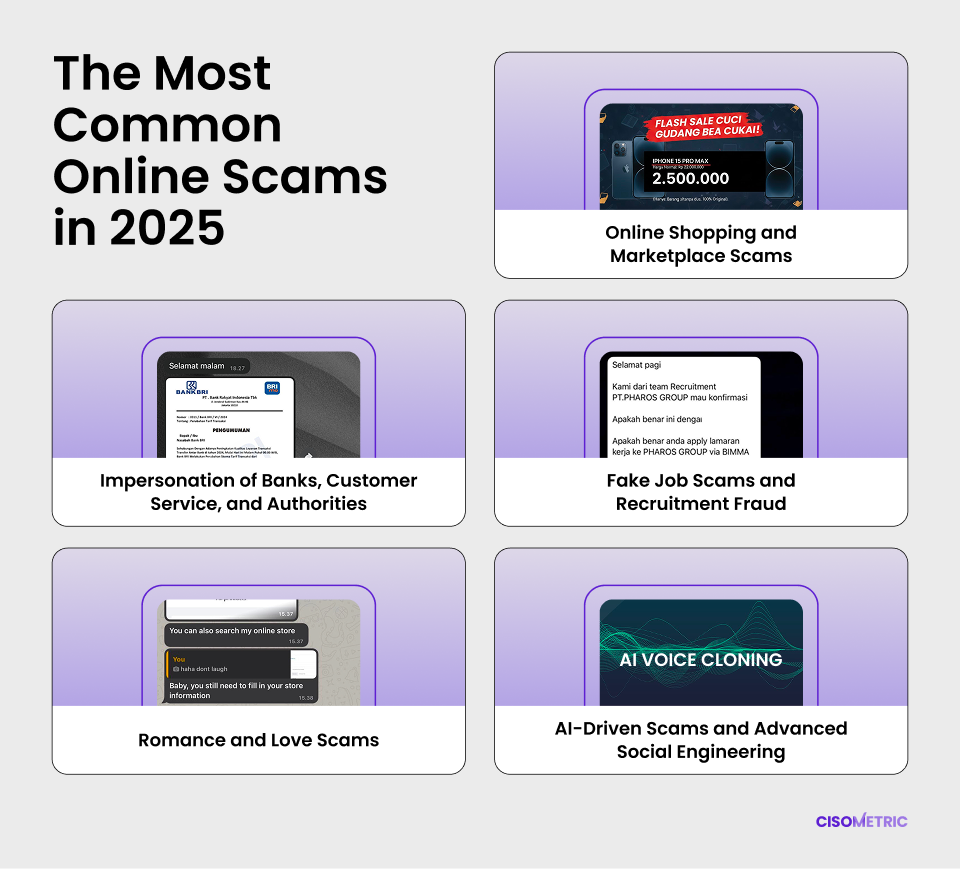
Online shopping scams remained the most frequently reported type of fraud in 2025. Victims were commonly directed to fake stores, cloned websites, or seller profiles on social media that appeared legitimate at first glance.
According to reports cited by OJK, more than 50,000 complaints related to online shopping scams in Indonesia were recorded, with estimated losses reaching nearly IDR 1 trillion (MetroTV, 2025; Finetiks, 2025).
Typical patterns included:
Prices far below market value
Requests to transfer funds outside official platforms
Sellers becoming unreachable after payment
Despite repeated warnings, these scams continue to succeed because they blend seamlessly into everyday online shopping behavior.
2. Impersonation of Banks, Customer Service, and Authorities
Impersonation scams caused some of the largest financial losses in 2025. Scammers posed as bank representatives, customer service agents, logistics providers, or government-related entities.
In Indonesia, losses linked to this type of scam were reported to reach approximately IDR 1.3 trillion in 2025 (Finetiks, 2025).
These scams often relied on urgency and authority. Victims were pressured to act quickly and asked to share sensitive information such as OTPs, PINs, or login credentials.
A key issue highlighted in many cases is that victims believed the communication was legitimate because scammers already possessed partial personal data.
Fake job scams expanded significantly in 2025, especially on platforms such as LinkedIn, Instagram, and Telegram. Scammers impersonated HR representatives from well-known companies and contacted job seekers with interview offers or recruitment messages.
Victims were commonly asked to pay administrative, training, or onboarding fees before the scammer disappeared.
More concerningly, recruitment-themed scams were also used as a delivery method for malware and targeted attacks against employees, a tactic widely referred to as the DreamJobscam (Public Safety, 2025; Zano Tyrannis, 2025).
This shows that job scams are no longer only a consumer issue, but also a business security risk.
Romance scams continued to cause financial and emotional harm in 2025.
Scammers built online relationships over time and later requested money for fabricated emergencies, investments, or personal needs.
What changed in 2025 was the increasing use of AI-generated images, voice messages, and deepfake content, making fake identities more convincing (Zano Tyrannis, 2025).
As a result, traditional warning signs (such as avoiding video calls) have become less reliable, as some scammers were able to simulate visual or audio interactions.
5. AI-Driven Scams and Advanced Social Engineering
AI played a major role in shaping scam tactics throughout 2025. According to multiple reports, scammers increasingly used AI tools to:
Generate more natural and personalized phishing messages
These methods allowed scammers to move beyond generic messages and focus on highly targeted manipulation (Public Safety, 2025; Zano Tyrannis, 2025).
What to Watch Out for in 2026
Looking ahead, AI-driven scams are expected to continue growing in scale and impact.
Security forecasts warn that scam operations are shifting away from mass messaging toward what is described as emotional engineering, where attackers adapt their messages in real time based on a victim’s reactions, such as fear or uncertainty (Security Brief, 2025).
In practice, this means scams in 2026 may:
Feel more personal and convincing
Rely less on technical tricks and more on psychology
Use real-time impersonation of voices, faces, and writing styles
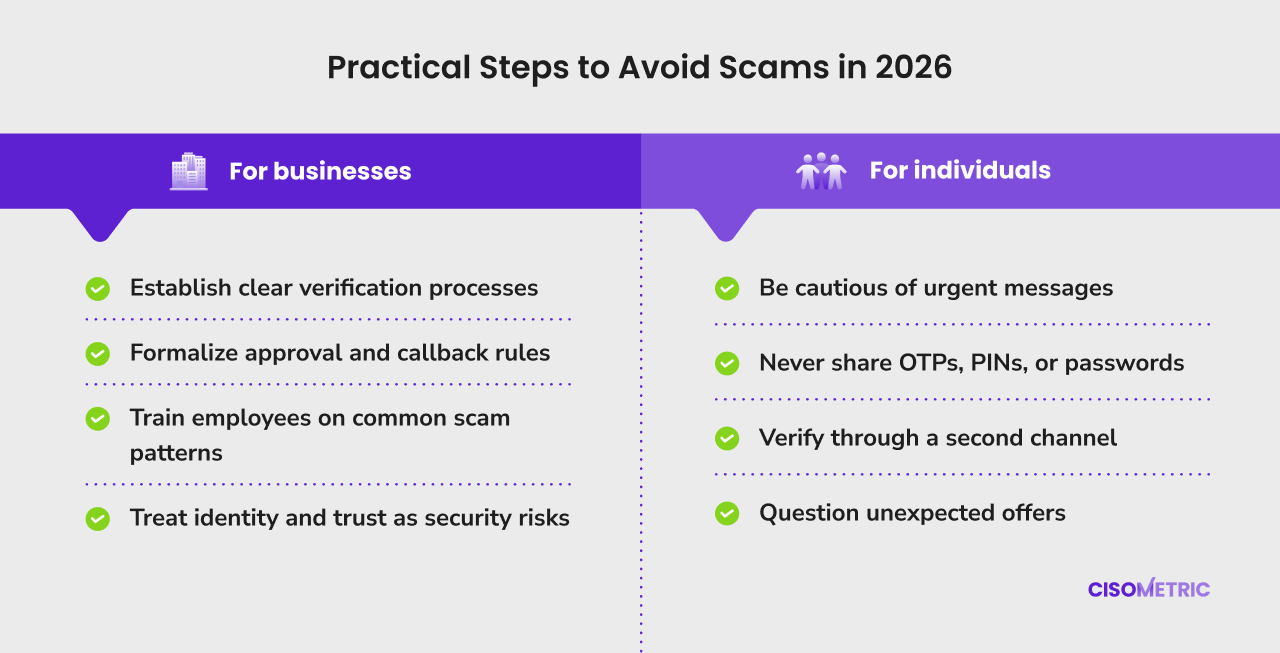
Practical Steps to Avoid Scams in 2026
While scam techniques continue to evolve, there are still practical steps that can significantly reduce risk.
Most scams targeting individuals rely on urgency, emotion, or convenience. Simple habits can help reduce exposure:
Be cautious of urgent messages
Messages that pressure you to act quickly (especially those involving account issues, payments, or limited time offers) should be treated with suspicion.
Never share OTPs, PINs, or passwords
Official banks, platforms, and service providers will never ask for these details via chat, call, or email.
Verify through a second channel
If a request comes via WhatsApp or email, confirm it through the official app, website, or a known phone number, not by replying to the same message.
Question unexpected offers
Sudden job offers, investment opportunities, or prize notifications are common entry points for scams. Take time to verify before responding.
For individuals, slowing down and double-checking information is often enough to stop a scam before it escalates.
2025 showed that the most successful scams are the scams that feel familiar, reasonable, and trustworthy, often blending seamlessly into everyday communication, transactions, and workflows.
As we move into 2026, reducing risk will depend less on spotting technical flaws and more on building secure habits and awareness, both at an individual and organizational level. This includes questioning urgency, validating identities through multiple channels, and treating trust as something that must be continuously verified.
For businesses, this shift is especially critical. Scam activity increasingly targets employees, business processes, and decision-making flows rather than systems alone. Without proper visibility, monitoring, and response readiness, even a single successful scam can lead to financial loss, data exposure, or reputational impact.
This is where a proactive cybersecurity approach becomes essential. Through continuous monitoring, threat detection, and incident response capabilities, organizations can better identify suspicious activity early, before it escalates into a larger incident.
At Cisometric, we help organizations strengthen their security posture by combining technology, expertise, and real-time monitoring through our Security Operations Center (SOC). Our goal is not only to respond to incidents, but to help businesses stay ahead of evolving threats, including modern scam and social engineering tactics.
DeepSeek AI is a game changer for AI chatbots. Within weeks of launching, it became the most-downloaded free app on Apple’s App Store, dethroning ChatGPT. Tech analysts marveled at its ability to perform at the same level as some of the biggest AI models on the market
How Supply-Chain Cyber Attacks Can Take Down Your Business
Supply-chain attacks come in multiple forms, all designed to exploit trust between businesses and their third-party vendors. Here are some case examples with different approaches:
What Makes a Security Operations Center (SOC) Truly Effective?
he best SOCs detect threats in real-time, not hours later. That’s why Artificial Intelligence (AI) and Machine Learning (ML) are now truly necessary. AI can analyze billions of data points instantly, identify hidden anomalies that manual methods
Cybersecurity incidents often bring to mind images of hackers exploiting complex technical technological vulnerabilities. But in reality, many successful cyber attacks don’t happen because of weak systems, they happen because of human errors.
“Many businesses still think cybersecurity is a ‘later’ problem. But when an attack happens, it’s already too late. Cyber threats don’t just steal data, they burn through money.”
Welcome to cisometric.com! In order to provide a more relevant experience for you, we use cookies to enable some website functionality. Cookies help us see which articles most interest you; allow you to easily share articles on social media; permit us to deliver content, jobs and ads tailored to your interests and locations; and provide many other site benefits. For more information, please review our
Privacy Notice.