By Patricia A. Pramono • Studio 1080, Published on February 24, 2026
TABLE OF CONTENTS
On January 22, 2026, South Korea officially brought into force the Framework Act on the Development of Artificial Intelligence and Establishment of a Foundation for Trustworthiness, widely referred to as the AI Basic Act.
The country positions this as the world’s first fully enforced comprehensive AI law enacted at a national level, ahead of the European Union’s phased AI Act implementation and while the United States continues to rely largely on sector-based approaches (Reuters, 2026; The Guardian, 2026).
This development marks a significant shift.
AI governance is no longer a policy discussion in progress, it is now enforceable law.
About The Framework
What makes South Korea’s approach notable is that it does not treat AI as something to suppress. Instead, the Act is designed to promote AI development while establishing trust and safety foundations (Reuters, 2026; The Guardian, 2026).
The law reflects an innovation-first philosophy. Companies are not required to seek prior approval before deploying AI systems, avoiding rigid pre-clearance mechanisms that could stifle growth (Sify, 2026).
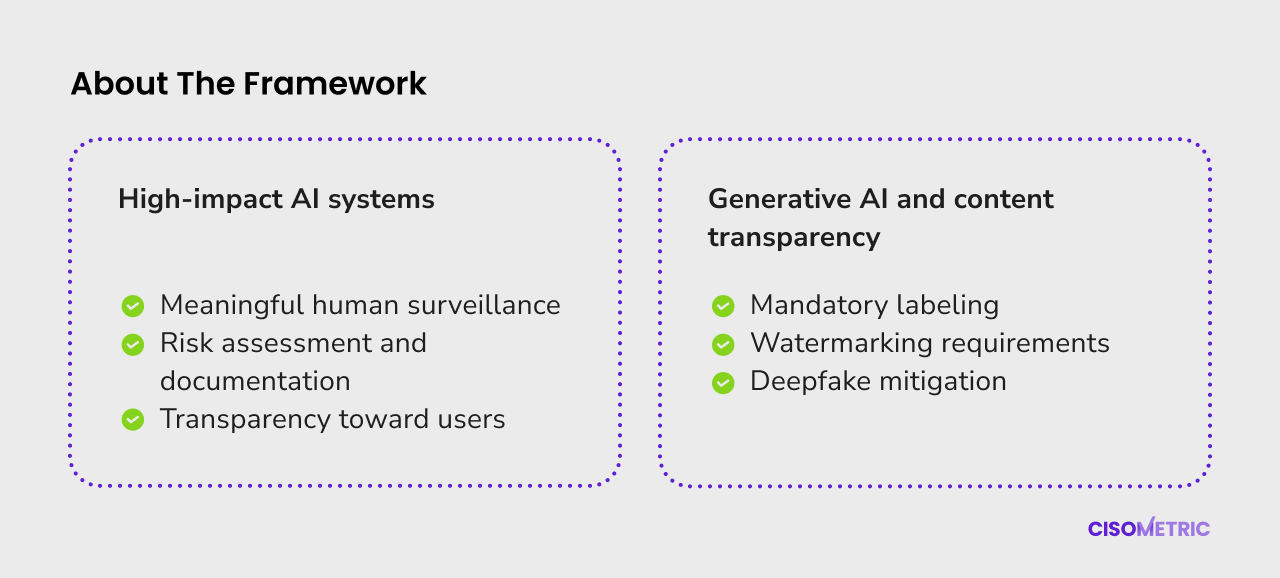
However, the framework introduces structured obligations in two key areas:
1. High-impact AI systems
The Act defines high-impact AI as systems used in sectors where failure could significantly affect human safety, property, or fundamental rights. This includes areas such as healthcare, employment, loan screening, transportation, nuclear safety, and water infrastructure (Reuters, 2026; Tech Policy, 2026; OneTrust, 2025).
Operators of such systems must ensure:
- Meaningful human surveillance
- Risk assessment and documentation
- Transparency toward users
2. Generative AI and content transparency
Companies must clearly label AI-generated outputs, especially where synthetic content may be difficult to distinguish from reality. Watermarking and visible labeling requirements aim to address deepfake misuse and misinformation (The Guardian, 2026; Tech Policy, 2026).
Also read: From Fiction to Reality: How Deepfakes Are Changing Our World
The government provides a minimum one-year grace period before enforcement of administrative penalties begins (Reuters, 2026; The Guardian, 2026).
After that period, violations (including failure to properly label generative AI content) may result in fines of up to 30 million won, or approximately USD 20,400 (Reuters, 2026; Tech Policy, 2026).
In essence, South Korea is signaling that AI development remains welcome, but it must be accountable.
Deepfakes and Real Harm
The timing of this legislation is closely linked to real societal challenges.
Deepfake-related sexual crimes have increased significantly in South Korea in recent years. Police-recorded cases rose from 156 in 2021 to 1,202 in 2024 (BBC News Indonesia, 2025). Many victims were teachers and students whose images were manipulated and distributed through online platforms.
Also read: Grok AI is Facing Global Backlash Over Generative Inappropriate Images of Women and Children on X
Behind these figures are personal stories of reputational damage, psychological distress, and long-term trauma (BBC News Indonesia, 2025).
When generative AI tools become widely accessible, misuse can scale rapidly. In this context, mandatory labeling and risk classification requirements are not abstract regulatory tools, they are mechanisms intended to mitigate real harm.
Industry Concerns: Readiness and Regulatory Clarity
Despite its structured intent, the AI Basic Act has faced criticism from industry stakeholders.
A December survey conducted by the Startup Alliance found that 98% of AI startups were unprepared for compliance (The Guardian, 2026).
Concerns raised include:
- Ambiguity in defining “high-impact AI”
- Potential compliance uncertainty
- Disproportionate burden on smaller startups
As reported by Reuters (2026), one industry leader openly questioned, “Why do we have to be the first to do this?”
At the same time, civil society organizations argue that the law may not go far enough to protect individuals affected by AI-related harm (The Guardian, 2026).
This dual criticism reflects the complexity of AI governance in balancing innovation, competitiveness, and public protection. South Korea is now operating at that intersection.
What About Indonesia?
The conversation is not limited to South Korea.
Indonesia is also moving toward formal AI governance measures, particularly around content transparency.
Indonesia’s Ministry of Communication and Digital (Komdigi) plans to require labeling or watermarking of AI-generated content as part of the upcoming Presidential Regulation on the national AI roadmap (Katadata, 2026).
This indicates a similar policy direction, towards transparency for generative AI outputs.
What This Means for Organizations
For organizations leveraging AI, whether in customer interaction, analytics, automation, decision-making, or marketing, the implications are:
- AI systems must be mapped and documented
- Higher-risk applications must be identified and assessed
- Transparency mechanisms must be built into processes
- Human surveillance must be demonstrable in critical use cases
The central question becomes:
If regulators were to review your AI practices tomorrow, could your organization explain how risk is managed?
AI governance is increasingly becoming a business discipline, not just a technical or legal matter.
Preparing for the AI Governance Shift
Preparation does not require halting innovation. It requires structure.
Organizations can begin by:
- Conducting an internal AI inventory
- Classifying use cases based on potential impact
- Establishing labeling protocols for generative content
- Implementing oversight mechanisms for high-risk systems
- Developing a documented AI governance framework aligned with evolving regulations
Structured AI Governance programs help organizations operationalize these controls while maintaining innovation.
AI Governance is designed to support organizations in navigating emerging regulatory expectations, turning governance into a strategic enabler rather than a reactive obligation.
Also read: Understanding AI Governance: Risks, Rules, and Best Practices
Conclusion
South Korea’s AI Basic Act represents more than a regulatory milestone. It reflects a broader shift in how nations approach innovations in AI that is no longer defined solely by technological capability, but also increasingly includes the ability to design responsible frameworks for deployment.
For more updates on digital scams, cybersecurity insights, and expert tips, follow our social media:
LinkedIn: Cisometric
Instagram: @cisometric
Youtube: @Cisometric
Reference:
South Korea launches landmark laws to regulate AI, startups warn of compliance burdens
South Korea’s ‘world-first’ AI laws face pushback amid bid to become leading tech power
South Korea May Regret Being First with New AI Law
South Korea’s new AI law: What it means for organizations and how to prepare
South Korea Passes World’s First AI Laws: Visionary or Foolish?
Korea Denda Konten AI Tanpa Label, Bagaimana di Indonesia?
Seperti Korea Selatan, RI Akan Wajibkan Penggunaan Label Khusus Konten AI