
Managed SIEM: Bring Your Own SIEM atau Platform Managed?
Membandingkan model Bring Your Own SIEM (BYOS) dan platform managed SIEM: kapabilitas deteksi, TCO aktual, biaya migrasi, dan matriks keputu...
Oleh Cisometric Marketing Team, Diterbitkan pada Mei 18, 2026
For many, phishing is still associated with suspicious emails, poorly written messages, or fake links that are easy to recognize.
Also read: Phishing: New Methods and How to Stay Safe
The W3LL case shows how much that has changed.
In April 2026, the FBI Atlanta Field Office and the Indonesian National Police concluded a multi-year joint investigation that led to the dismantling of a global phishing network. The operation targeted the alleged developer of the W3LL phishing kit, identified as G.L., who was apprehended by Indonesian authorities. Law enforcement also seized assets and hardware containing evidence of thousands of global targets (U.S. Embassy & Consulates in Indonesia, 2026).
The W3LL case was a structured phishing operation supported by tools, infrastructure, stolen credentials, and an underground marketplace.
FBI Atlanta Special Agent in Charge Marlo Graham stated that, “This wasn’t just phishing, it was a full-service cybercrime platform.”
This shows that phishing can now operate through service-based models where cybercriminals can buy access to tools, launch campaigns, harvest credentials, and trade compromised accounts with far less technical effort.
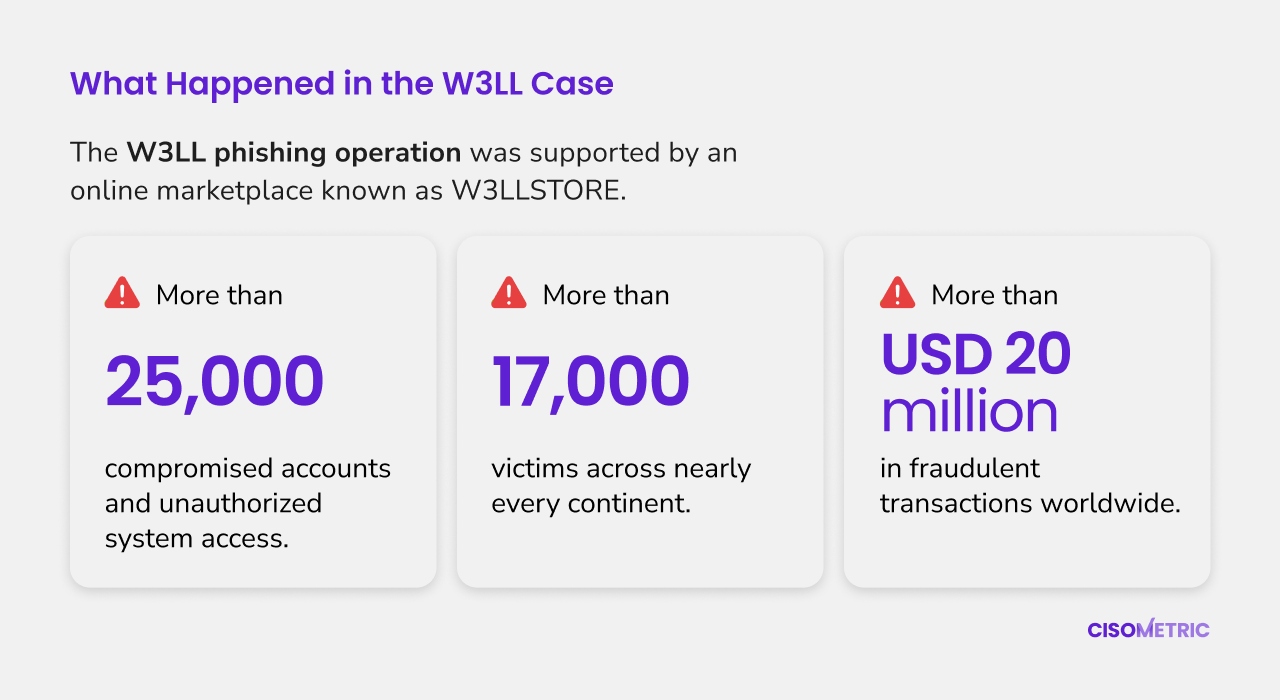
The W3LL phishing operation was supported by an online marketplace known as W3LLSTORE.
Between 2019 and 2023, this marketplace facilitated the sale of more than 25,000 compromised accounts and unauthorized system access. From 2023 to 2024 alone, the W3LL phishing kit was reportedly used to target more than 17,000 victims across nearly every continent. In total, the developer behind the toolkit facilitated the theft of thousands of account credentials and attempted more than USD 20 million in fraudulent transactions worldwide, or approximately IDR 350 billion.
The joint investigation involved Polri, FBI Atlanta, the Cyber Directorate of Bareskrim Polri, and the International Relations Division of Polri. Indonesian authorities detained the suspected developer in Indonesia as part of the operation (Tempo, 2026).
The case is significant not only because of its financial scale, but also because it reflects how cybercrime often works across borders. The developer may be in one country, the victims in another, the infrastructure spread globally, and the financial trail moving across several jurisdictions.
For this reason, cross-border cybercrime requires cross-border enforcement. The W3LL case became an example of how international cooperation can directly disrupt a cybercrime ecosystem.
The W3LL phishing kit allowed criminals to create fake login pages that closely resembled legitimate websites. Victims who entered their credentials into these pages were unknowingly giving attackers access to their accounts.
However, W3LL was more than a fake-login-page tool.
W3LL was part of a broader phishing ecosystem designed to target corporate environments, especially business email systems such as Microsoft 365. The W3LL Store offered managed phishing tools for criminals with different skill levels, including compromised email accounts, victim email lists, access to compromised servers, phishing kits, custom phishing lures, VPN accounts, and other tools used to support business email compromise attacks (Group-IB, 2023).
W3LL is also a phishing-as-a-service operation. For only around USD 500, cybercriminals could purchase access to the toolkit and launch convincing phishing campaigns without needing to build the entire operation themselves (The Cyber Express, 2026).
This is what makes the case relevant for businesses. W3LL lowered the barrier to cybercrime. Attackers did not need to develop a phishing infrastructure from scratch. They could use an existing ecosystem that already provided tools, support, and access to stolen data.
In practical terms, phishing became easier to scale.
One of the most concerning aspects of W3LL was its ability to bypass multi-factor authentication, or MFA.
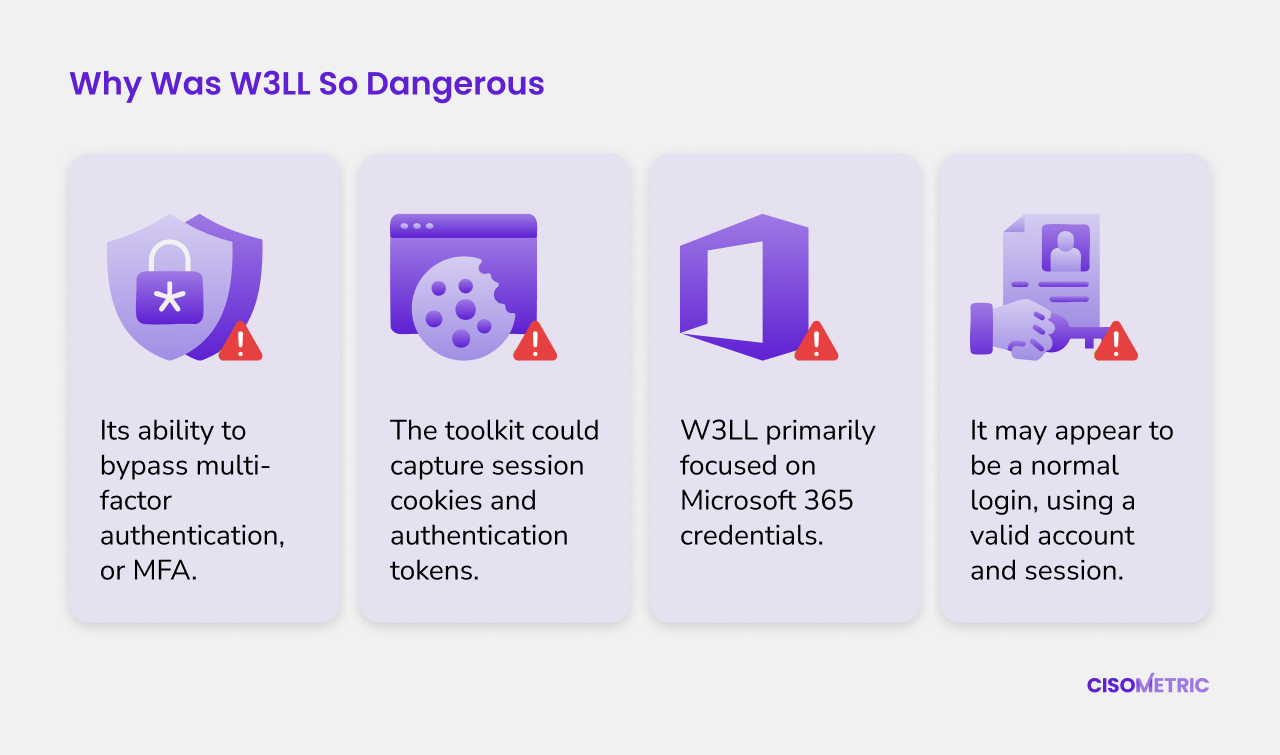
The W3LL tool could capture session data, allowing attackers to bypass MFA and remain logged in even after the victim changed their password. The toolkit could capture session cookies and authentication tokens. This allowed attackers to establish unauthorized access without always triggering obvious security alerts.
W3LL primarily focused on Microsoft 365 credentials and used adversary-in-the-middle techniques to hijack session cookies and bypass MFA (The Hacker News, 2026).
This creates a serious challenge for businesses.
If attackers only steal a password, a password reset may help contain the risk. But if attackers capture valid session data, they may be able to access the account as if they had already passed authentication.
From the organization’s perspective, that activity may not immediately look suspicious. It may appear to be a normal login, using a valid account and a valid session.
This is why modern phishing cannot be addressed only through email filtering or employee awareness. Once an attacker obtains access, the organization needs visibility into user behavior, login anomalies, device activity, mailbox changes, and suspicious account actions.
The W3LL ecosystem was built with corporate environments in mind.
The W3LL tools were designed to target companies and support business email compromise campaigns. The most frequently targeted industries include manufacturing, IT, financial services, consulting, healthcare, and legal services.
This matters because a compromised corporate email account can expose invoices, vendor conversations, payment instructions, customer information, internal documents, password reset links, and sensitive business discussions.
Once attackers enter a corporate mailbox, they can observe communication patterns and wait for the right moment to act. They may impersonate an employee, alter payment details, send fraudulent invoices, or use the compromised account to target colleagues, partners, and customers.
This is why, while employee awareness of phishing is important, phishing is also an identity security issue, a monitoring issue, an incident response issue, and a business risk issue.
The W3LL case shows that phishing has become more organized, more automated, and more difficult to detect with basic controls alone.
Many organizations focus heavily on preventing employees from clicking unverified links.
That focus is understandable. Blocking phishing emails, training employees, and encouraging people to report suspicious messages are all important parts of defense.
However, the W3LL case shows that the larger risk often begins after the click.
Once attackers obtain credentials or session access, they can attempt to enter the account, read emails, monitor conversations, set up forwarding rules, delete traces, or impersonate the account owner. They may not act immediately. In some cases, they may observe quietly until they find a payment process, vendor discussion, or internal request they can manipulate.
At that point, phishing becomes a business-impacting incident.
The problem is no longer only that someone clicked a link. The problem is that attackers may now have access to trusted communication channels inside the organization.
Without proper monitoring, that access can remain unnoticed until financial, operational, or reputational damage has already occurred.
The W3LL case shows that phishing is no longer limited to obvious scam emails or poorly written messages. It can now be supported by marketplaces, automation, stolen credentials, MFA bypass techniques, and organized cybercriminal networks.
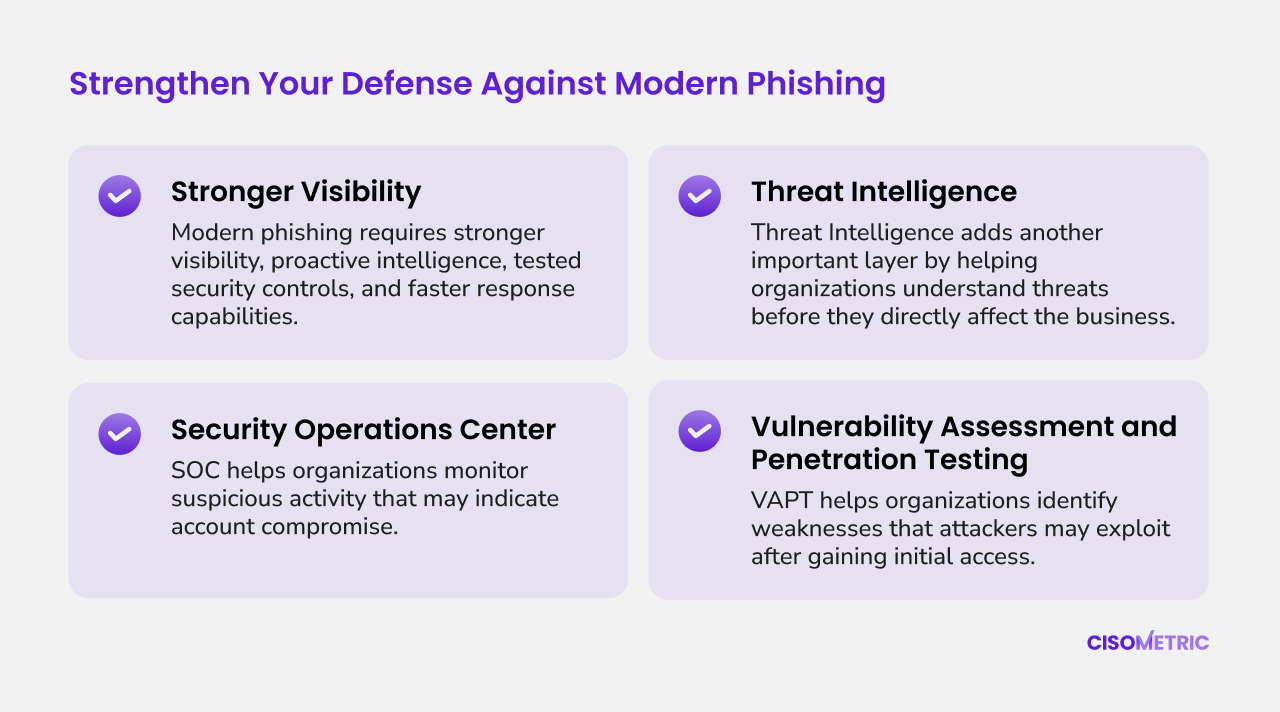
This means businesses need to strengthen more than email security alone. Modern phishing requires stronger visibility, proactive intelligence, tested security controls, and faster response capabilities.
A Security Operations Center, or SOC, helps organizations monitor suspicious activity that may indicate account compromise. These can include unusual login locations, unfamiliar devices, abnormal login times, impossible travel patterns, suspicious mailbox activity, new inbox forwarding rules, or user behavior that does not match normal patterns.
The challenge is that these signs are not always obvious. A compromised account may not immediately trigger a clear alarm. In many cases, the activity may appear to come from a legitimate user, especially when attackers use stolen credentials or valid session data.
This is why visibility matters.
Threat Intelligence adds another important layer by helping organizations understand threats before they directly affect the business. For businesses, this kind of intelligence can help security teams identify exposed credentials, monitor emerging phishing infrastructure, detect lookalike domains, understand attacker techniques, and prioritize risks based on active threats.
At the same time, Vulnerability Assessment and Penetration Testing, or VAPT, helps organizations identify weaknesses that attackers may exploit after gaining initial access. Phishing is often only the first stage of a larger attack path. Once attackers enter through a compromised account, they may look for weak access controls, misconfigured systems, exposed services, poor password practices, or insufficient segmentation.
Together, SOC, Threat Intelligence, and VAPT help businesses answer three critical questions:
These questions are important because prevention alone is no longer enough. The key question is not only whether an organization can stop a phishing email from reaching an employee. The more important question is whether the organization can detect and respond when an attacker has already gained access.
Cisometric helps organizations strengthen their cybersecurity posture through Security Operations Center, Threat Intelligence, and Vulnerability Assessment and Penetration Testing services.
Through continuous monitoring, proactive threat visibility, and security testing, organizations can better detect suspicious activity, understand emerging threats, and identify weaknesses before attackers exploit them.
For more updates on cybersecurity insights, follow our social media:
LinkedIn: Cisometric
Instagram: @cisometric
Youtube: @Cisometric
Reference:
United States and Indonesia Dismantle Global Phishing Network
FBI and Indonesian Police Dismantle W3LL Phishing Network Behind $20M Fraud Attempts
Polri-FBI Atlanta Bongkar Jaringan Phishing Global
W3LL-CRAFTED EMAILS: Inside a secret phishing ecosystem | by Group-IB
Authorities Dismantle ‘W3LL’ Phishing Empire
W3LL Phishing Kit Takedown Hits Global Credential Theft and MFA Bypass Operation
Membandingkan model Bring Your Own SIEM (BYOS) dan platform managed SIEM: kapabilitas deteksi, TCO aktual, biaya migrasi, dan matriks keputu...

Perbandingan mendalam In-House SOC dan Managed SOC berdasarkan biaya operasional, kebutuhan analis 24/7, regulasi OJK dan BI, serta kesiapan...
Bagaimana ancaman berbasis AI mengubah operasional SOC? Simak perkembangan terbaru dan kapabilitas deteksi, investigasi, serta respons yang...
Cari Artikel Berdasarkan Kategori
Kami menggunakan cookie untuk meningkatkan pengalaman menjelajah, menganalisis lalu lintas situs, dan menyajikan konten yang relevan. Pilih cookie mana yang Anda izinkan. Kebijakan Privasi