
Ancaman Berbasis AI: Apa yang Berubah dan Apa yang Tetap Relevan bagi SOC?
Bagaimana ancaman berbasis AI mengubah operasional SOC? Simak perkembangan terbaru dan kapabilitas deteksi, investigasi, serta respons yang...

Oleh Cisometric Marketing Team, Diterbitkan pada Maret 4, 2026
Nowadays, cybersecurity is increasingly assessed and evaluated through the lens of data governance, infrastructure alignment, and regulatory compliance.
One critical but often overlooked is where your SOC (Security Operations Center) data is processed and stored.
For many organizations operating in Indonesia, especially those classified as Public Electronic System Providers (Public ESPs), the answer to that question carries legal and operational consequences.
With the enforcement of Permenkomdigi No. 5 of 2025 and a compliance deadline set for March 2026, alignment between Security Operations Centers (SOCs) and Indonesia’s data center regulations has become a matter of urgency.
Indonesia’s digital economy continues to expand rapidly, projected to surpass USD 130 billion in gross merchandise value (MEF, 2025). As digital infrastructure scales, regulatory supervision has strengthened in parallel.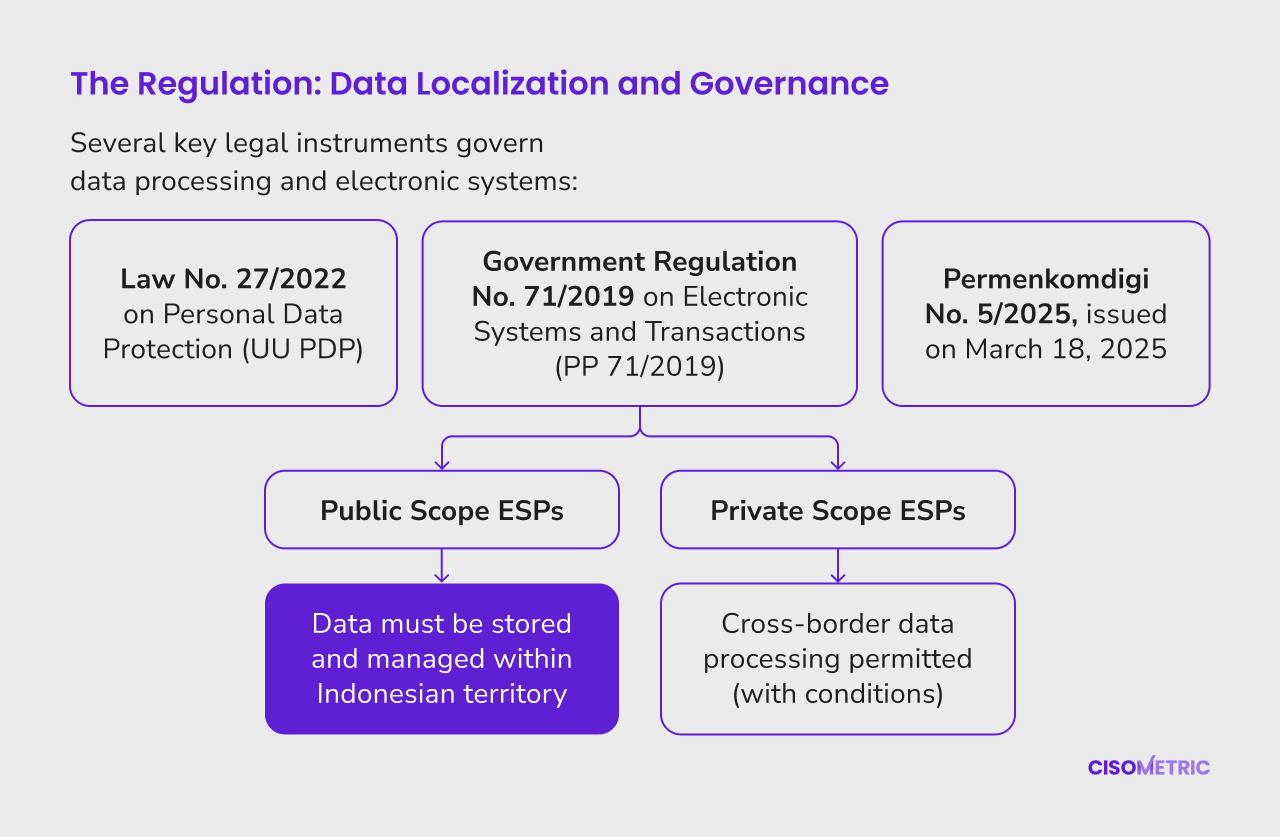
Several key legal instruments govern data processing and electronic systems:
Under PP 71/2019, Electronic System Providers (ESPs) are divided into:
For Public Scope ESPs, the obligation is explicit:
Data must be stored and managed within Indonesian territory.
Private Scope ESPs may process data offshore, provided that (Cloudmatika, 2025):
Permenkomdigi No. 5/2025 reinforces these obligations and introduces mandatory re-registration requirements. It also establishes progressive administrative sanctions (ranging from written warnings to suspension and delisting) for non-compliance after March 2026 (MEF, 2025).
This regulatory tightening reflects a broader emphasis on digital sovereignty and infrastructure control.
Not every organization operating in Indonesia falls under the same regulatory category.
However, the distinction between Public and Private Electronic System Providers is not always as straightforward as many assume. In practice, some private entities may unexpectedly fall within the Public ESP classification due to the nature of the services they provide.
Under Permenkomdigi No. 5/2025, a Public ESP is defined as:
This classification may extend beyond ministries and state agencies. Private companies that operate digital platforms or infrastructure on behalf of public institutions (such as healthcare portals, e-learning systems, public service platforms, or other government-facing applications) may also be designated as Public ESPs (MEF, 2025).
For entities that fall within this scope, data center localization is mandatory.
Understanding whether your organization qualifies as a Public ESP determines where your data infrastructure, including SOC operations, must be located.
When discussing regulatory compliance, organizations typically focus on:
However, the Security Operations Center is frequently excluded from this conversation, and this oversight can be significant.
SOC processes extensive volumes of operational and security-related data, often continuously and in real-time. Depending on context, this data may qualify as personal data under UU PDP, particularly where logs contain identifiable information.
Common data types transmitted to SOCs include (MindPoint Group, 2025):
Under Indonesia’s Personal Data Protection Law (UU PDP), certain data elements (such as IP addresses, user identifiers, and login records) may constitute personal data, particularly when they can be linked to identifiable individuals.
Accordingly, the geographic location \of SOC data processing becomes a regulatory consideration.
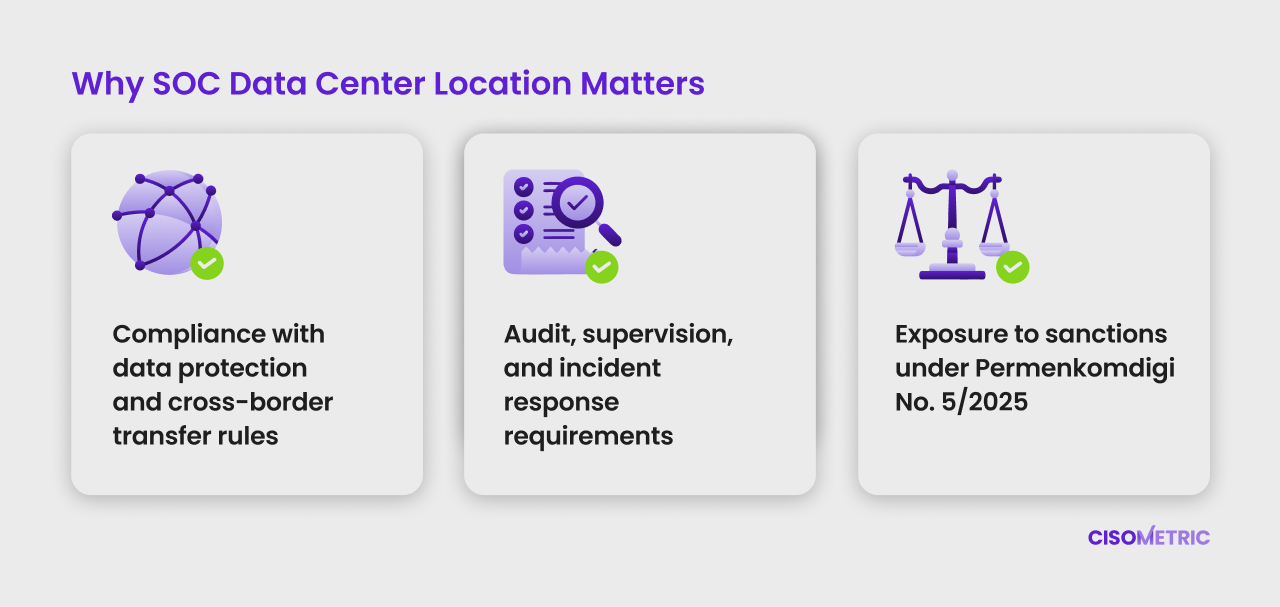
1. Compliance with data protection and cross-border transfer rules
The PDP Law permits cross-border transfers under specific conditions (ICLG, 2025):
Organizations must be able to demonstrate that such protection exists. Without clear documentation, cross-border SOC processing may expose the organization to compliance risk.
2. Audit, supervision, and incident response requirements
Electronic System Operators are subject to obligations under the EIT (Electronic Information and Transactions) Law in Indonesia and related regulations, including (ICLG, 2025):
If SOC data is processed outside Indonesia, practical challenges may arise during:
Operational latency, jurisdictional barriers, and documentation inconsistencies can complicate compliance during critical moments.
3. Exposure to sanctions under Permenkomdigi No. 5/2025
After March 2026, Public ESPs that fail to comply may face (MEF, 2025):
For organizations providing essential digital services, such sanctions may significantly disrupt operations and impact stakeholder trust.
Evaluating Your SOC: Compliance as a Governance Strategy
As regulatory scrutiny increases, evaluating your SOC infrastructure should no longer be treated as a purely technical review. It is a governance exercise.
For organizations utilizing SOC, several fundamental questions must be addressed:
These are not operational details to be delegated entirely to IT teams. They form part of a broader compliance and risk management framework, one that increasingly requires board-level visibility.
Indonesia’s evolving regulatory landscape reflects a wider global movement toward digital sovereignty, infrastructure accountability, and stricter oversight of electronic systems (MEF, 2025). In this context, SOC alignment is not merely about avoiding penalties.
Organizations that proactively ensure their SOC complies with national data center requirements can:
SOC evaluation should no longer focus solely on detection capability, response speed, or technicalities. Regulatory alignment must now be part of the conversation.
Organizations should assess:
In an environment where digital sovereignty and infrastructure governance are becoming more stringent (MEF, 2025), infrastructure decisions carry legal, operational, and reputational implications.
SOC misalignment can quietly introduce compliance exposure, particularly for Public ESPs or organizations supporting government institutions.
Cisometric’s SOC infrastructure is located within Indonesia. This positioning enables:
For organizations operating as Public ESPs (or those anticipating collaboration with public sector entities), local SOC infrastructure can significantly reduce regulatory friction.
If your organization has not yet evaluated the location and regulatory posture of its SOC infrastructure, now is the time.
Schedule a free consultation with our experts today, click here.
For more updates on digital scams, cybersecurity insights, and expert tips, follow our social media:
LinkedIn: Cisometric
Instagram: @cisometric
Youtube: @Cisometric
Reference:
Peraturan Kominfo tentang Data Center: Aspek Hukum di Indonesia
Navigating Indonesia’s New Data Regulation: What Public ESPs Must Do to Stay Compliant
What Types of Logs or Data Can Be Sent to a SOC?
Technology Sourcing Laws and Regulations Indonesia 2025-2026 (
Bagaimana ancaman berbasis AI mengubah operasional SOC? Simak perkembangan terbaru dan kapabilitas deteksi, investigasi, serta respons yang...

Panduan teknis CTI: 3 tingkatan CTI, klasifikasi stealer logs vs combolists, Scattered Spider help desk bypass, IMDS cloud, dan kepatuhan UU...

Panduan teknis membedah batas ukur MTTD dan MTTR, blindspot validasi triage analis, risiko under-classification SLA, dan kapasitas respons a...
Cari Artikel Berdasarkan Kategori
Kami menggunakan cookie untuk meningkatkan pengalaman menjelajah, menganalisis lalu lintas situs, dan menyajikan konten yang relevan. Pilih cookie mana yang Anda izinkan. Kebijakan Privasi