

Managed SIEM: Bring Your Own SIEM atau Platform Managed?
Membandingkan model Bring Your Own SIEM (BYOS) dan platform managed SIEM: kapabilitas deteksi, TCO aktual, biaya migrasi, dan matriks keputu...
By Cisometric Marketing Team, Published on May 5, 2026
For years, ransomware has been one of the most disruptive cyber threats facing organizations. It can lock critical files, stop business operations, trigger regulatory concerns, and put companies under intense pressure to recover quickly.
Also read: Understanding Malware Threats
But what happens when ransomware no longer depends only on pre-written code?
What happens when it can use artificial intelligence to scan files, generate attack scripts, decide what to encrypt, and even create a ransom note based on what it finds inside a victim’s system?
That is the concern raised by PromptLock, a new type of ransomware discovered by ESET researchers in August 2025. While it has not been observed in actual attacks and is currently believed to be a proof-of-concept or work in progress, PromptLock still gives businesses an important warning, that AI-powered cyber threats are no longer just theoretical (ESET, 2025; WeLiveSecurity, 2025).
And sometimes, a proof-of-concept is enough to show where the threat landscape may be heading next.
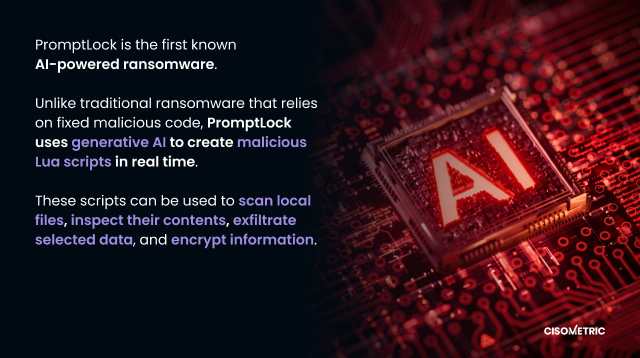
PromptLock is described by ESET as the first known AI-powered ransomware. Unlike traditional ransomware that relies on fixed malicious code, PromptLock uses generative AI to create malicious Lua scripts in real time. These scripts can be used to scan local files, inspect their contents, exfiltrate selected data, and encrypt information (ESET, 2025; WeLiveSecurity, 2025).
Technically, PromptLock is written in Golang, which allows it to work across multiple operating systems. It also uses SPECK 128-bit encryption and communicates with an open-source AI model, gpt-oss:20b, through the Ollama API to execute step-by-step instructions (ThaiCERT, 2025).
Golang, or Go, is the programming language used to build the main body of the malware. Known for being fast, lightweight, and cross-platform, Golang allows software to run across different operating systems such as Windows, macOS, and Linux. In PromptLock’s case, this helps the malware become more adaptable across different environments.
But the real concern is not only what PromptLock does, it is how it does it.
Instead of carrying every malicious instruction inside the malware from the beginning, PromptLock uses predefined prompts to make an AI model generate parts of the attack during execution. In simpler terms, the malware asks AI to help create parts of the attack as it goes.
Most ransomware follows a more predictable flow. It enters a system, looks for files, encrypts them, and leaves a ransom note. Security teams can often study the malware, identify patterns, and build detection rules based on known signatures, file hashes, or repeated behavior.
PromptLock makes that harder.
Because its malicious scripts are generated dynamically, the code may vary from one execution to another. This could cause Indicators of Compromise, or IoCs, to change each time the code runs, making detection and mitigation more difficult (ThaiCERT, 2025).
For businesses, if yesterday’s ransomware could be detected by recognizing its repeated patterns, tomorrow’s ransomware may be harder to identify because it can change its shape.
It is a bit like trying to recognize an intruder who changes clothes, route, language, and method every time they enter a building. You may still know something is wrong, but the usual wanted poster becomes less useful.
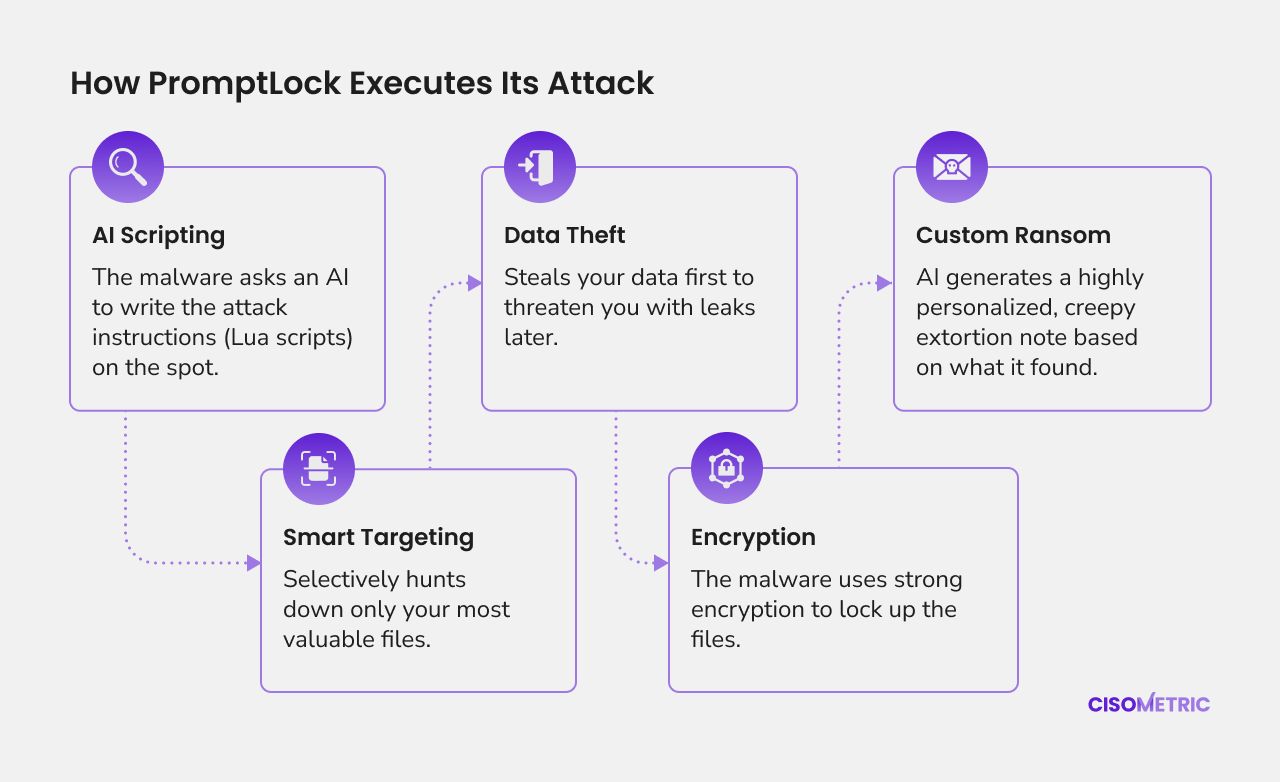
PromptLock’s attack flow can be understood in several key stages:
This is why PromptLock feels different, because it is able to automate ransomware, showing that it can adapt.
PromptLock has not been observed in real-world attacks.
PromptLock was not spotted in actual attacks and is instead believed to be a proof-of-concept or work in progress. ESET also later updated its findings after being contacted by the authors of an academic study whose research prototype closely resembled the PromptLock samples discovered on VirusTotal. This supported ESET’s belief that PromptLock was a proof-of-concept rather than fully operational malware deployed in the wild.
A proof-of-concept can still be a preview. It shows what is technically possible before the same idea is refined, copied, or adapted by real attackers.
With AI, attackers may not need to manually build every part of the malware. AI can help generate scripts, analyze environments, identify valuable files, and automate parts of the attack process. A well-configured AI model could make complex, self-adapting malware easier to create and harder for defenders to detect.
For businesses, this creates several important implications:
Also read: Understanding AI Governance: Risks, Rules, and Best Practices
Businesses need to move from reactive security to continuous, adaptive defense. That means combining prevention, detection, response, and recovery in a way that can keep up with evolving threats.
One important step is to strengthen behavior-based detection. Security tools should be able to detect unusual file access, mass file modification, suspicious encryption behavior, unexpected script execution, and abnormal outbound traffic. This becomes even more important when static indicators are no longer enough.
Another step is to monitor sensitive file changes. Ransomware often leaves traces before it creates full damage. If a system suddenly modifies, copies, deletes, or encrypts critical files, that activity should trigger immediate investigation. This is where File Integrity Monitoring, or FIM, can play an important role.
Also read: What is File Integrity Monitoring in SOC?
Organizations also need to strengthen access control. If ransomware enters through a user account with broad access, the impact can spread quickly. Least privilege, segmentation, and access control help limit how far an attack can go.
AI usage inside the organization should also be secured. Companies need visibility over which AI tools are being used, what data is being shared, and whether internal AI systems are properly monitored.
Finally, businesses need to prepare for a faster response. When attacks move faster, the response must also move faster. Security teams need automation, clear escalation paths, tested incident response playbooks, and reliable backup recovery procedures.
There is a simple lesson behind PromptLock, that attackers are experimenting with AI. So, defenders need to evolve too.
Defenders can also use AI to simulate attacks, strengthen analysis, and automate response. In this context, AI is not only a risk. It can also become part of the defense, as long as it is used with proper oversight and human validation.
This is where a modern Security Operations Center becomes highly relevant.
With Cisometric’s AI-powered SOC, organizations can strengthen their ability to monitor threats, detect suspicious behavior, analyze incidents, and respond more efficiently. AI can help security teams process large volumes of alerts and identify patterns that may be difficult to catch manually.
Cisometric also uses File Integrity Monitoring, which helps detect suspicious or unauthorized changes to critical files. If files are being deleted, copied, modified, or encrypted unexpectedly, FIM can help raise alerts before the damage becomes more significant.
Of course, FIM is not a standalone solution to ransomware. It should work together with broader security controls such as endpoint protection, access management, backup strategy, incident response planning, and continuous monitoring.
To learn more about how Cisometric’s AI-powered SOC and File Integrity Monitoring can help your business detect, respond to, and stay ahead of evolving cyber threats, contact us for further information.
Schedule a free consultation with our experts today to discuss your security needs, click here.
For more updates on digital scams, cybersecurity insights, and expert tips, follow our social media:
LinkedIn: Cisometric
Instagram: @cisometric
Youtube: @Cisometric
Reference:
ESET discovers PromptLock, the first AI-powered ransomware
PromptLock: AI Ransomware That Writes Its Own Attack Code in Real Time
First known AI-powered ransomware uncovered by ESET Research
Membandingkan model Bring Your Own SIEM (BYOS) dan platform managed SIEM: kapabilitas deteksi, TCO aktual, biaya migrasi, dan matriks keputu...

Perbandingan mendalam In-House SOC dan Managed SOC berdasarkan biaya operasional, kebutuhan analis 24/7, regulasi OJK dan BI, serta kesiapan...
Explore how AI-powered threats are changing attack speed, scale, and autonomy, and what SOC teams need to strengthen detection, investigatio...
Search Article by Category
We use cookies to enhance your browsing experience, analyse site traffic, and deliver relevant content. Choose which cookies you allow. Privacy Policy