
Managed SIEM: Bring Your Own SIEM atau Platform Managed?
Membandingkan model Bring Your Own SIEM (BYOS) dan platform managed SIEM: kapabilitas deteksi, TCO aktual, biaya migrasi, dan matriks keputu...

Oleh Cisometric Marketing Team, Diterbitkan pada April 6, 2026
Consider this scenario, where someone (whether an external attacker or an internal user) quietly modifies a configuration file on one of your servers. No alerts are triggered, and no one notices.
Weeks later, that change becomes the entry point for a full-scale breach.
This happens more often than most organizations realize, and this is precisely the kind of threat that File Integrity Monitoring (FIM) is designed to detect.
If your Security Operations Center (SOC) isn't leveraging it, there's a critical blind spot in your security posture.
FIM is a security process that continuously monitors critical files, including operating system components, application configurations, databases, and logs, and flags when unauthorized or unexpected changes occur (BeyondTrust).It functions, in many ways, like a security camera for your file system. It may not prevent someone from entering, but the moment something is altered, your team knows about it (Tahir, 2025).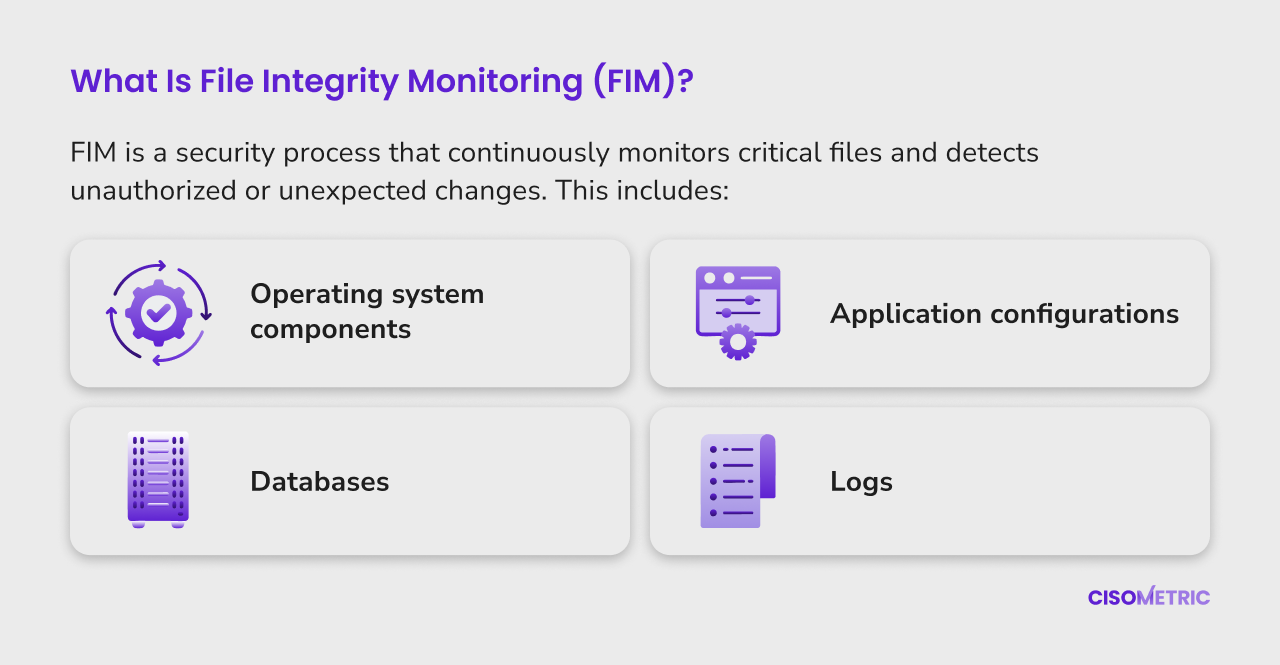
FIM operates through two primary approaches, reactive auditing, which examines changes forensically after the fact, and proactive monitoring, which applies predefined rules to flag suspicious modifications in real time (CrowdStrike, 2024).
The underlying process is methodical but straightforward (Tahir, 2025; Crowdstrike, 2024):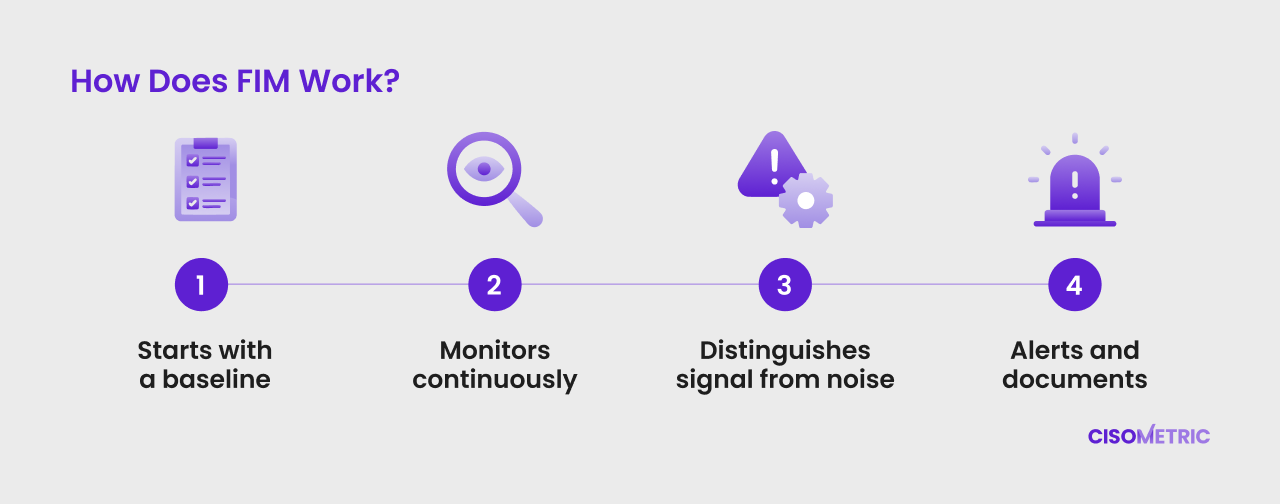
FIM takes a cryptographic snapshot of critical files, capturing their contents, permissions, hash values, configurations, and attributes.
This snapshot becomes the trusted reference state against which all future comparisons are made.
2. It monitors continuously
At defined intervals, whether in real time, hourly, or daily, FIM rescans those files and compares the current state to the baseline. If a file's hash value has changed, something has been modified.
3. It distinguishes signal from noise
Not every change signals a threat.
Software updates, patches, and routine administrative actions all modify files. Effective FIM solutions whitelist expected changes so security teams can focus on what actually matters.
4. It alerts and documents
When an unexpected modification is detected, FIM generates an alert and records key details, such as who made the change, when it occurred, and from where. This audit trail proves invaluable during investigation and incident response.
68% of breaches involve some form of file tampering (Verizon DBIR, 2024). That means it represents the majority of incidents.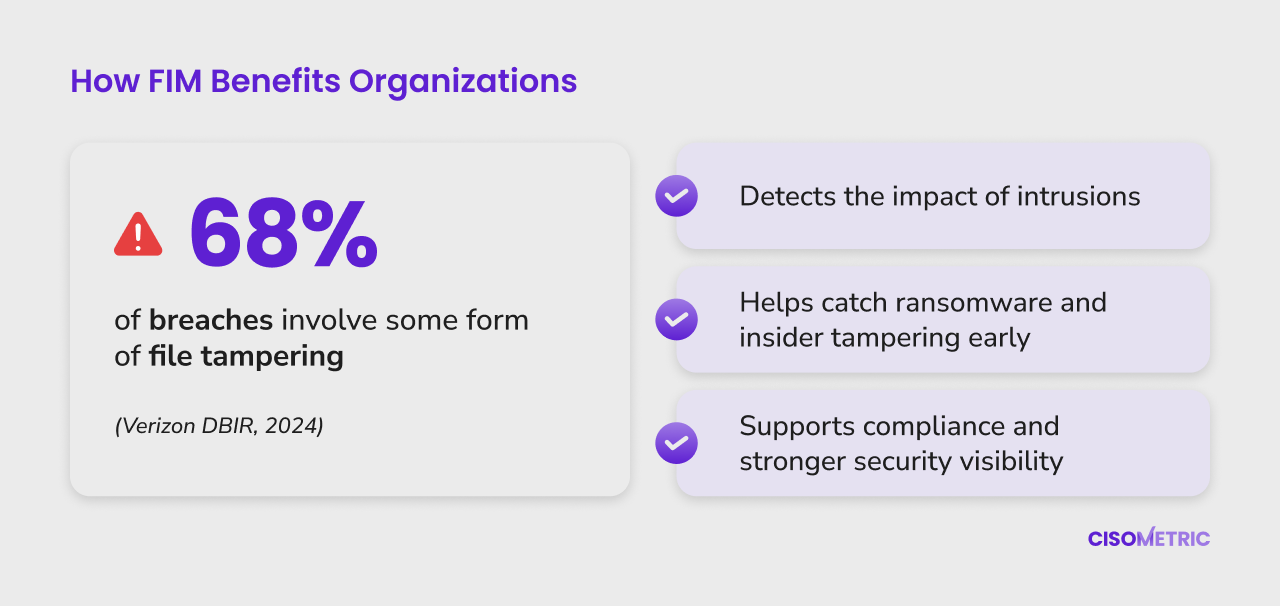
Most security tools are designed to prevent intrusion. Firewalls guard the perimeter, antivirus scans for known malware, Security Information and Event Management (SIEM) aggregate and analyze logs.
But what happens when an attacker gets past all of those defenses? Because they do, and with increasing frequency.
FIM addresses that gap. It doesn't just monitor for intrusions, it monitors for the consequences of intrusions as well (Tahir, 2025). If ransomware begins encrypting files, FIM can detect the sudden mass modifications before the damage becomes irreversible. If an insider alters log files to conceal unauthorized activity, FIM catches the discrepancy.
Then there's the compliance dimension.
Regulatory frameworks such as Payment Card Industry Data Security Standard (PCI DSS, Requirement 11.5), Health Insurance Portability and Accountability Act (HIPAA), Sarbanes-Oxley Act (SOX), and General Data Protection Regulation (GDPR) mandate FIM (CrowdStrike, 2024; Palo Alto Networks, 2025). Without FIM in place, meeting audit requirements becomes significantly more difficult.
FIM also integrates naturally into modern security architectures. It feeds correlated alerts into SIEM platforms, adds file-level visibility to Endpoint Detection and Response (EDR) solutions, and reinforces Zero Trust models by continuously verifying that no unauthorized changes have occurred.
For organizations still weighing the investment of FIM, consider these (Tahir, 2025):
1. Ransomware modifies before it encrypts
A well-configured FIM system can detect the early indicators of ransomware, such as sudden, widespread file modifications, before encryption completes. The 2017 NotPetya attack, for example, altered the Master Boot Record before beginning encryption. FIM would have flagged that change immediately.
2. Insider threats operate in the shadows
Whether through compromised credentials or malicious intent, insiders often cover their tracks by editing logs or altering configurations. FIM makes such tampering significantly harder to conceal.
3. Cloud environments are equally vulnerable
Misconfigured storage buckets, unauthorized Identity and Access Management (IAM) role changes, and tampered Continuous Integration/Continuous Deployment (CI/CD) pipelines all represent risks that extend beyond traditional infrastructure. FIM provides the same file-level vigilance across cloud and DevOps environments.
Key Use Cases for FIM
Where does FIM deliver the most value? These are the scenarios that best picture it (BeyondTrust; CrowdStrike, 2024):
During the initial stages of a sophisticated attack, adversaries frequently modify OS or application files. Even if they alter log files to mask their activity, FIM identifies the inconsistency because it validates files against a cryptographic baseline, not just against logs.
Not every harmful modification comes from an attacker. An administrator may alter a configuration that introduces a vulnerability or disrupts operations. FIM pinpoints exactly what changed, enabling rapid rollback and remediation.
After deploying updates across your environment, FIM can confirm whether files have been patched to the correct version on every machine. It's a straightforward but highly effective way to maintain system health.
With regulations requiring organizations to monitor, audit, and report on file-level changes, FIM provides the documentation and audit trails that compliance teams depend on.
This is where strategy meets execution.
Many organizations deploy FIM as a standalone solution, complete with its own agent, management console, and event forwarding pipeline. That approach works, but it adds complexity.
More tools to maintain, more integrations to manage, and more potential gaps between systems (Palo Alto Networks, 2025).
There's a more streamlined alternative.
Cisometric's SOC integrates File Integrity Monitoring directly into its security operations.
Rather than introducing another standalone product, Cisometric embeds FIM within a unified platform. Your critical files, system configurations, and application data are continuously monitored within the same environment that handles threat detection and incident response.
When FIM identifies an anomaly, the alert doesn't sit in a separate dashboard waiting to be noticed. It feeds directly into the SOC's investigation and response workflow, ensuring that every change is analyzed promptly and acted upon decisively.
Also read: What Makes a Next Gen SOC and Why Your Business Needs One Now
One platform, one integration, and with complete visibility.
Schedule a free consultation with our experts today to discuss your security needs, click here.
For more updates on digital scams, cybersecurity insights, and expert tips, follow our social media:
LinkedIn: Cisometric
Instagram: @cisometric
Youtube: @Cisometric
Membandingkan model Bring Your Own SIEM (BYOS) dan platform managed SIEM: kapabilitas deteksi, TCO aktual, biaya migrasi, dan matriks keputu...

Perbandingan mendalam In-House SOC dan Managed SOC berdasarkan biaya operasional, kebutuhan analis 24/7, regulasi OJK dan BI, serta kesiapan...

Bagaimana ancaman berbasis AI mengubah operasional SOC? Simak perkembangan terbaru dan kapabilitas deteksi, investigasi, serta respons yang...
Cari Artikel Berdasarkan Kategori
Kami menggunakan cookie untuk meningkatkan pengalaman menjelajah, menganalisis lalu lintas situs, dan menyajikan konten yang relevan. Pilih cookie mana yang Anda izinkan. Kebijakan Privasi