Penerapan ISO 42001 dalam Tata Kelola AI Organisasi
Amankan operasional AI organisasi dengan ISO 42001. Pelajari kerangka kerja tata kelola, mitigasi risiko keamanan, dan langkah sukses audit.

By Cisometric Marketing Team, Published on May 14, 2026
Cisometric AI Governance: Helping Organizations Manage AI Risk with Confidence
Artificial Intelligence is becoming increasingly embedded in business operations, as it supports how teams analyze data, automate workflows, detect risks, generate content, assist customers, and support decision-making.
As adoption grows, the challenge for organizations is whether AI is being used with the right controls.
Without proper governance, AI can introduce risks that are difficult to detect early. These may include biased outcomes, privacy violations, unclear accountability, regulatory exposure, security gaps, operational disruption, and reputational damage.
This is why Cisometric is introducing AI Governance service, a structured service designed to help organizations evaluate, manage, and oversee AI-related risks across the AI lifecycle.
Through this service, Cisometric helps organizations implement practical, risk-based AI Governance frameworks that support ethical AI use, regulatory alignment, clear accountability, and appropriate safeguards.
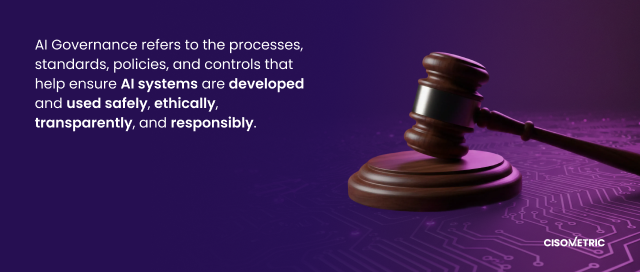
AI Governance refers to the processes, standards, policies, and controls that help ensure AI systems are developed and used safely, ethically, transparently, and responsibly.
These questions matter because AI risk does not only appear during development. It can emerge across the full AI lifecycle, from data collection and model design to deployment, monitoring, user interaction, and ongoing system improvement.
Without clear governance, organizations may face risks such as bias and unfair outcomes, lack of transparency and explainability, data misuse, privacy violations, regulatory exposure, operational disruption, and security weaknesses.
AI Governance helps turn these risks into something organizations can identify, assess, manage, and monitor.
Also read: Understanding AI Governance: Risks, Rules, and Best Practices
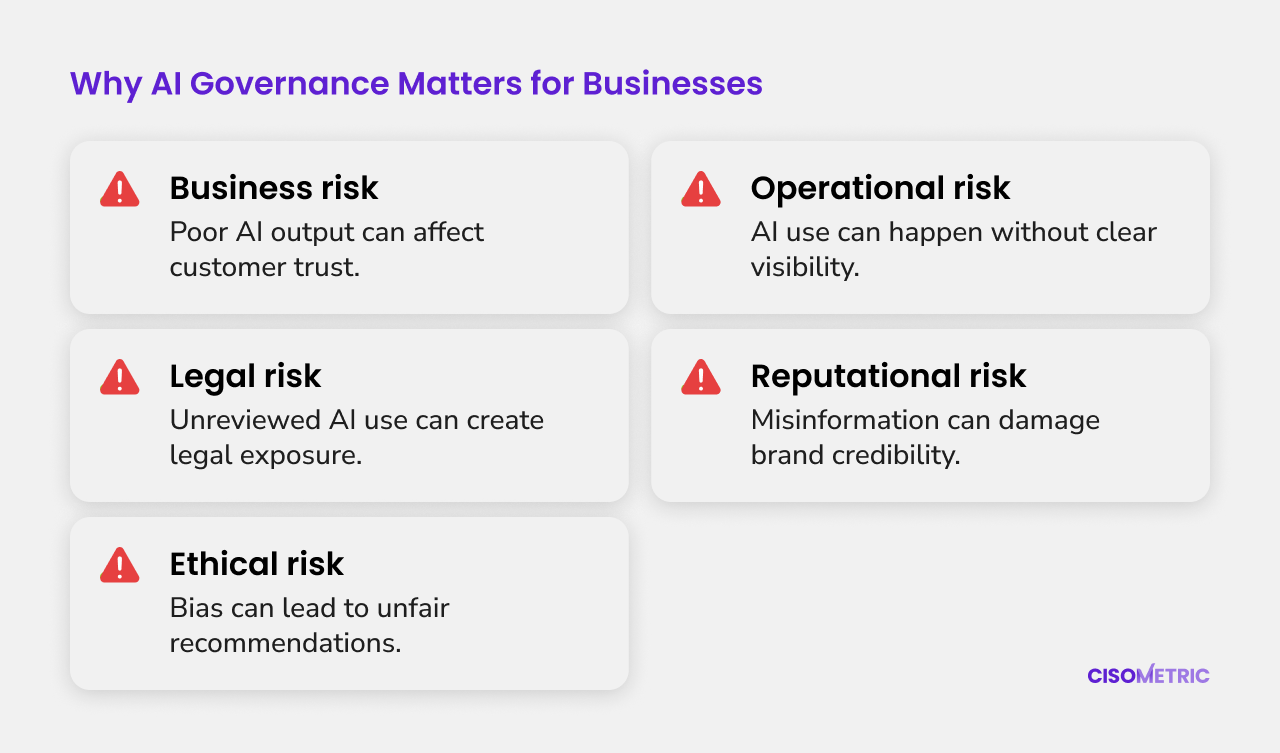
AI risk is a business, legal, ethical, operational, and reputational issue.
A system that produces biased recommendations can affect customer trust. An AI tool that processes sensitive data without the right safeguards can create privacy and compliance concerns. An AI-generated output used without proper review can create misinformation, legal exposure, or poor business decisions.
80% of business leaders see AI explainability, ethics, bias, or trust as a major roadblock to generative AI adoption (IBM, 2026).
A 2025 survey also found that organizations with real-time AI monitoring and formal oversight committees were 34% more likely to report revenue growth and 65% more likely to report cost savings. At the same time, 99% of organizations reported financial losses linked to AI risks, with 64% losing more than US$1 million (Swiss Cyber Institute, 2026).
AI can create measurable business value, but AI-related risks can also create measurable business losses. For many organizations, the challenge is that AI adoption often happens faster than governance.
Teams may already be using AI tools for drafting, analysis, customer communication, coding, research, or internal decision support. Some of these tools may be approved, others may not. In some cases, leadership may not have full visibility over what tools are being used, what data is being entered, and how AI-generated outputs are being applied.
This is where AI Governance becomes essential.
It helps organizations move from informal use to controlled adoption, with clearer rules, risk assessment, accountability, monitoring, and safeguards.
AI Governance is increasingly becoming part of global business expectations.
Organizations are beginning to use recognized frameworks to structure AI risk management, internal controls, accountability, and monitoring. These frameworks provide a common language for responsible AI use and help organizations demonstrate that their AI systems are governed properly:
Together, these frameworks show that AI Governance is becoming part of enterprise risk management, cybersecurity, data governance, compliance, and business resilience.
AI Governance is also becoming increasingly relevant in Indonesia.
Indonesia’s AI regulatory direction is evolving toward a more formal, risk-based framework led by institutions such as the Ministry of Communication and Digital Affairs, or Komdigi, and the Financial Services Authority, or OJK.
Indonesia already has the National Strategy for Artificial Intelligence 2020–2045, which positions AI as part of the country’s long-term digital development agenda. Indonesia also has the Personal Data Protection Law, or UU PDP, which is highly relevant to AI systems that process personal data, including data used for training, inference, profiling, or automated decision support (Indonesia AI Regulations Overview, 2026).
In 2023, Komdigi issued Circular Letter No. 9 of 2023 on AI Ethics, which introduced ethical values for AI development and use. These values include inclusivity, humanity, security, accessibility, transparency, credibility and accountability, personal data protection, sustainable environment, and intellectual property.
In 2025, Komdigi also opened public consultation for the National AI Roadmap White Paper and the Concept of AI Ethics Guidelines, reflecting Indonesia’s move toward a more structured AI policy direction.
The financial sector has moved even more specifically. OJK introduced guidance on AI Governance for Indonesian Banking in 2025 to support responsible AI development and implementation in the banking sector. This guidance emphasizes areas such as end-to-end governance, risk assessment, accountability, transparency, data protection, and human oversight.
For businesses in Indonesia, these developments show that AI Governance should not only be seen as an international best practice, but also becoming part of the local regulatory and compliance. Organizations that begin building AI Governance earlier will be better positioned to adapt as regulatory expectations become more formal.
Cisometric’s AI Governance is designed to help organizations build governance that is practical, risk-based, and aligned with both global standards and Indonesia’s developing regulatory landscape.
The service is designed to help organizations understand their actual AI maturity, identify relevant risks, and define appropriate controls based on their business use cases.
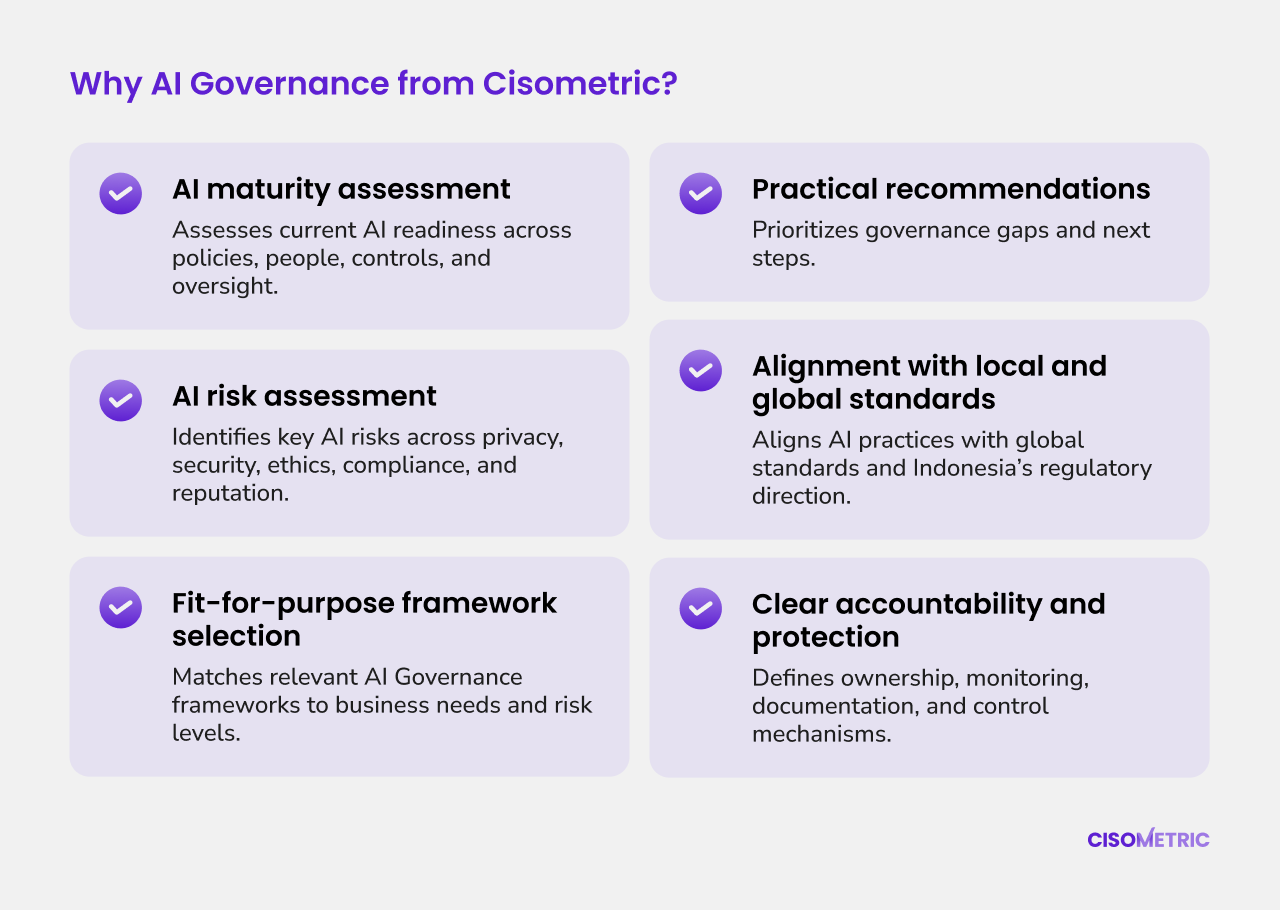
Cisometric helps organizations assess their current readiness across policy, process, people, accountability, controls, and oversight. This gives businesses a clearer view of where they stand before building or expanding AI Governance.
The service helps identify AI-related risks across areas such as ethics, transparency, explainability, data privacy, security, regulatory exposure, operational reliability, and reputational impact.
Different organizations have different AI use cases, risk levels, and regulatory exposure. Cisometric helps select and apply relevant governance frameworks based on organizational needs, including ISO/IEC 42001:2023, NIST AI RMF, COBIT 2019, and the OECD AI Principles.
Cisometric provides prioritized recommendations that help organizations understand which governance gaps should be addressed first and what actions need to be taken.
Cisometric helps organizations connect international AI Governance practices with Indonesian regulatory direction, including developments from Komdigi, OJK, and data protection requirements under Indonesia’s Personal Data Protection Law.
The service helps organizations define ownership, oversight, documentation, monitoring, and control mechanisms so AI can be used responsibly across teams and business functions.
This approach allows organizations to adopt AI with stronger confidence, instead of relying on fragmented policies or informal internal practices.
Cisometric also applies a risk-driven approach.
AI risks are evaluated based on the organization’s business use case, system characteristics, data sensitivity, regulatory exposure, and potential impact on individuals, customers, or operations.
A lower-risk use case may need basic controls, such as approved tool usage, data handling rules, and human review. A higher-risk AI system may require stronger safeguards, including formal risk assessment, documentation, audit trails, explainability review, security testing, human oversight, and continuous monitoring.
Cisometric’s AI Governance service can help organizations assess AI governance readiness and risk exposure across several control areas:
This includes accountability, AI policy, AI asset management, ownership, approval processes, and risk management.
This includes data quality, data protection, privacy safeguards, AI incident management, and security controls for AI systems.
This includes data flow mapping, version control, change management, monitoring, logging, and ongoing review.
This includes project management, ideation, design, development, testing, deployment, and post-deployment monitoring.
This includes legal exposure, regulatory obligations, contracts, documentation, and compliance requirements.
This includes consent management, bias management, transparency, explainability, and human oversight.
An AI Governance engagement should provide more than a high-level policy recommendation. It should help organizations make better decisions about AI use, risk, and accountability.
With Cisometric’s AI Governance service, organizations can gain:
This is especially important for organizations that are already using AI in sensitive, regulated, or high-impact areas.
AI Governance requires the ability to connect cybersecurity, data protection, regulatory context, enterprise risk management, governance frameworks, and business operations.
Cisometric brings three key strengths to support organizations in this area:
Cisometric’s AI Governance service is delivered by consultants with internationally recognized AI Governance credentials, including the first ISACA AAIA-certified professional in Indonesia and team members who have completed ISO/IEC 42001 training programs.
This gives organizations access to a team that understands both the governance framework and the practical implementation requirements behind responsible AI use.
Cisometric evaluates AI risks based on business use case, regulatory exposure, system characteristics, data sensitivity, and governance needs.
This helps organizations implement controls that are proportionate, relevant, and practical. High-risk systems receive stronger oversight, while lower-risk use cases remain manageable without unnecessary complexity.
Cisometric helps organizations connect global AI Governance frameworks with Indonesian regulatory guidance.
This is important for organizations operating in Indonesia, especially as Komdigi, OJK, UU PDP, and future AI-related developments continue to shape the local compliance landscape.
AI adoption will continue to grow across industries. However, long-term value from AI will depend not only on how quickly organizations adopt the technology, but also on how responsibly they govern it.
When AI systems process sensitive data, influence decisions, support customer interactions, or affect business operations, organizations need to show that risks are understood and controls are in place.
Strengthen your AI accountability, risk control, and regulatory readiness with Cisometric AI Governance.
Contact our team to learn how your organization can start building responsible, secure, and trustworthy AI practices.
For more updates on cybersecurity insights, follow our social media:
LinkedIn: Cisometric
Instagram: @cisometric
Youtube: @Cisometric
Reference:
Indonesia AI Regulation Overview
Membangun AI Governance yang Etis di Indonesia 2026 - ITGID
AI governance in business: The rules, risks, and responsibilities leaders can't ignore
Amankan operasional AI organisasi dengan ISO 42001. Pelajari kerangka kerja tata kelola, mitigasi risiko keamanan, dan langkah sukses audit.

In August 2025, a young woman from Makassar known publicly as NR reported her ex-husband to the police on allegations of sexual violence. As...

Welcome to the era of agentic AI, a new breed of artificial intelligence that doesn't just respond to prompts. It thinks, plans, and acts on...
Search Article by Category
We use cookies to enhance your browsing experience, analyse site traffic, and deliver relevant content. Choose which cookies you allow. Privacy Policy