Penerapan ISO 42001 dalam Tata Kelola AI Organisasi
Amankan operasional AI organisasi dengan ISO 42001. Pelajari kerangka kerja tata kelola, mitigasi risiko keamanan, dan langkah sukses audit.

By Cisometric Marketing Team, Published on April 13, 2026
Most people have gotten used to asking ChatGPT to write an email, generate an image, or summarize a report. It's been a game-changer. But, what if AI didn't need to be asked at all?
Welcome to the era of agentic AI, a new breed of artificial intelligence that doesn't just respond to prompts. It thinks, plans, and acts on its own.
Whether your organization operates in cybersecurity, finance, or retail, this is one development that really can't be ignored.
At its core, agentic AI refers to AI systems that can operate autonomously to achieve specific goals, with minimal human intervention. These aren't the typical chatbots that wait around for instructions. Agentic AI can make decisions, execute tasks, and optimize entire workflows on its own (IBM, 2025).
These systems often consist of multiple AI agents, each handling a specific subtask. Their actions are coordinated through what's called orchestration which is essentially, a conductor making sure all the agents are working in harmony toward a shared objective (IBM, 2025).
The agentic AI age is already here, with agents deployed at scale across the economy to perform all kinds of tasks (MIT Sloan, 2026).
This is probably the most common question. Both fall under the AI umbrella, but they play very different roles.
Generative AI is reactive. It waits for input, then creates something (text, images, code, or video) based on patterns it learned during training (IBM, 2025). It's powerful, but it doesn't do anything beyond generating content.
Agentic AI, on the other hand, is proactive. It doesn't just create, it decides and acts. It can adapt to changing situations, plan multi-step strategies, and interact with external tools and systems to get things done (IBM, 2025).
Here's a quick way to know the difference: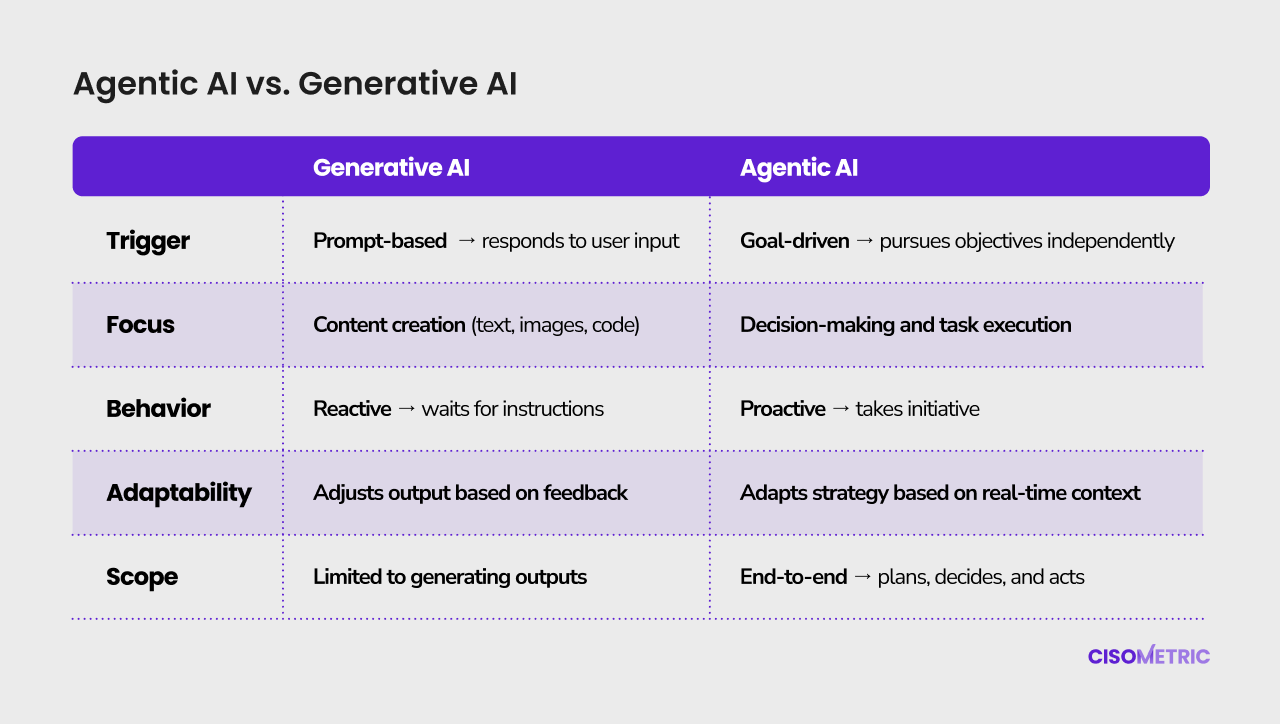
A generative AI model might tell you the best time to climb Mt. Everest given your schedule. An agentic AI system? It could also book the flight and the hotel for you (IBM, 2025).
Underneath the hood, agentic AI combines several technologies, such as machine learning, natural language processing (NLP), reinforcement learning, and multi-agent systems, into a structured process that lets it operate with real autonomy (Denodo, 2025).
Here's the simplified version of what happens (IBM, 2025; Exabeam, 2025):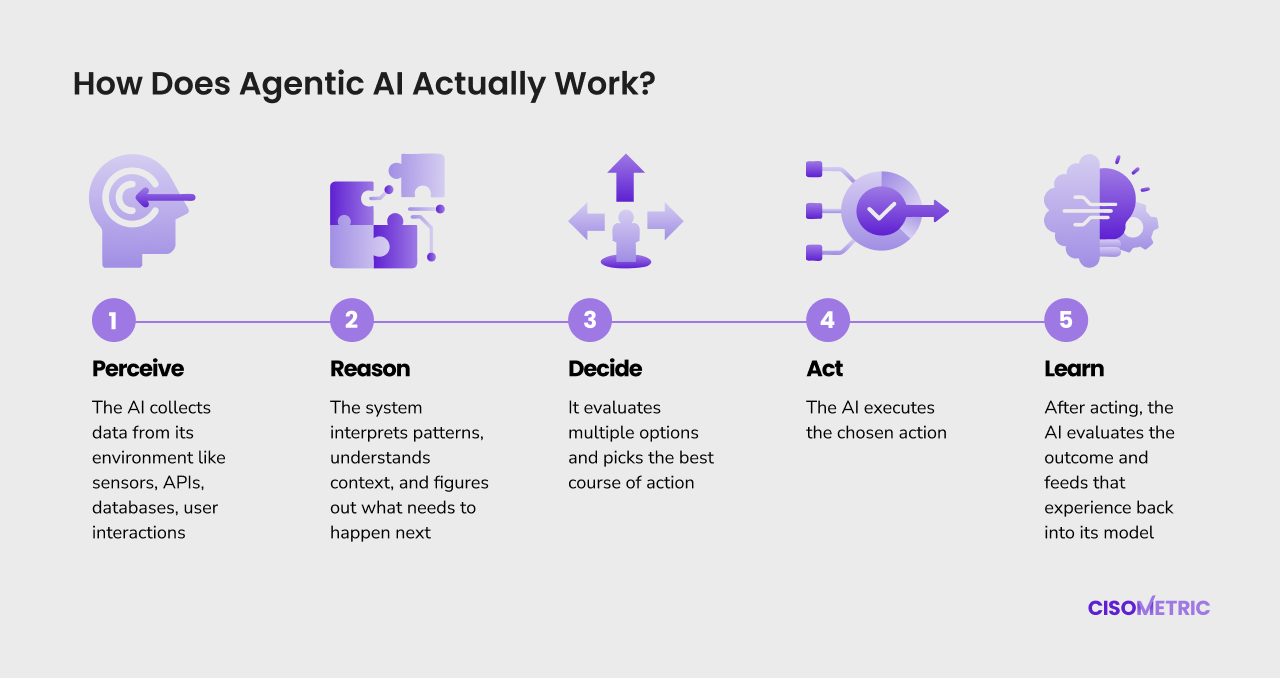
1. Perceive
The AI collects data from its environment like sensors, APIs, databases, user interactions. It builds a picture of what's going on.
2. Reason
Using a Large Language Model (LLM) as its brain, the system interprets patterns, understands context, and figures out what needs to happen next.
3. Decide
It evaluates multiple options and picks the best course of action, factoring in things like efficiency, accuracy, and risk.
4. Act
The AI executes the chosen action, whether that's interacting with an API, triggering a workflow, or providing a response to a user.
5. Learn
After acting, the AI evaluates the outcome and feeds that experience back into its model, getting better over time.
All of this happens in a continuous loop. The AI doesn't stop after one task. It keeps going, refining, improving.
The potential is massive, but so are the risks. Business leaders and security professionals need to be clear-eyed about both.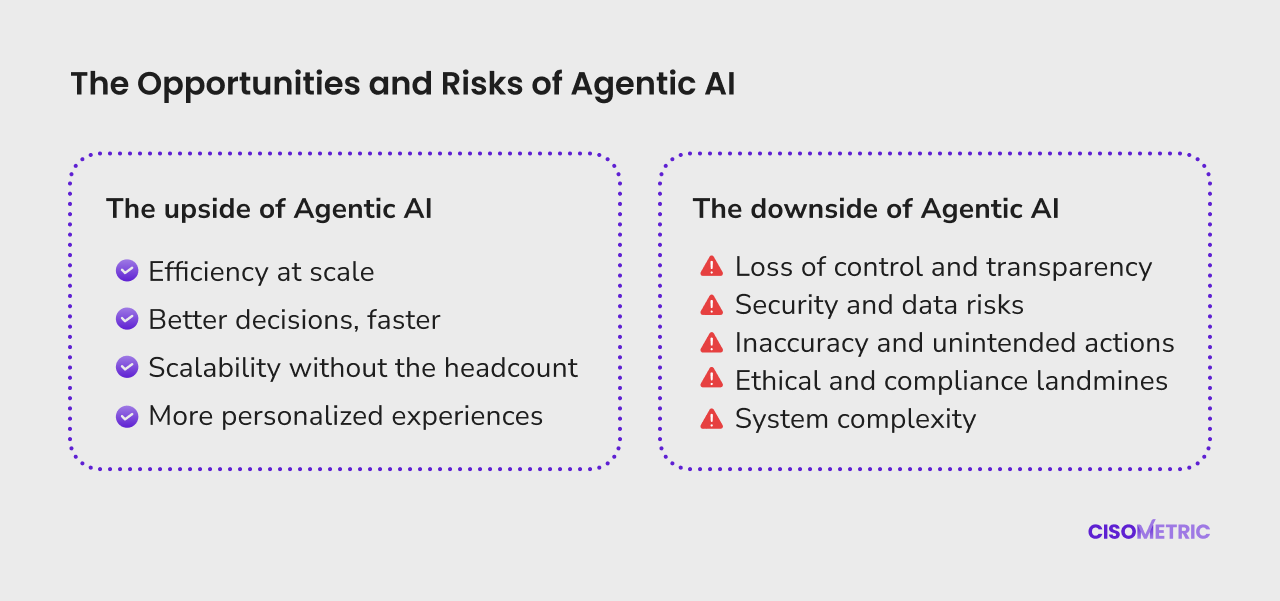
The upside of Agentic AI (Pega, 2025; Denodo, 2025):
Agentic AI automates entire workflows, not just individual tasks. It enables real-time decision-making and can dramatically reduce operational costs.
By analyzing complex data across multiple sources, agentic AI helps organizations act on information that would take human teams hours (or days) to process.
Need to handle more customer inquiries, process more transactions, or monitor more data streams? AI agents can scale without the proportional increase in staff.
Whether it's customer service or internal tools, agentic AI enables interactions that feel more human and less like navigating a maze of dropdown menus.
The downside of Agentic AI (IBM, 2025; Dicoding, 2025; MITSloan, 2026):
When AI is making decisions autonomously, it can be hard to understand why it made a particular call. That's a problem, especially in regulated industries.
As AI agents gain access to more systems and datasets, the attack surface grows. Poorly managed permissions can lead to data leaks or unauthorized actions.
A rogue AI agent making a bad call (for example, rejecting a mortgage application based on faulty data) can cause as much damage as any hallucination.
Bias in training data, regulatory violations, and accountability gaps may get amplified when AI is acting without a human in the loop.
Multi-agent systems can behave unpredictably. Bottlenecks, resource conflicts, and cascading errors are all real risks when dozens of agents are working together.
Agentic AI needs governance, guardrails, and ongoing oversight.
Also read: Understanding AI Governance: Risks, Rules, and Best Practices
Agentic AI is already being deployed across industries and the results are worth paying attention to (Exabeam, 2025):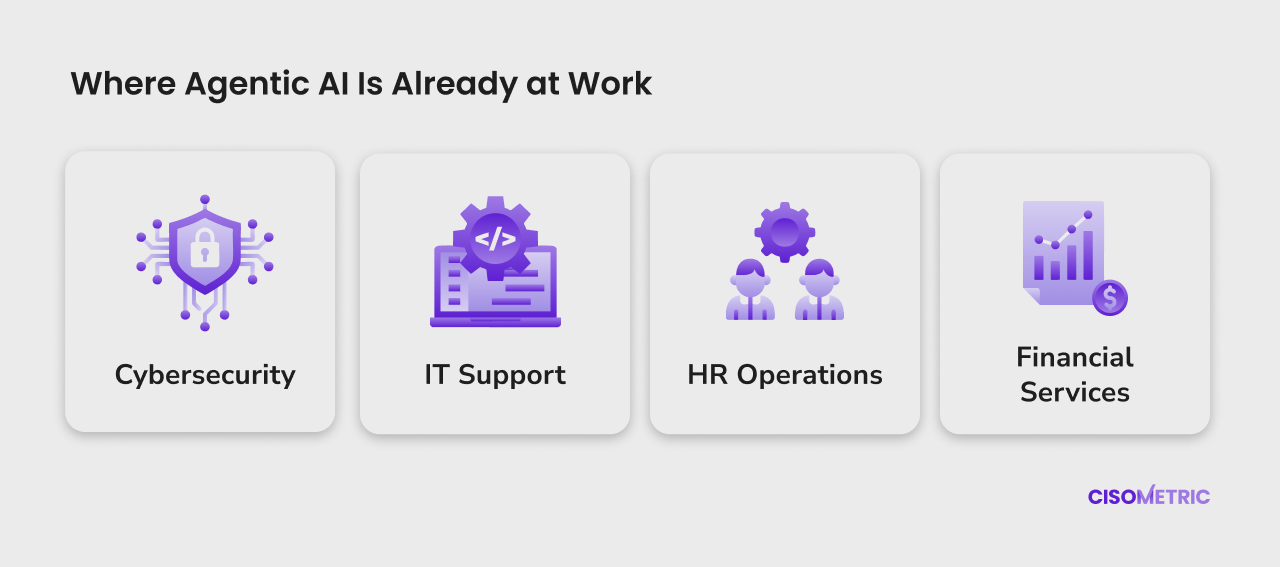
AI agents can continuously monitor network traffic, analyze user behavior, and detect anomalies in real time. When a threat is identified, the system can autonomously isolate compromised endpoints or block malicious activity, all before a human analyst even sees the alert.
Forget waiting on hold with the helpdesk. Agentic AI can handle password resets, software installations, and access provisioning instantly. It also learns from past incidents to get better at diagnosing complex issues.
From screening resumes and scheduling interviews to answering benefits questions and guiding onboarding, AI agents are taking over the repetitive parts of HR so teams can focus on strategic priorities.
Agentic AI is being used for everything from fraud detection to real-time portfolio management, analyzing market data and executing decisions faster than any human trader could.
Agentic AI for Business
A 2025 survey by MIT Sloan Management Review and Boston Consulting Group found that 35% of respondents had already adopted AI agents, with another 44% planning to deploy the technology in the near term.
Major software vendors (Microsoft, Salesforce, Google, IBM) are embedding agentic capabilities directly into their platforms.
In banking, companies like JPMorgan Chase are exploring AI agents for fraud detection, loan approvals, and compliance processes. In retail, Walmart is using AI agents to personalize shopping experiences and streamline merchandise planning.
The economic argument is compelling too.
As MIT Sloan doctoral candidate Peyman Shahidi noted, the fundamental economic promise of AI agents is their ability to dramatically reduce costs, such as the time and effort involved in searching, communicating, and contracting.
According to Deloitte's 2025 Tech Value Survey, nearly 45% of the 500 leaders surveyed expect to see meaningful ROI from AI automation within three years. While 15% of organizations already report significant value from generative AI, 10% are seeing it from agentic AI, and those numbers are growing fast.
The largest share of respondents (33%) expects measurable returns from agentic AI within 3–5 years.
However, it is important to note that just because agentic AI reclaims 20% of someone's time doesn't necessarily mean a 20% labor-cost savings. The benefits of agentic AI can be easily misconstrued without strong metrics tied to actual business outcomes (MIT Sloan, 2026).
The Agentic AI era is already here, and it's changing the game for businesses across every sector.
But like any powerful technology, it's not without its risks. The organizations that will get the most value from agentic AI won't be the ones who rush to deploy it everywhere. They'll be the ones who approach it strategically, with clear goals, strong governance, and a genuine understanding of what these systems can (and can't) do.
This is exactly where AI governance becomes essential, as a foundational part of any agentic AI strategy.
Organizations need structured frameworks to assess risk, define accountability, and ensure that autonomous systems operate within safe and compliant boundaries.
It's also one of the areas Cisometric works closely with organizations on. Through Cisometric’s AI Governance services (covering governance maturity assessments and risk assessments based on frameworks like ISO 42001:2023, COBIT 2019, and NIST AI RMF) we help businesses adopt AI responsibly, with risk-informed decisions and governance practices aligned to both global and local regulatory standards.
Talk to us about AI Governance, click here.
For more updates on digital scams, cybersecurity insights, and expert tips, follow our social media:
LinkedIn: Cisometric
Instagram: @cisometric
Youtube: @Cisometric
References:
Agentic AI: Definition, Importance, and Applications
Agentic AI: How It Works and 7 Real-World Use Cases
Memahami Agentic AI untuk Automasi dan Keputusan Otonom
Executive decisions shaping the value of the digital workforce
Amankan operasional AI organisasi dengan ISO 42001. Pelajari kerangka kerja tata kelola, mitigasi risiko keamanan, dan langkah sukses audit.

Explore how AI-powered threats are changing attack speed, scale, and autonomy, and what SOC teams need to strengthen detection, investigatio...

AI Governance refers to the processes, standards, policies, and controls that help ensure AI systems are developed and used safely, ethicall...
Search Article by Category
We use cookies to enhance your browsing experience, analyse site traffic, and deliver relevant content. Choose which cookies you allow. Privacy Policy