By Patricia A. Pramono • Studio 1080, Published on November 15, 2025
TABLE OF CONTENTS
When businesses discuss cybersecurity, the conversation often revolves around advanced threats, AI-powered defenses, or complex ransomware attacks. But as recent events in the United Kingdom have shown, sometimes the biggest risks stem from something considered very basic, a weak password.
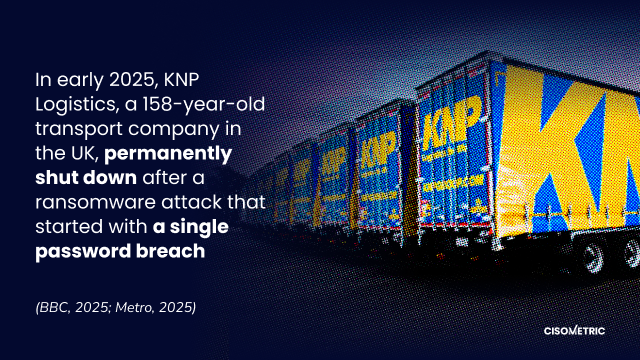
In early 2025, KNP Logistics, a 158-year-old transport company in the UK, permanently shut down after a ransomware attack that started with a single password breach (BBC, 2025; Metro, 2025).
It’s a massive reminder that in cybersecurity, the smallest lapse in human behavior can lead to the largest consequences.
Also read: Cybersecurity Weakest Link: The Human Factor
A 158-Year Legacy Ended by One Password
According to reports, the ransomware group known as Akira infiltrated KNP’s systems after successfully guessing an employee’s password. Once inside, they encrypted the company’s data, locked internal systems, and demanded a ransom estimated at £5 million (BBC, 2025).
Ransomware is a type of malicious software designed to block access to a company’s files or systems until a ransom is paid. In many cases, attackers threaten to leak stolen data publicly if the victim refuses to comply. This dual-pressure tactic (operational paralysis and data exposure) often leaves organisations with few options but to pay or shut down.
KNP couldn’t afford the ransom. Without access to its operational data, delivery schedules, or internal systems, the company was forced to cease operations entirely, leaving 700 employees jobless and ending a business that had been running for over a century and a half (Daily Record, 2025).
The UK’s National Cyber Security Centre (NCSC) has reported a surge in similar incidents, noting that attackers often don’t rely on new tactics, they simply exploit weak passwords or human error (BBC, 2025).
Why Passwords Remain a Critical Business Risk
As the KNP case illustrates, compliance doesn’t always equal protection. Even when advanced tools are in place, a single weak password can act as an open door to attackers.
Globally, more than 80% of data breaches involve weak or stolen passwords (Verizon, 2020). The reason is simple, passwords are both essential and fragile.
Passwords remain one of the most widely used authentication methods in the world, yet they rely entirely on human behavior. Employees often choose convenience over security, using passwords that are short with predictable combinations that are easy to remember and easy for hackers to guess.
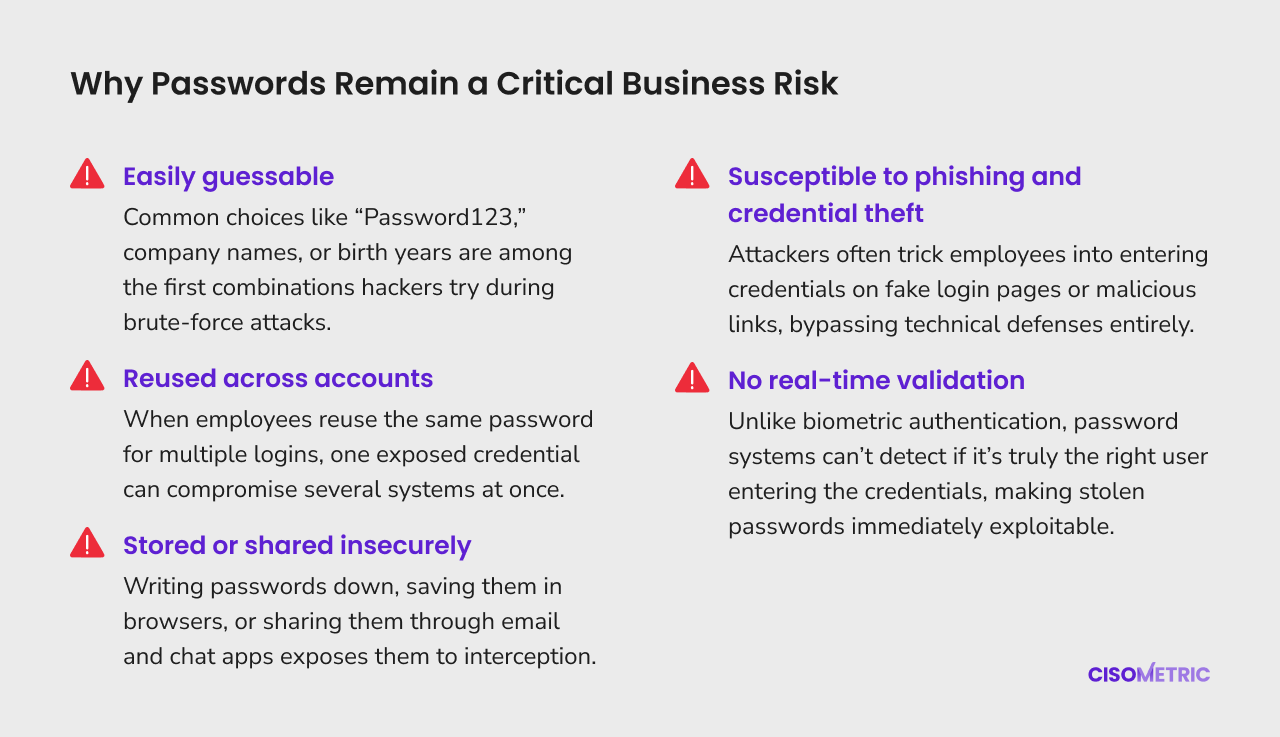
Here’s why passwords continue to pose serious risks:
- Easily guessable
Common choices like “Password123,” company names, or birth years are among the first combinations hackers try during brute-force attacks.
- Reused across accounts
When employees reuse the same password for multiple logins, one exposed credential can compromise several systems at once.
- Stored or shared insecurely
Writing passwords down, saving them in browsers, or sharing them through email and chat apps exposes them to interception.
- Susceptible to phishing and credential theft
Attackers often trick employees into entering credentials on fake login pages or malicious links, bypassing technical defenses entirely.
Also read: Phishing: New Methods and How to Stay Safe
- No real-time validation
Unlike biometric authentication, password systems can’t detect if it’s truly the right user entering the credentials, making stolen passwords immediately exploitable.
In short, passwords are the easiest key to steal and the hardest one to control. They depend on every individual in the organisation doing the right thing, every time. And in a time where attackers only need to succeed once, that’s a fragile defense strategy.
The issue, then, isn’t just about technology, it’s about trust, habits, and awareness. Passwords are the first line of defense, but also the weakest, if not managed properly.
The Real Cost of Password Leaks for Businesses
The damage from a weak password goes far beyond IT disruption. In KNP’s case, the company lost access to operational data, halted deliveries, and ultimately collapsed. But behind those figures are also the human consequences such as employees losing livelihoods, customers losing trust, and partners losing long-term business relationships.
When access credentials are compromised, attackers can:
- Interrupt day-to-day operations through system lockouts or data encryption
- Leak or sell sensitive customer and financial data
- Damage a company’s reputation and client trust
- Trigger legal and regulatory implications under data protection laws
The risks translate directly into financial and reputational losses.
How to Stay Safe by Building Better Password Habits
The most sophisticated security systems can’t protect a company if its passwords are weak. Cyber resilience starts with simple, consistent digital hygiene, across both organisational and personal levels. Here’s how businesses and individuals can strengthen their first line of defense:
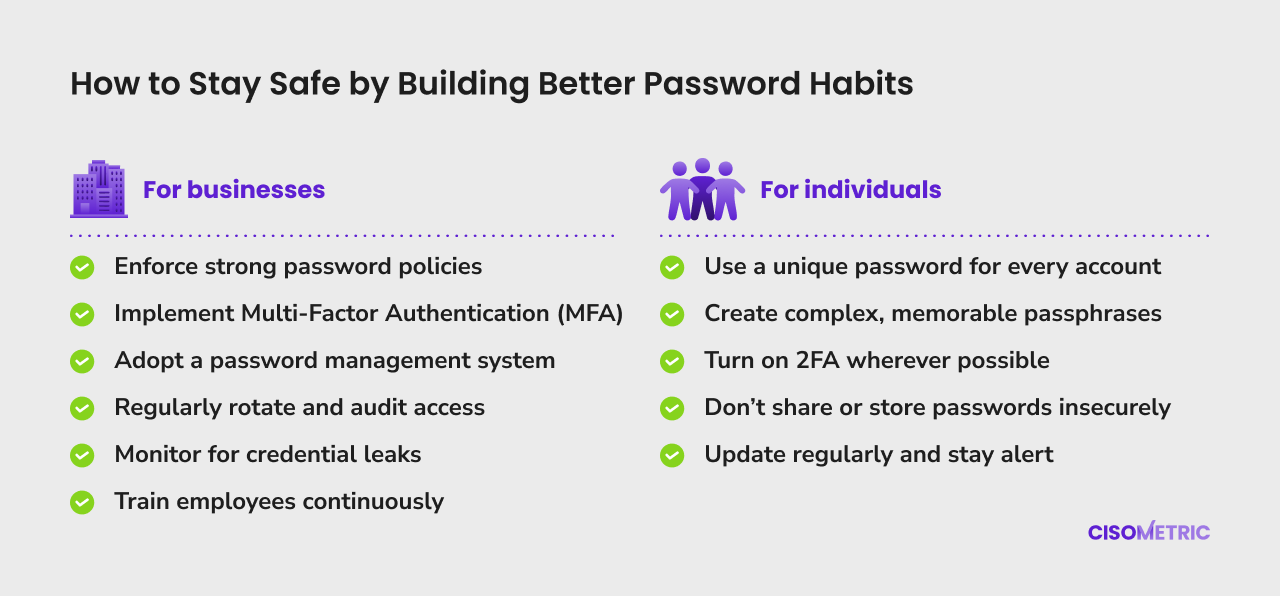
For businesses:
Cybersecurity begins with company culture. It’s not enough to have policies. Employees also need structure, tools, and accountability to follow them.
1. Enforce strong password policies
Require passwords to be at least 12 characters long, with a mix of upper and lowercase letters, numbers, and symbols. Discourage predictable formats like CompanyName2025!
2. Implement Multi-Factor Authentication (MFA)
MFA significantly reduces the risk of unauthorized access, even if a password is compromised. Prioritise MFA for critical systems such as email, VPN, and cloud services.
3. Adopt a password management system
Provide employees with a secure password manager to create and store strong, unique credentials. This reduces password reuse and helps manage access efficiently.
4. Regularly rotate and audit access
Review and update credentials at least every 6–12 months, or immediately after role changes or staff departures. Conduct periodic audits to ensure compliance with internal policies.
5. Monitor for credential leaks
Use monitoring tools, often integrated in modern Security Operations Centers (SOC), to detect leaked or compromised credentials on the dark web before they’re exploited.
6. Train employees continuously
Cybersecurity awareness should be ongoing. Run regular refreshers and phishing simulations to keep security top of mind across all departments.
For individuals:
Even outside the workplace, weak passwords remain one of the biggest risks to personal and financial data.
1. Use a unique password for every account
Avoid reusing the same password across multiple logins. If one account is breached, reused passwords make it easier for attackers to access others.
2. Create complex, memorable passphrases
Combine unrelated words or phrases, and add symbols or numbers, for example “BlueCoffee!Rain93”.
3. Turn on 2FA wherever possible
Two-Factor Authentication adds a second layer of defense, through extra steps, such as a code sent to your device, that can block most unauthorized attempts.
Also read: Protect Your Accounts with 2FA – It's Easier Than You Think!
4. Don’t share or store passwords insecurely
Avoid saving passwords in browsers or sending them via chat apps or email. Use a reputable password manager instead.
5. Update regularly and stay alert
Change passwords every few months, especially after hearing about data breaches from platforms you use. Be cautious of emails or messages asking you to log in unexpectedly, they may be phishing attempts.
Also read: Stop Making These Common Password Mistakes
Conclusion
The collapse of KNP Logistics serves as a powerful reminder that cybersecurity doesn’t always fail because of advanced threats, sometimes, it fails because of everyday neglect. A single weak password opened the door to ransomware, disrupted operations, and ended a century-old business.
For organisations everywhere, this case highlights that while technology can defend, but discipline sustains. Every employee, every password, and every login attempt contributes to either your business resilience or risk.
At Cisometric, we believe that proactive cybersecurity is fundamental. Our Next-Generation Security Operations Center (SOC) helps businesses identify early warning signs, detect compromised credentials, and respond swiftly before a small oversight becomes a major breach.
Schedule a free consultation with our experts today, click here.
For more updates on digital scams, cybersecurity insights, and expert tips, follow our social media:
LinkedIn: Cisometric
Instagram: @cisometric
Youtube: @Cisometric
Reference :
Weak password allowed hackers to sink a 158-year-old company
Tech expert's warning after weak password let hackers sink a 158-year-old company
Weak Password, Massive Fallout: How a Simple Mistake Shut Down a 158-Year-Old British Firm
Weak password let hackers bring down 148-year-old logistics firm