By Patricia A. Pramono • Studio 1080, Published on April 17, 2025
TABLE OF CONTENTS
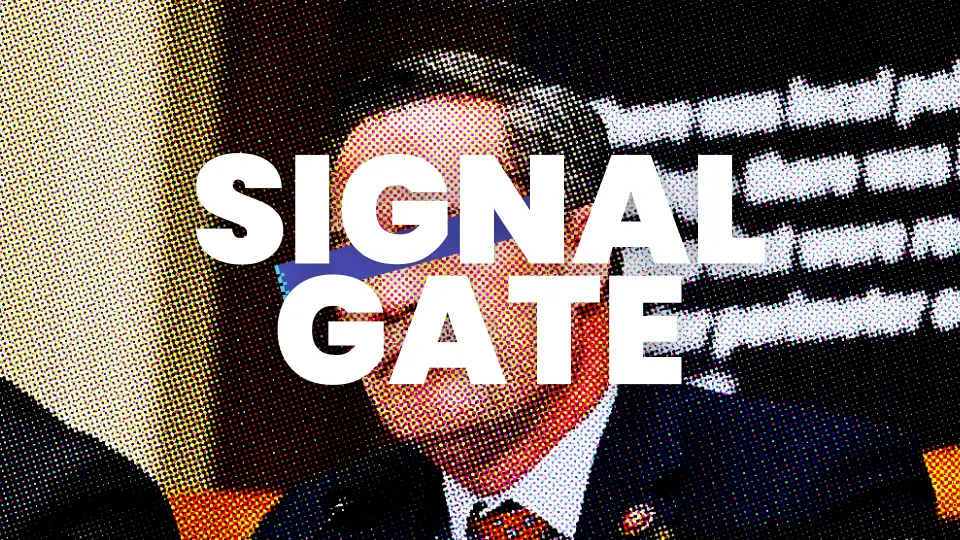
What happens when national security slips into a group chat? It’s real, and it happened inside the Trump administration.
On an otherwise ordinary Wednesday, The Atlantic’s Editor-in-Chief Jeffrey Goldberg was accidentally added to a Signal group chat by National Security Advisor of the United States, Mike Waltz. What Goldberg found wasn’t a group for casual plans, but rather a live discussion between top U.S. officials on an upcoming military strike in Yemen against Iran-backed Houthi forces.
This moment is a chilling reminder of what happens when high-level officials treat digital hygiene as an afterthought. And while the Signal app itself is end-to-end encrypted and generally secure, no tool can save you from human error like this.
Goldberg later said that it was like walking into a room and realizing you weren’t supposed to be there (The Atlantic, March 2025).
This accidental invite exposed a high-stakes national security failure, one that didn’t involve complex hacking tools or foreign intelligence, but a simple human mistake.
The Chronology of SignalGate
The incident now referred to as SignalGate began with what appeared to be a routine coordination effort among top-ranking U.S. government officials. A Signal group chat, titled “Houthi PC small group,” was created by a staff member under National Security Advisor Mike Waltz to discuss an impending military operation targeting Houthi rebels in Yemen.
The members of the chat included some of the most senior figures in U.S. national security:
- Vice President, JD Vance
- Secretary of Defense, Pete Hegseth
- CIA Director, John Ratcliffe
- Director of National Intelligence, Tulsi Gabbard
- Secretary of State, Marco Rubio
- White House and National Security Council Staff
The conversation included highly sensitive operational details: weather updates, target confirmation, flight schedules for military aircraft, and launch timelines for drone and missile strikes. While the information may not have been formally marked as classified, its strategic importance was undeniable.
In the midst of these ongoing discussions, a critical error then occurred. Jeffrey Goldberg, Editor-in-Chief of The Atlantic, was mistakenly added to the chat group. He had no security clearance and no role in the operation. Yet for a brief period, he had front-row access to military coordination in real-time.
According to Cybernews, Goldberg later likened the experience to quietly exiting a room after unintentionally witnessing something deeply private, an apt analogy for the surreal and troubling nature of the breach.
What made the situation more alarming was the apparent lack of response. Goldberg was not immediately noticed. The discussion continued as planned. Sensitive information continued to circulate. Only later, after Goldberg had left the chat and reported on the incident, did the full scale of the mistake become clear.
Within hours of the conversation, the military operation commenced. And although the administration maintained that no classified information had been disclosed, the public reaction (fueled by detailed reporting from The Atlantic, BBC, and others) made it clear that this was more than a procedural oversight. It was a national security lapse.
The incident triggered intense scrutiny over the Trump administration’s communication practices, particularly:
- The use of encrypted consumer apps like Signal for official matters
- The reliance on personal devices for sensitive discussions
- The absence of clear protocols for secure group communication
What unfolded in that Signal group chat served as a case study in how a single misstep (like adding the wrong contact) can compromise operational security at the highest levels. No malware. No cyber intrusion. Just human error.
More Cybersecurity Concerns From Trump’s Administration
The SignalGate incident, while alarming on its own, was only one part of a larger pattern of weak cybersecurity practices among senior U.S. officials during the Trump administration. What followed was a string of revelations that painted a worrying picture of digital carelessness at the highest levels of government:
- More than 20 Signal group chats were reportedly used by Trump’s national security team to discuss sensitive topics such as Ukraine, China, Gaza, and active military strategies (Cybernews, 2025):
- These chats occurred outside official, secured government communication systems
- Messages were sent through personal devices, with no formal oversight or message logging
- Encrypted apps ≠ secure behavior: While Signal offers strong end-to-end encryption, that protection becomes meaningless when operational security protocols are ignored (such as adding unauthorized participants or failing to verify members)
- Public Venmo connections exposed key relationships:
- National Security Adviser Mike Waltz’s Venmo account was public, showing over 300 connections (Forbes, 2025)
- These included military officials, NSC members, and journalists, giving adversaries an easy way to map interpersonal networks and identify targets for manipulation or phishing - Personal email addresses and phone numbers of officials were publicly accessible: As reported by The Hill via Der Spiegel, these details weren’t leaked through a breach but were openly available online
- This repeated use of personal platforms and unsecured accounts reflects a larger issue: Digital convenience was prioritized over cybersecurity best practices and contradicts basic cyber hygiene standards expected from anyone handling sensitive information (let alone those managing national security)
The Risks of Digital Breadcrumbs Add Up
This incident reminds us that not all cybersecurity threats are technical. Sometimes, it’s just us. Our habits. Our tools. Our settings.
Threat actors don’t need to break into a server when they can build a complete social graph of an organization from public payment apps, LinkedIn connections, and exposed contact lists.
From there, the risk grows:
- Phishing with context becomes easier
- Insider targeting becomes more precise
- Credential harvesting becomes more dangerous
- And yes, national security can be compromised
What SignalGate makes painfully clear is: cybersecurity isn’t just about tools, it’s also about behavior. Even encrypted apps like Signal are useless when you add the wrong person to the chat. Even private emails are a risk if they’re accessed on unsecured personal devices. Convenience is often the enemy of security.
Also read: Cybersecurity Weakest Link: The Human Factor
How Do We Fix This?
To prevent similar incidents in the future, whether in government or in any organization managing sensitive information, several key actions are essential:
1. Digital hygiene training at all levels: Cybersecurity training shouldn’t stop at the entry level.
- Senior leadership, including cabinet members, executives, and high-ranking officials, must be held to the same (or even higher) standards of cybersecurity awareness as everyone else
- These trainings should go beyond basic phishing simulations and cover digital footprint risks, app usage guidelines, and real-world case studies like SignalGate itself
2. Limit personal device use for official work:
- Official communication should occur through authorized, monitored systems
- While encrypted apps have their place, they must be paired with clear, enforced policies for access, usage, and contact verification
- This includes vetting group members, managing device access, and ensuring logging or archiving capabilities where appropriate
- In high-risk sectors, zero-trust communication environments should be the standard
3.Regular audits of public and open-source information: What’s publicly accessible about your organization and your people, matters more than ever.
- Publicly visible details such as Venmo transactions, LinkedIn networks, social media posts, or leaked email addresses can be weaponized
- For public figures and executives, even friend lists or tagged photos can provide enough data for adversaries to launch targeted attacks
4.Normalize a security-first culture:
- Cybersecurity shouldn't be seen as a technical addition, but as a core part of modern leadership and risk management
- That means building environments where secure practices are second nature (from verifying who’s in the group chat, to checking if an email should really be forwarded, to locking down exposed data before it spreads)
- Leaders must set the tone, if decision-makers demonstrate poor digital habits, it sends the wrong message to the rest of the organization
- Make cybersecurity part of onboarding, daily operations, and even strategic planning
Ultimately, security is about building the habits, systems, and culture that minimize risk and respond quickly when things go wrong. SignalGate may have started with a single wrong click, but the consequences remind us just how far one error can reach.
Conclusion
The SignalGate incident wasn’t caused by a zero-day exploit. There was no malware. No sophisticated espionage. And yet it exposed an entire web of digital vulnerabilities, proving that even at the highest levels of power, the smallest mistakes can have massive consequences.
So the next time someone shrugs off a public financial account, an outdated contact list, or an unmonitored group chat, remember this: every little detail matters. Each digital breadcrumb can quietly build the path to a much larger breach.
At Cisometric, we help organizations build resilience against exactly these kinds of human-driven risks through proactive threat detection, secure communication protocols, and practical training that empowers your team to think like an attacker before one gets in.
If you're ready to tighten your security posture, schedule a meeting with our team today!
Reference:
Signal Leak And The Danger Of Digital Breadcrumbs
Trump’s Signalgate proves, once again, that human error is still the number one cybersecurity threat
Read the messages Trump officials exchanged on leaked Signal thread
SignalGate: When Secure Technology Meets Human Error
Even More Venmo Accounts Tied to Trump Officials in Signal Group Chat Left Data Public