
From Policy to Proof: What PP No. 33 of 2026 Really Changes for Organizations
PP 33/2026 takes effect on 16 January 2027. Discover the compliance gaps organizations must address now, with expert insights from Cisometri...

By Cisometric, Published on November 16, 2026
What happens when a cyberattack against a service provider gives attackers access to something far more valuable than the provider's own systems: customers' accounts, credentials, or financial information?
Between June and October 2026, three major cyber incidents in Japan demonstrated how quickly security compromises can turn into customer-facing risks.
The warning signs had already been emerging. In May 2026, Japan's Financial Services Agency (FSA) and Bank of Japan called on financial institutions to address evolving cyber threats associated with frontier AI.
The incidents involving GMO Internet, KDDI, and Aflac Japan subsequently highlighted three distinct exposure scenarios: unauthorized financial transactions, credential theft, and large-scale personal data leakage.
What makes these cases worth examining is how attackers were able to reach customer assets and information through the systems customers depended on.
Service provider compromises can create downstream risks. A single compromised environment can expose customer credentials, financial assets, or sensitive information across connected services.
Malicious activity does not always look suspicious at first. Attackers may exploit legitimate access paths, application requests, or previously unknown vulnerabilities, making conventional detection rules insufficient.
Detection quality directly affects incident containment. Visibility across critical systems, context-aware detection rules, and timely investigation help organizations identify potential customer impact before an incident escalates.
Although all three incidents exposed customers to potential harm, the attack surfaces and consequences differed significantly.
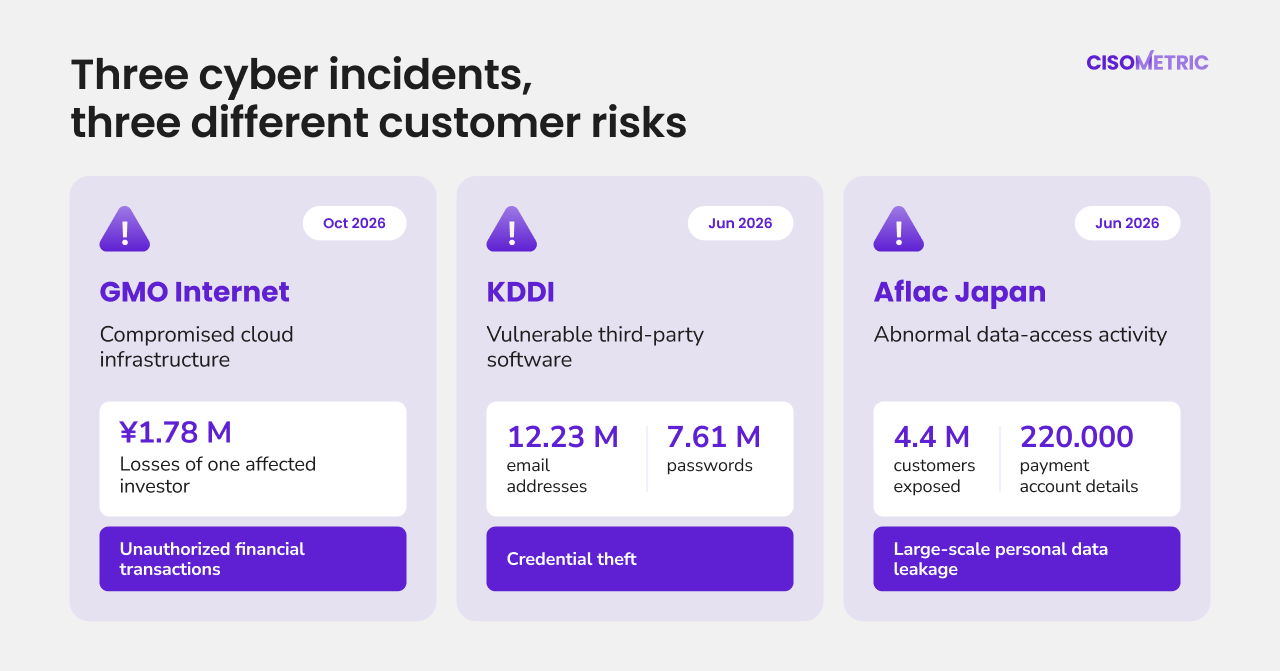
From compromised cloud infrastructure to vulnerable third-party software and abnormal data-access activity, each case reveals a different path through which attackers can reach customer assets or sensitive information:
In October 2026, GMO Internet confirmed unauthorized access to its Onamae.com Desktop Cloud service, a virtual desktop environment used by customers running applications such as automated FX trading tools.
According to GMO Internet's October 22 disclosure, malicious programs had been installed in some customers' server environments. Trading account credentials stored within those environments may have been accessed, while customers began reporting unauthorized trading activity.
The financial consequences were immediate. The Japan News reported that one affected investor suffered losses totaling approximately ¥1.78 million following transactions she had never authorized.
GMO subsequently confirmed that customer information had been taken outside its environment and received reports of unauthorized trades. On October 27, the company also acknowledged that suspected attackers had published information believed to be connected to customers, while verification continued.
The security concern: Compromising a hosted computing environment can expose credentials and active workflows connected to entirely separate financial platforms.
For SOC teams, this raises an important detection question. Can suspicious activity within a hosted workload be identified and contained before compromised access is used against a downstream customer account?
In June 2026, Japanese telecommunications provider KDDI disclosed unauthorized access to an email system supporting multiple internet service providers.
The attack exploited a previously unknown vulnerability in third-party software integrated into the shared infrastructure.
By July 6, KDDI had confirmed the exposure of approximately 12.23 million email addresses and 7.61 million passwords. Although no secondary damage had been confirmed at the time of that report, the security implications extended beyond the compromised email platform.
Exposed credentials can facilitate credential-stuffing attacks where passwords have been reused. Compromised email access can also provide attackers with an entry point into password-reset workflows for other accounts.
The security concern: A vulnerability in one shared component can expand the blast radius across multiple customer-facing services.
Vulnerability management remains essential, but previously unknown vulnerabilities also require detection capabilities that can identify suspicious exploitation attempts and post-exploitation behavior before the full scope of an incident becomes apparent.
In June 2026, Aflac Japan disclosed unauthorized access affecting its customer portal and related systems.
According to Aflac's updated incident findings, approximately 4.4 million customers had personal information exposed, including around 220,000 whose premium payment account details were affected.
One detail in its investigation deserves particular attention. Aflac acknowledged that existing detection and blocking mechanisms failed to immediately recognize the malicious activity because the requests resembled legitimate user activity. Its systems also lacked adequate monitoring and controls for unusually large volumes of data queries within short periods.
The incident was initially investigated after abnormal CPU utilization was detected on June 25. Further investigation identified unauthorized access dating back to June 10.
The security concern: Attackers may interact with applications using seemingly valid request patterns while conducting unauthorized bulk data access.
Detecting these situations requires behavioral baselines, query-volume monitoring, and context-aware detection rules capable of distinguishing normal usage from anomalous data-access behavior.
The three cases involved different attack surfaces, yet they raise a common operational question:
Would your security team recognize the activity as a potential customer-impacting incident before the damage becomes visible?
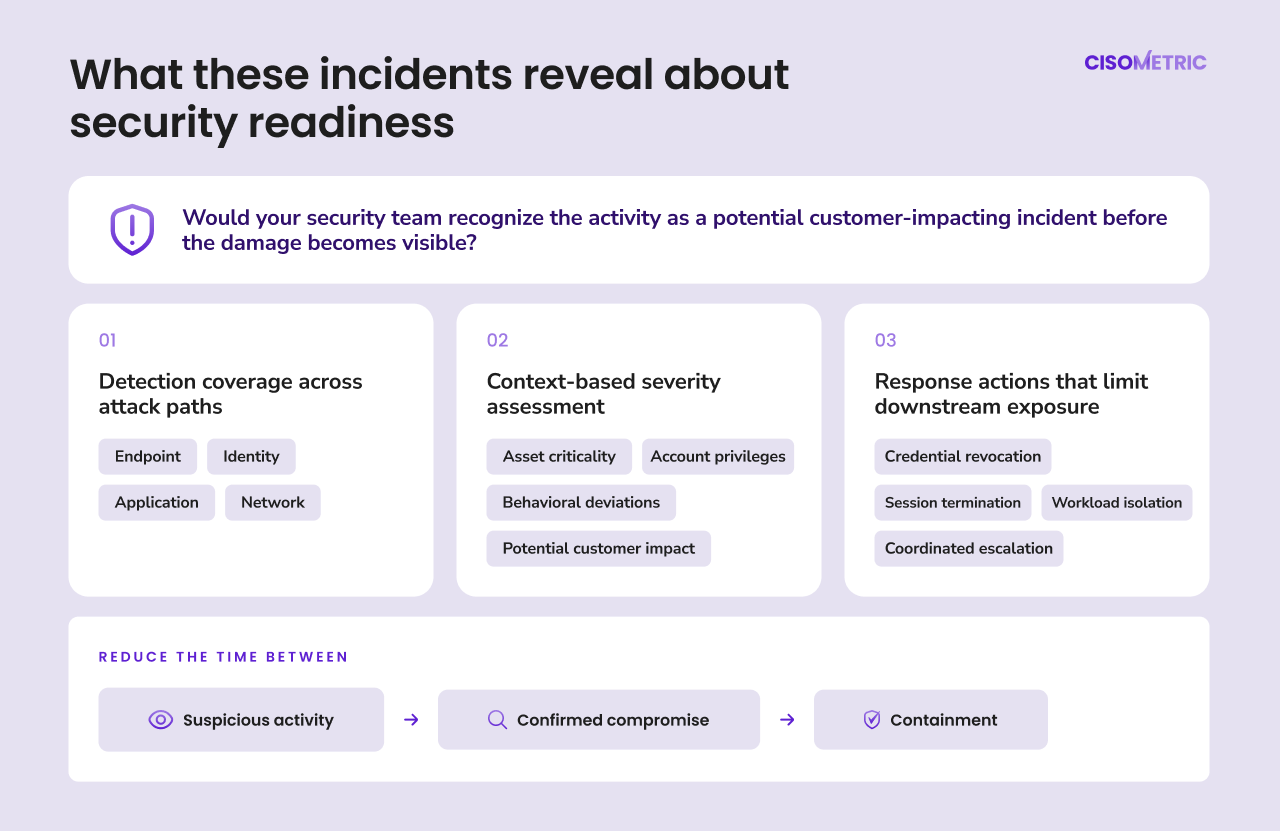
For organizations managing customer-facing services, several capabilities deserve closer attention:
Detection coverage across attack paths
Correlate endpoint, identity, application, and network telemetry to identify suspicious activity extending across systems or service boundaries.
Context-based severity assessment
Evaluate alerts against asset criticality, account privileges, behavioral deviations, and potential customer impact. Detection thresholds should be tuned to reduce false positives without suppressing high-risk anomalies.
Response actions that limit downstream exposure
Establish procedures for credential revocation, session termination, workload isolation, and coordinated escalation when compromised access may affect customer accounts or data.
These capabilities must work alongside application security, vulnerability management, and transaction-level fraud controls. SOC cannot compensate for every weakness in those systems, but effective monitoring and investigation can reduce the time between suspicious activity, confirmed compromise, and containment.
For organizations in Indonesia, these incidents offer a useful opportunity to reassess how well existing security operations can identify threats across customer-facing environments.
Cisometric's 24/7 Security Operations Center (SOC) supports continuous security monitoring, threat detection, investigation, and incident response.
Through security telemetry correlation, environment-specific detection rules, and structured analyst escalation, Cisometric helps organizations identify suspicious activities, assess their severity, and coordinate appropriate responses.
Because the real test of security readiness is what happens when suspicious activity reaches the systems your customers rely on.
Explore Cisometric SOC to strengthen your organization's security monitoring and incident response capabilities.
Stay connected with Cisometric for insights and updates on cybersecurity:
LinkedIn: Cisometric
Instagram: @cisometric
YouTube: @Cisometric
A successful login does not necessarily indicate legitimate access. SOC teams can correlate authentication logs with behavioral indicators such as unusual access locations, session activity, privilege changes, and abnormal data requests. Cisometric Security Operations Center (SOC) uses environment-specific detection rules and continuous monitoring to help identify suspicious activity that traditional login-failure alerts may miss.
Compromised third-party infrastructure can expose credentials, customer information, or connected applications even when an organization's primary systems have not been directly breached. Cisometric Security Operations Center (SOC) helps monitor relevant security telemetry within the organization's available visibility, supporting earlier detection and investigation of suspicious activities affecting connected environments.
Severity assessment should consider the sensitivity of the affected data, asset criticality, scope of suspicious activity, and potential for further compromise. Cisometric Security Operations Center (SOC) supports alert validation, threat investigation, and structured escalation to help organizations prioritize incidents according to their operational risk and potential impact.
No security monitoring capability can guarantee complete prevention. However, continuous monitoring, tailored detection rules, and timely incident response can help organizations identify suspicious activities earlier and limit potential damage. Cisometric Security Operations Center (SOC) provides 24/7 monitoring and investigation support to strengthen these capabilities.
PP 33/2026 takes effect on 16 January 2027. Discover the compliance gaps organizations must address now, with expert insights from Cisometri...

Pelajari perbedaan incident response playbook dan SOAR, cara keduanya bekerja saat menangani insiden, batas otomasi, serta persiapan sebelum...

Tingkatkan kesiapan incident response dengan memahami siklus NIST SP 800-61 Rev. 3, siklus penanganan insiden, langkah kesiapan, dan peran S...
Search Article by Category
We use cookies to enhance your browsing experience, analyse site traffic, and deliver relevant content. Choose which cookies you allow. Privacy Policy