
Managed SIEM: Bring Your Own SIEM atau Platform Managed?
Membandingkan model Bring Your Own SIEM (BYOS) dan platform managed SIEM: kapabilitas deteksi, TCO aktual, biaya migrasi, dan matriks keputu...
By Cisometric Marketing Team, Published on November 17, 2025
Despite significant progress in digital defenses, organizations remain vulnerable to one critical factor that technology cannot fully secure, human behavior. Social engineering attacks capitalize on this gap, manipulating individuals into performing actions that compromise the integrity of even the most sophisticated systems.
According to IBM’s Cost of a Data Breach Report 2025, attacks involving social engineering techniques (such as phishing and business email compromise) remain among the most costly breaches worldwide. These incidents continue to prove that cybersecurity is not solely a technical issue, but a human one.
Also read: Cybersecurity Weakest Link: The Human Factor
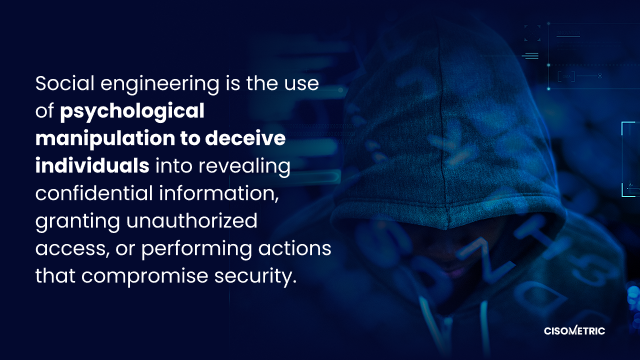
Social engineering is the use of psychological manipulation to deceive individuals into revealing confidential information, granting unauthorized access, or performing actions that compromise security. Often referred to as “human hacking,” it focuses on exploiting human tendencies (such as trust, curiosity, helpfulness, and compliance) rather than exploiting system or software vulnerabilities (CSO, 2024; IBM, 2025).
Unlike technical intrusions that require coding skills or system exploits, social engineering leverages communication and persuasion. A well-made message or voice call can be as dangerous as a malware injection, simply because it feels more personal and credible.
Attackers carefully study their targets’ behavior, language, and online presence to make their approach appear legitimate and familiar. The goal is to gain trust long enough to lower a person’s guard. Once that trust is established, the attacker can obtain sensitive data, financial information, or internal access, often without triggering any security alerts.
Because social engineering targets human judgment rather than technology, it remains one of the most persistent and challenging forms of cyber threat to defend against. Even the most advanced systems can be compromised by a convincing email, phone call, or message that reaches the right person at the wrong time.
Most social engineering campaigns follow a recognizable pattern (GeeksforGeeks, 2025):
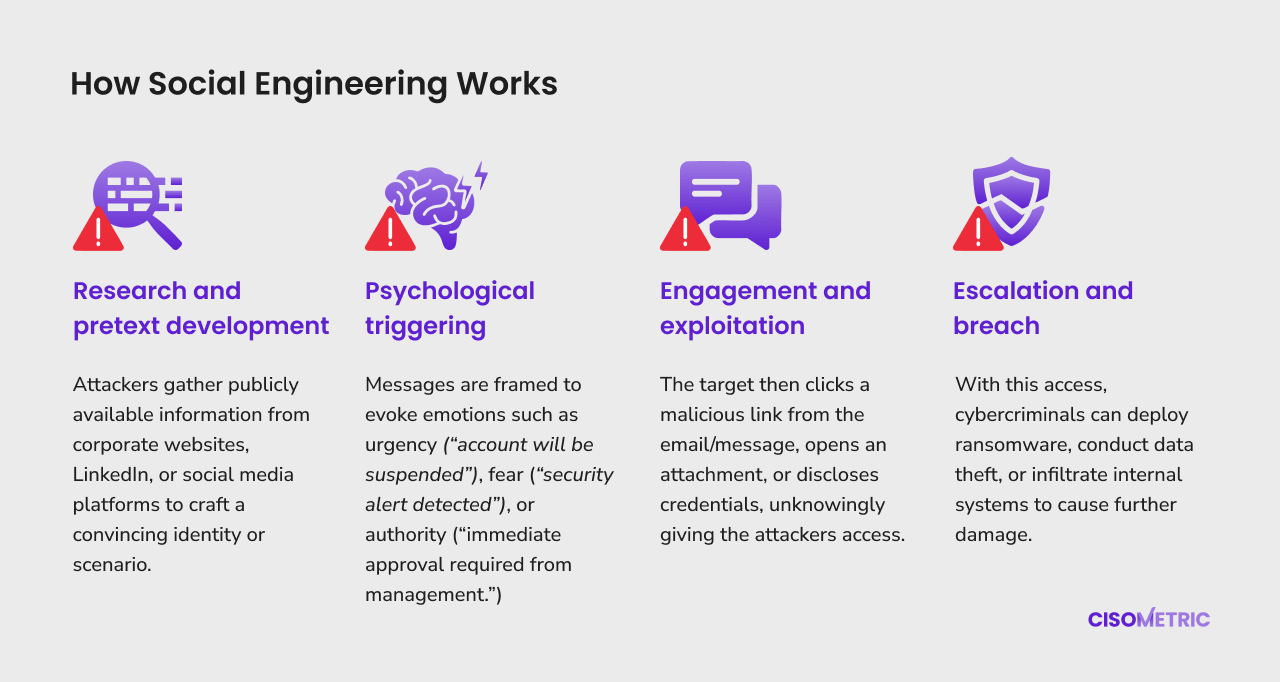
Attackers gather publicly available information from corporate websites, LinkedIn, or social media platforms to craft a convincing identity or scenario.
2.Psychological triggering
Messages are framed to evoke emotions such as urgency (like “your account will be suspended”), fear ( like “security alert detected”), or authority (like “immediate approval required from management”).
3. Engagement and exploitation
The target then clicks a malicious link from the email/message, opens an attachment, or discloses credentials, unknowingly giving the attackers access.
4. Escalation and breach
With this access, cybercriminals can deploy ransomware, conduct data theft, or infiltrate internal systems to cause further damage.
Common Types of Social Engineering Attacks
Social engineering can take many forms and often adapts to the habits of its targets. These attacks may appear through emails, phone calls, social media messages, text messages, or even in-person encounters.
Some of the most common forms include:
Deceptive emails or messages that impersonate trusted organizations to steal credentials or install malware.
Also read: Phishing: New Methods and How to Stay Safe
Personalized attacks that target specific individuals, often executives or employees with privileged access to a company, using information gathered from public profiles or company data.
Voice and SMS-based variants of phishing, where attackers impersonate customer service representatives, financial institutions, government agencies, etc.
The attacker fabricates a convincing story or scenario to extract sensitive information, such as claiming to be IT support verifying a system access.
Offering something enticing, such as free downloads, rewards, or USB drives, that secretly install malware or open access points.
Also read: Understanding Malware Threats
Following authorized personnel into restricted areas, exploiting workplace politeness or trust.
Fake pop-up alerts or notifications that claim the user’s system is infected, tricking them into downloading malicious “security” software.
Compromising legitimate websites that specific organizations or communities frequently visit, turning a trusted source into a delivery mechanism for malware.
Attackers continually adjust their methods to blend into daily communication patterns, making them harder to detect and easier to believe. Phishing remains the most dominant vector of attack, identified in 41% of all incidents worldwide (IBM, 2025).
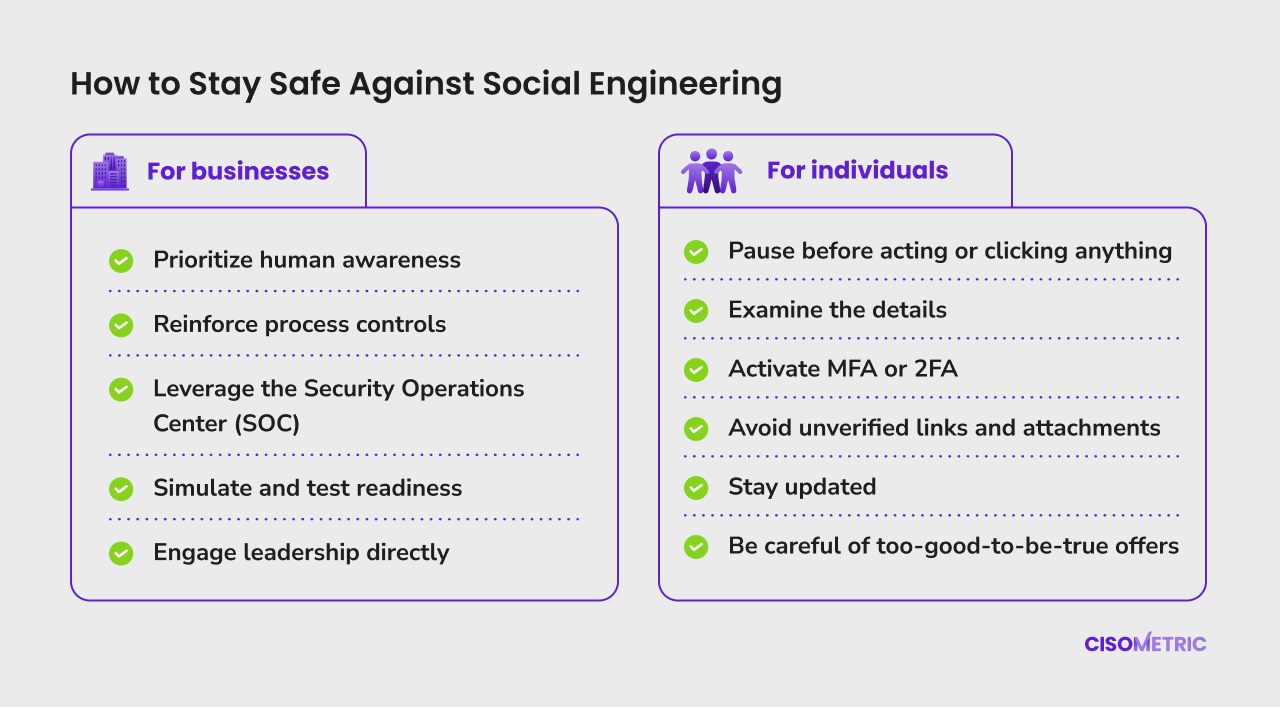
Defending against social engineering demands awareness and disciplined processes from both individuals and organizations. Since these attacks exploit human psychology rather than technical flaws, prevention starts with informed decision-making and consistent security habits.
For businesses:
1. Prioritize human awareness
Implement continuous, role-based security awareness programs that address real-world social engineering tactics such as phishing, pretexting, and deepfake-enabled fraud. Employees across departments (especially in finance, HR, and executive support) should receive periodic, scenario-based training (IBM, 2025).
2. Reinforce process controls
Establish multi-level verification protocols for all sensitive approvals, including vendor banking changes, wire transfers, or data access requests. Require out-of-band confirmation via phone or secure internal channels before executing transactions.
3. Leverage the Security Operations Center (SOC)
A next-generation SOC provides 24/7 monitoring, detection, and response to potential social engineering incidents. By integrating advanced analytics with human expertise, SOC teams can quickly identify suspicious patterns (such as unauthorized login attempts or unusual communication behavior) and respond before they escalate.
Also read: How Cisometric’s SOC Protected Businesses from Hundreds of Cyber Threats
4. Simulate and test readiness
Conduct regular social engineering simulations, such as phishing drills or executive impersonation scenarios, to assess user response and refine escalation procedures. Include these exercises within the organization’s broader incident response framework.
5. Engage leadership directly
Executive-level participation in training is crucial. Leadership is frequently targeted in business email compromise (BEC) and deepfake attacks; their awareness reinforces accountability and sets the tone for a security-conscious culture (CSO, 2024; IBM, 2025).
For individuals:
1. Pause before acting or clicking anything
Treat any message that creates a sense of urgency, fear, or pressure with suspicion. Verify unusual requests (especially those involving money, credentials, or confidential information) through a separate, trusted channel (IBM, 2025).
2. Examine the details
Pay attention to sender addresses, domain names, and links before clicking or responding. Small inconsistencies or misspellings are often the clearest indicators of fraud.
3. Activate MFA or 2FA
Never share authentication codes, and be alert to repeated or unexpected login prompts. Attackers increasingly use MFA fatigue tactics to trick users into approving unauthorized access (SOCRadar, 2025).
Also read: Protect Your Accounts with 2FA – It's Easier Than You Think!
4. Avoid unverified links and attachments
Access websites by typing their official URLs directly instead of following links sent via email, text message, or social media.
5. Stay updated
Ensure devices, browsers, and operating systems are regularly updated. Many social engineering campaigns exploit unpatched software vulnerabilities to deliver malware or gain access.
6. Be careful of too-good-to-be-true offers
Enticing rewards, online giveaways, or exclusive job offers remain classic baiting techniques.
Social engineering is one of the most persistent threats in today’s digital age, not because systems are weak, but because human behavior is inherently vulnerable. A single moment of misplaced trust can open the door to large-scale breaches, financial losses, and reputational harm.
The most effective defense is preparedness. Building awareness, verifying every request, and integrating active monitoring through a trusted Security Operations Center (SOC) can significantly reduce the risks of social manipulation.
If your organization is ready to strengthen its defenses against social engineering and other evolving cyber threats, connect with our team at Cisometric to learn how our next-generation SOC can help you stay one step ahead.
Schedule a free consultation with our experts today, click here.
For more updates on digital scams, cybersecurity insights, and expert tips, follow our social media:
LinkedIn: Cisometric
Instagram: @cisometric
Youtube: @Cisometric
Reference:
Social engineering: Definition, examples, and techniques
What is Social Engineering? Working, Types, Prevention and Impact
Membandingkan model Bring Your Own SIEM (BYOS) dan platform managed SIEM: kapabilitas deteksi, TCO aktual, biaya migrasi, dan matriks keputu...

Perbandingan mendalam In-House SOC dan Managed SOC berdasarkan biaya operasional, kebutuhan analis 24/7, regulasi OJK dan BI, serta kesiapan...
Explore how AI-powered threats are changing attack speed, scale, and autonomy, and what SOC teams need to strengthen detection, investigatio...
Search Article by Category
We use cookies to enhance your browsing experience, analyse site traffic, and deliver relevant content. Choose which cookies you allow. Privacy Policy