
By Patricia A. Pramono • Studio 1080, Published on November 05, 2025
TABLE OF CONTENTS
Denmark has taken a bold step in addressing one of today’s most complex digital threats, deepfakes.
In June 2025, the Danish government introduced a proposal to amend its Copyright Act, extending protection not only to creative works but also to the most personal creation of all: the human self.
Under the proposal, people in Denmark would have the right to control how their face, body, and voice are used online, effectively making their likeness subject to copyright-style protection (The Guardian, 2025; Schjødt, 2025).
Denmark’s proposal marks a significant shift in how governments are responding to the risks of synthetic media (digital content that is created or altered by AI and machine learning instead of being recorded from real-world events), moving from moral debates to legal action. But what exactly does this new copyright law cover? How will it work in practice to combat deepfakes? And can such regulation truly keep pace with fast-evolving AI technology?
What Are Deepfakes?
First, we need to understand what deepfakes are.
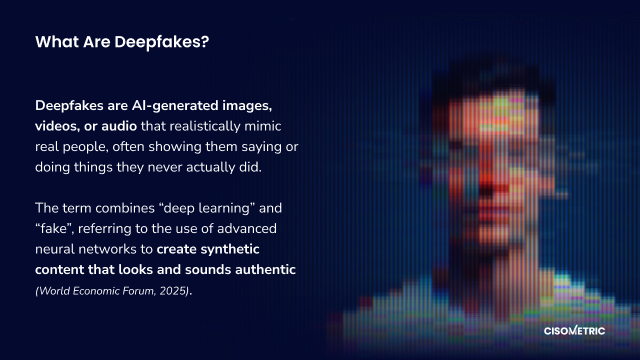
Deepfakes are AI-generated images, videos, or audio that realistically mimic real people, often showing them saying or doing things they never actually did. The term combines “deep learning” and “fake”, referring to the use of advanced neural networks to create synthetic content that looks and sounds authentic (World Economic Forum, 2025).
At first, deepfakes were used for entertainment or satire. But as the technology became more sophisticated, the same tools began to power misinformation campaigns, scams, and digital impersonation attacks.
Recent incidents have shown how dangerous this can be. Criminals have used deepfake video calls to impersonate executives and trick employees into transferring millions of dollars, while others have used synthetic voices to bypass identity verification systems (World Economic Forum, 2025).
This growing misuse has pushed governments to rethink how digital identity should be protected, and Denmark’s approach could redefine the legal landscape for AI-generated media.
Also read: From Fiction to Reality: How Deepfakes Are Changing Our World
A Legal Response to the Deepfake Surge
Denmark’s proposal arrives at a time when deepfake-related crimes are accelerating worldwide.
According to Resemble.ai’s 2025 Deepfake Threat Intelligence Report, there were 487 confirmed deepfake attacks in Q2 2025 alone, marking a 41% increase from the previous quarter and more than 300% year-on-year growth. The report estimated direct financial losses nearing $350 million, stemming from scams, impersonations, and disinformation campaigns (World Economic Forum, 2025).
Danish Culture Minister Jakob Engel-Schmidt acknowledged the urgency of this issue, stating that “technology has outpaced our current legislation” (The New York Times, 2025).
In other words, while AI is evolving, the legal frameworks governing digital identity are still years behind. Deepfakes are now a growing cybersecurity concern, used to spread false information, commit financial fraud, or damage reputations.
For Denmark, the solution lies in redefining how the law views personal likeness, not merely as an attribute of privacy, but as a protected intellectual property right.
What Denmark’s Copyright Law Covers
At the core of Denmark’s proposal is a simple but powerful principle: your likeness belongs to you.
The draft amendment introduces two new sections to the Copyright Act that extend legal protection over a person’s image, voice, and physical appearance, effectively treating them as intellectual property.
Under the proposal (Schjødt, 2025):
- Performing Artists (Section 65-a)
Prohibits unauthorized, AI-generated imitations of performances, ensuring that artists maintain control over their creative work and identity.
- General Public (Section 73-a)
Grants every individual the right to request the removal of any deepfake image, video, or audio that reproduces their likeness without consent.
If passed, these rules would allow Danish citizens to file takedown requests directly to online platforms, similar to copyright infringement claims. Platforms that fail to act could face significant fines (The Guardian, 2025).
The bill also explicitly safeguards freedom of expression, allowing exceptions for parody, satire, and legitimate social commentary. This balance aims to protect individuals from abuse without stifling creative or journalistic work.
By anchoring these rights in copyright law, Denmark is taking advantage of an existing enforcement mechanism that’s already recognized across Europe, meaning takedowns can happen faster and with clearer legal authority.
It’s a shift from abstract data protection to actionable ownership, giving citizens and performers a tangible way to defend their digital identity.
A Shift from Reactive to Preventive Regulation
Traditionally, most countries have taken a reactive stance toward deepfakes, addressing the harm only after it occurs. Existing laws tend to focus on specific forms of misuse, such as non-consensual pornography, election interference, or financial fraud. While these rules are important, they often fail to address the creation and distribution of manipulated media without consent.
Denmark’s approach is different.
By embedding likeness rights within copyright law, the country is adopting a preventive and harm-agnostic model. In practice, this means the legal violation is not defined by what the deepfake is used for, but by whether the person depicted consented to it.
It’s a fundamental reframing of digital identity in the AI era, from proving harm to proving consent (The New York Times, 2025).
This makes Denmark the first European nation to institutionalize the concept of “consent by design” in law, ensuring that individuals retain ownership of how their digital likeness is used before damage can occur.
The government also plans to use its position as current president of the Council of the European Union to advocate for similar frameworks across EU member states (Tech Policy Press, 2025).
How Other Countries and Indonesia Are Responding to Deepfakes
Denmark’s proposal joins a growing global effort to regulate synthetic media. As deepfakes become more realistic and widely used, countries are rushing to strengthen protection for individuals and organizations alike.
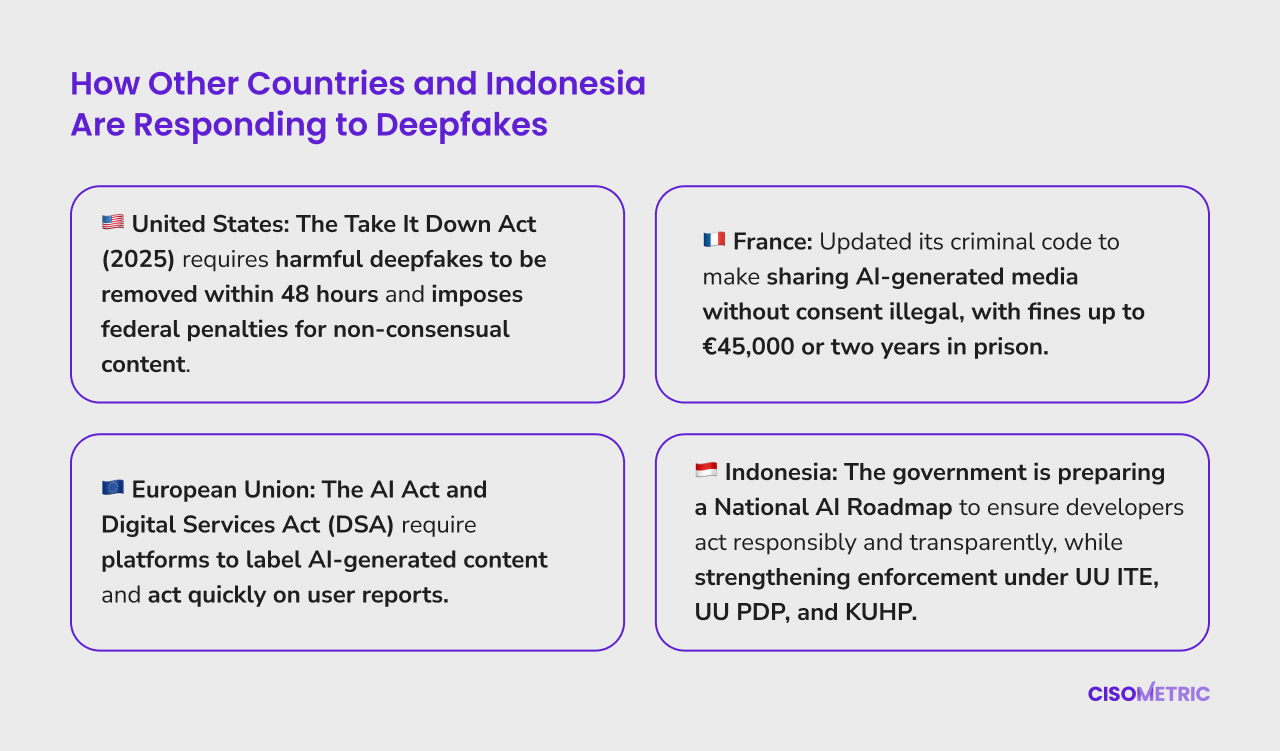
- In the United States, the Take It Down Act (2025) requires harmful deepfakes to be removed within 48 hours and introduces federal penalties for distributing non-consensual content.
- France has also updated its criminal code, making it illegal to share AI-generated media without permission, with fines up to €45,000 and prison terms of up to two years.
- Across the European Union, the AI Act and Digital Services Act (DSA) now require platforms to label AI-generated content and act swiftly on user reports (Euronews, 2025).
Indonesia, while still developing its regulatory framework, has also begun to acknowledge the growing threat. According to Wamenkomdigi Nezar Patria, losses from AI-based scams in Indonesia (particularly deepfake-related fraud) have caused an estimated Rp700 billion (approximately USD 44 million) in losses (Detikcom, 2025).
He warned that “AI-generated deepfake products, when used for criminal purposes, can be extraordinarily deceptive,” emphasizing the need for preventive measures.
The government is now preparing a National AI Roadmap, which will require AI developers to act accountably and transparently while strengthening enforcement through existing laws such as the Electronic Information and Transactions Law (ITE), the Personal Data Protection Law (PDP), and the Criminal Code (KUHP).
While Indonesia’s approach is still evolving, the recognition of AI-driven scams as a national concern marks an important first step toward comprehensive regulation and public awareness.
Denmark’s approach still stands out by combining these elements (consent, copyright, and accountability) into one framework. By embedding likeness rights into copyright law, it moves enforcement from theory to action, offering a model other nations (including ours) may soon follow (Tech Policy Press, 2025).
Challenges and Implications
While Denmark’s proposal is widely praised for its innovation, it also raises complex legal and practical questions.
Treating a person’s likeness as intellectual property is unprecedented, and while it enables faster enforcement through copyright systems, it blurs the line between personal rights and commercial ownership (Tech Policy Press, 2025).
Some legal experts warn that copyright can be transferred or sold, unlike personality rights, which are inherently non-transferable. This raises questions about whether people could one day “license” their faces or voices as digital assets and what that might mean for privacy and human dignity.
Enforcement also remains a major challenge. Deepfake content is often hosted across multiple jurisdictions, making takedowns difficult even under new legal frameworks (The New York Times, 2025).
Still, Denmark’s approach, if successfully implemented, it could provide a foundation for faster takedowns, clearer platform responsibilities, and a more accountable digital ecosystem.
Why Businesses Should Pay Attention
While Denmark’s move may seem distant, its implications reach far beyond Europe, including Indonesia.
Deepfake-related scams are no longer limited to political or celebrity misuse. They’ve become a real business risk, targeting companies through fake video calls, manipulated invoices, and synthetic voices that can imitate executives with alarming accuracy.
For Indonesian organizations, this signals the need to strengthen digital verification and internal awareness, even before similar regulations arrive locally.
Companies can start by:
1. Reviewing media and communication policies
Ensure consent and authenticity checks for any digital or promotional material that uses AI or likenesses.
Also read: Customer Consent: The Trust Currency of the Digital Age
2. Strengthening approval workflows
Verify any financial transaction or sensitive request through secondary channels, not just video or voice.
3. Conducting employee training
Teach your teams how to recognize synthetic content and suspicious communication patterns.
4. Investing in monitoring and detection tools
Solutions like a Security Operations Center (SOC) can help identify and respond to deepfake-related threats faster.
Also read: What Makes a Next Gen SOC and Why Your Business Needs One Now
While Indonesia doesn’t yet have a specific law addressing deepfakes, data protection and digital ethics are increasingly part of business compliance. Denmark’s step shows where the global conversation is heading and why companies here should start preparing now.
Why Individuals Should Care
Deepfakes don’t just threaten organizations, they target individuals too. The biggest risks now come from harassment and social engineering rather than political misinformation (World Economic Forum, 2025).
AI-generated images and videos are increasingly used for non-consensual content and blackmail scams, while voice cloning has made impersonation easier than ever.
Also read: Silent Calls and AI Voice Cloning
To defend against these threats, experts recommend a few simple habits (Deep Media, 2024; World Economic Forum, 2025):
- Stay alert to inconsistencies in speech, tone, or behavior (even when you’re watching or listening to familiar voices or faces)
- Verify requests through another channel before acting on them
- Avoid sharing sensitive data on unverified calls or platforms
- Set a verification phrase with family or colleagues (a specific word or code only you would know) to confirm identity during urgent calls or messages
Conclusion
Denmark’s move to extend copyright protection to faces and voices marks an important milestone in global digital governance. It shows that as technology advances, regulation must evolve to protect human identity, not just data.
For Indonesian businesses, this serves as a reminder that the deepfake threat is no longer theoretical, it’s already here. The ability to verify authenticity, detect manipulation, and respond quickly will soon be a standard expectation for organizations operating online.
At Cisometric, we believe safeguarding digital trust requires both awareness and readiness. Through our Security Operations Center (SOC) and cybersecurity intelligence services, we help companies detect emerging threats (including deepfake-related attacks) before they cause real damage.
Also read: How Cisometric’s SOC Protected Businesses from Hundreds of Cyber Threats
Stay ahead of the next digital risk.
Explore how Cisometric can strengthen your organization’s security posture and digital resilience.
Book a free consultation with our experts today, click here.
For more updates on digital scams, cybersecurity insights, and expert tips, follow our social media:
LinkedIn: Cisometric
Instagram: @cisometric
Youtube: @Cisometric
Reference:
Owning the Self: Denmark’s Copyright Turn Against Deepfakes
Denmark Aims to Use Copyright Law to Protect People From Deepfakes
Denmark to tackle deepfakes by giving people copyright to their own features
Deepfake legislation: Denmark moves to protect digital identity (World Economic Forum)
Denmark fights back against deepfakes with copyright protection. What other laws exist in Europe?
Denmark Leads EU Push to Copyright Faces in Fight Against Deepfakes


