Ancaman Berbasis AI: Apa yang Berubah dan Apa yang Tetap Relevan bagi SOC?
Bagaimana ancaman berbasis AI mengubah operasional SOC? Simak perkembangan terbaru dan kapabilitas deteksi, investigasi, serta respons yang...
Oleh Cisometric Marketing Team, Diterbitkan pada November 11, 2025
The past National Cybersecurity Connect (NCSC) 2025 brought together experts, innovators, and policymakers to discuss the evolving landscape of cybersecurity in Indonesia and beyond.
Held on 29–30 October 2025 at Bidakara Hotel, Jakarta, the event served as the country’s largest cybersecurity gathering, featuring exhibitions, silent conferences, cyber stage sessions, workshops, and executive discussions.
This year’s theme centered around building data security readiness to strengthen national economic resilience, in line with Indonesia’s target of achieving 8% economic growth by 2025 amid rising cyber threats across key sectors like banking, transportation, and energy.
Cisometric, together with PT Perkom, joined this year’s NCSC as part of the exhibition, showcasing their next-generation Security Operations Center (SOC) and innovations in AI-powered threat detection.
Also read: How Cisometric’s SOC Protected Businesses from Hundreds of Cyber Threats
Visitors had the chance to connect with Cisometric’s experts, where discussions revolved around enterprise defense strategies, automation, and how businesses can prepare for machine-speed threats.
Panel 5: Cybersecurity in the Age of AI and Automation
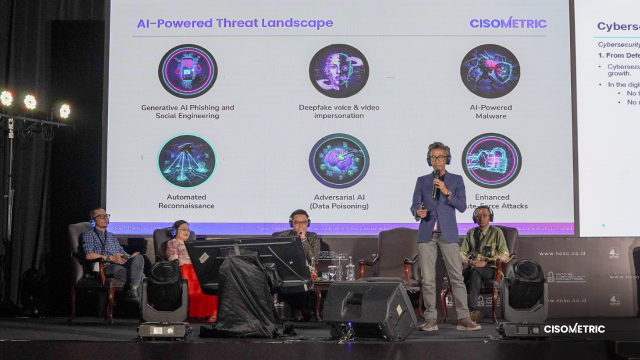
In this session, Hana Abriyansyah, CEO & Founder of Cisometric, highlighted how artificial intelligence has become both a game-changer and a disruptor in cybersecurity.
He explained that while AI can enhance defense capabilities, it’s also giving rise to a new generation of AI-powered threats, including:
Also read: Phishing: New Methods and How to Stay Safe
Also read: Understanding Malware Threats
Unlike traditional cyber threats, AI-driven attacks are faster, more scalable, more sophisticated, and context-aware, which allows threat actors to automate reconnaissance, personalize phishing attempts, and evade detection with dynamic code.
“Traditional defenses simply can’t keep up with machine-speed threats. To fight AI, we need AI.” Hana emphasized.
Hana also highlighted the need for next-generation SOCs that combine automation, AI-powered analytics, and real-time data processing. Cisometric’s own SOC integrates these technologies with a 5-minute response time, dark web monitoring, and AI-driven threat detection to address the speed, scale, and adaptability of modern attacks.
Also read: What Makes a Next Gen SOC and Why Your Business Needs One Now
Trust, Truth, Threats — Navigating AI Risks in the Digital Era
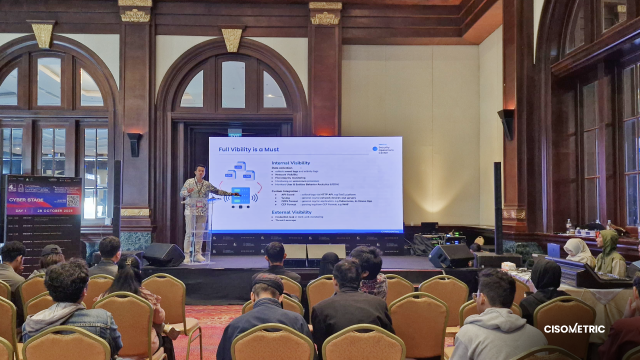
On the Cyber Stage, Muhammad Luqman, Head of Tech Security at Cisometric, also brought the discussion by diving into real-world AI threat cases.
He presented recent findings from CrowdStrike’s 2025 Threat Hunting Report, showing how attackers are now leveraging AI to target wider sectors (from government to retail) through social engineering, technical operations, and information manipulation.
One of the standout examples was the Scattered Spider case, where hackers used AI-powered social engineering calls to trick help desks into resetting credentials and bypassing MFA (Multi-Factor Authentication). Within minutes, attackers gained access to Microsoft 365 environments and exfiltrated corporate data.
Another case involved AI-driven cloud intrusions, where threat actors exploited unmanaged cloud systems and credentials to deploy malware and perform data exfiltration under the guise of legitimate operations.
These cases demonstrate that AI-powered attacks don’t just happen faster. In 2025, they’re smarter, stealthier, and harder to detect.
In Luqman’s session, he outlined four core principles that define an effective modern Security Operations Center (SOC):
1. Full Visibility
You can’t protect what you can’t see. Complete monitoring of all assets, including unmanaged systems and cloud environments, is essential.
2. Reducing False Positives
AI and Machine Learning (ML) models help filter noise, providing analysts with clearer, actionable insights.
3. Speed is Everything
Real-time event detection and rapid mitigation reduce incident impact.
4. Proper Security Control
Technology alone isn’t enough. Continuous improvement and human oversight ensure that tools deliver measurable security outcomes.
He also shared how Cisometric’s SOC leverages AI/ML for use cases such as:
Detecting anomalies like impossible travel or unusual login behavior.
Consolidating multiple failed logins into a single case for faster triage.
Using generative AI to summarize incidents, assess risks, and suggest immediate actions.
These capabilities show how AI can be used responsibly and effectively, not to replace human analysts, but to empower them with faster, smarter insights.
“Buying tools isn’t enough. What matters is how you integrate, monitor, and manage them for real security outcomes.” said Muhammad Luqman.
The discussions at NCSC 2025 underscored a crucial truth of how AI has permanently changed the cybersecurity battlefield. As attacks evolve in speed and sophistication, organizations must evolve too, by building smarter systems, stronger governance, and adaptive defenses.
Through its collaboration with Perkom, Cisometric continues to advocate for AI-driven defense strategies, enabling companies to stay one step ahead of modern threats.
Want to learn more about how Cisometric is applying AI in real-world security operations to strengthen your business’s digital defense?
Schedule a free consultation with our team today, click here.
For more updates on digital scams, cybersecurity insights, and expert tips, follow our social media:
LinkedIn: Cisometric
Instagram: @cisometric
Youtube: @Cisometric
Bagaimana ancaman berbasis AI mengubah operasional SOC? Simak perkembangan terbaru dan kapabilitas deteksi, investigasi, serta respons yang...

Panduan teknis CTI: 3 tingkatan CTI, klasifikasi stealer logs vs combolists, Scattered Spider help desk bypass, IMDS cloud, dan kepatuhan UU...

Panduan teknis membedah batas ukur MTTD dan MTTR, blindspot validasi triage analis, risiko under-classification SLA, dan kapasitas respons a...
Cari Artikel Berdasarkan Kategori
Kami menggunakan cookie untuk meningkatkan pengalaman menjelajah, menganalisis lalu lintas situs, dan menyajikan konten yang relevan. Pilih cookie mana yang Anda izinkan. Kebijakan Privasi