
Shadow AI Security: Mengapa AI Tools Bisa Menjadi Supply-Chain Risk bagi Perusahaan
Kendalikan risiko shadow AI pada rantai pasok enterprise. Identifikasi celah token pihak ketiga dari insiden Vercel dan tata kelola akses ap...

Published on October 5, 2026
An active security incident is a difficult time to discover that the SOC does not have the access required to isolate a workload, that no clear escalation path exists to the engineering team, or that analysts cannot determine whether a configuration change is expected or suspicious.
These are often treated as incident-response problems because they become visible during an incident. In reality, many of them are readiness problems that existed long before the first alert even appeared.
A Security Operations Center (SOC) remains responsible for monitoring, detecting, investigating, and responding to security activity across the operational environment. DevSecOps, though, has a different role: integrating security into how applications, infrastructure, pipelines, identities, and cloud environments are built and operated. Those responsibilities remain distinct, but they become closely connected when the SOC needs to understand what happened and act quickly.
For Rikky Khurniawan, DevSecOps at Cisometric, this relationship is especially important during incident response. His perspective is that response speed is rarely created at the moment an incident occurs. Much of it is determined beforehand through system context, telemetry, access, automation, and agreed response paths.
Also read: Cisometric Drives SOC Effectiveness Through Upstream DevSecOps Engineering
The SOC still owns the incident
DevSecOps supports the response with engineering context and remediation capability.
The handoff should not be improvised
Escalation paths, ownership, and shared context need to exist before an incident occurs.
Automation depends on preparation
SOAR playbooks are useful only when access, APIs, IAM permissions, and approved response actions are already in place.
Monitoring cannot compensate for weak foundations
Poor configuration, inconsistent patching, and missing controls can create recurring noise that slows the SOC down.
Incident-response readiness starts with the environment
Asset visibility, telemetry, hardened baselines, privileged-access controls, and response mechanisms all affect what the SOC can do when an incident becomes real.
Once an incident is confirmed, the operational responsibility becomes clearer.
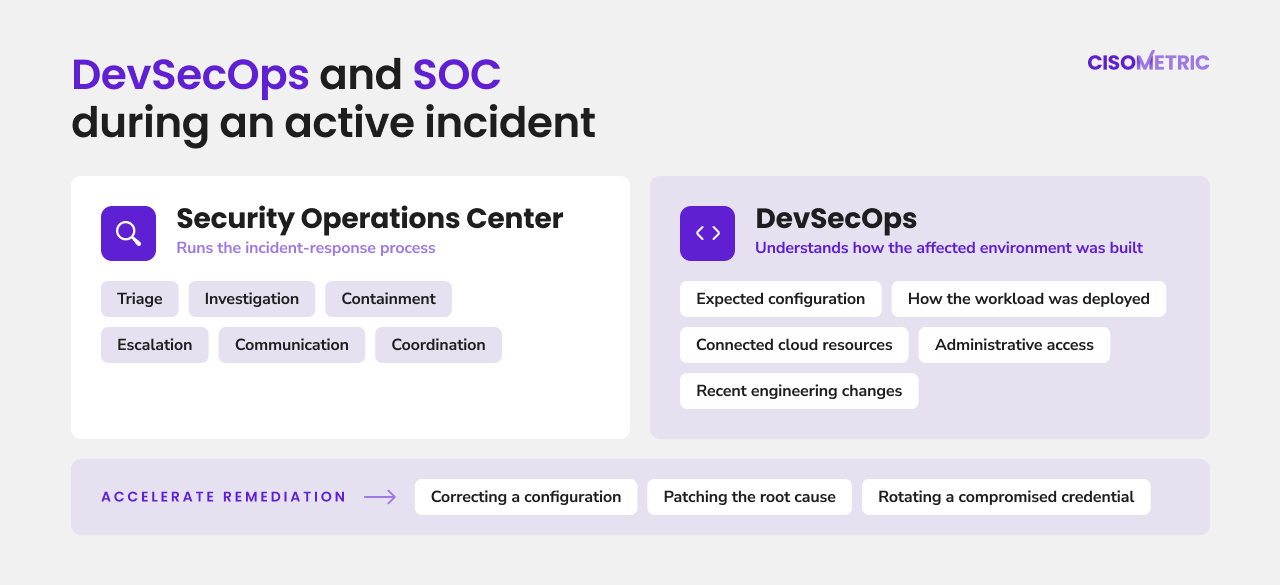
The SOC runs the incident-response process. Depending on the organization and severity of the incident, that includes triage, investigation, containment, escalation, communication, and coordination of the response. This aligns with the broader role of security operations, where analysts identify suspicious activity, establish scope, investigate supporting evidence, and coordinate action against confirmed threats.
DevSecOps does not suddenly become the incident-response team. Their value during the incident comes from knowledge of the affected application, service, workload, pipeline, and infrastructure. The SOC may know that suspicious authentication was followed by an unexpected configuration change, for example, but DevSecOps can help establish what configuration should normally exist, how that workload was deployed, which cloud resources or dependencies are connected to it, which identities have administrative access, and whether a recent engineering change could explain the activity.
Rikky describes this division clearly, how during an active incident, the SOC owns the response, while DevSecOps can be brought in because they understand how the affected environment was actually built. That context can help accelerate remediation, whether the response requires correcting a configuration, patching the actual root cause, or rotating a compromised credential.
This distinction also avoids oversimplifying DevSecOps as something that exists only before production. Modern DevSecOps practices extend through deployment, infrastructure automation, cloud posture, identity governance, continuous security checks, and production monitoring. DevSecOps spans the software lifecycle through ongoing monitoring, with security controls embedded across code, pipelines, infrastructure, identity, and workloads.
The important boundary during an incident is therefore ownership, not whether DevSecOps is still involved.
In Rikky’s operating model, the clearest handoff happens once suspicious activity has been validated as a real incident, “The handoff point is the moment an incident is confirmed real.”
From that point, the SOC runs the incident while DevSecOps supports the response where engineering knowledge or execution is required. The more important part, however, is what needs to happen before that handoff.
The SOC should already know whom to contact for a particular application or infrastructure layer. DevSecOps should understand what information the SOC is likely to require. The escalation route, asset ownership, access model, and expected response responsibilities should already be established. If those connections are built for the first time during an active incident, analysts and engineers may lose time reconstructing information that could have been available from the beginning.
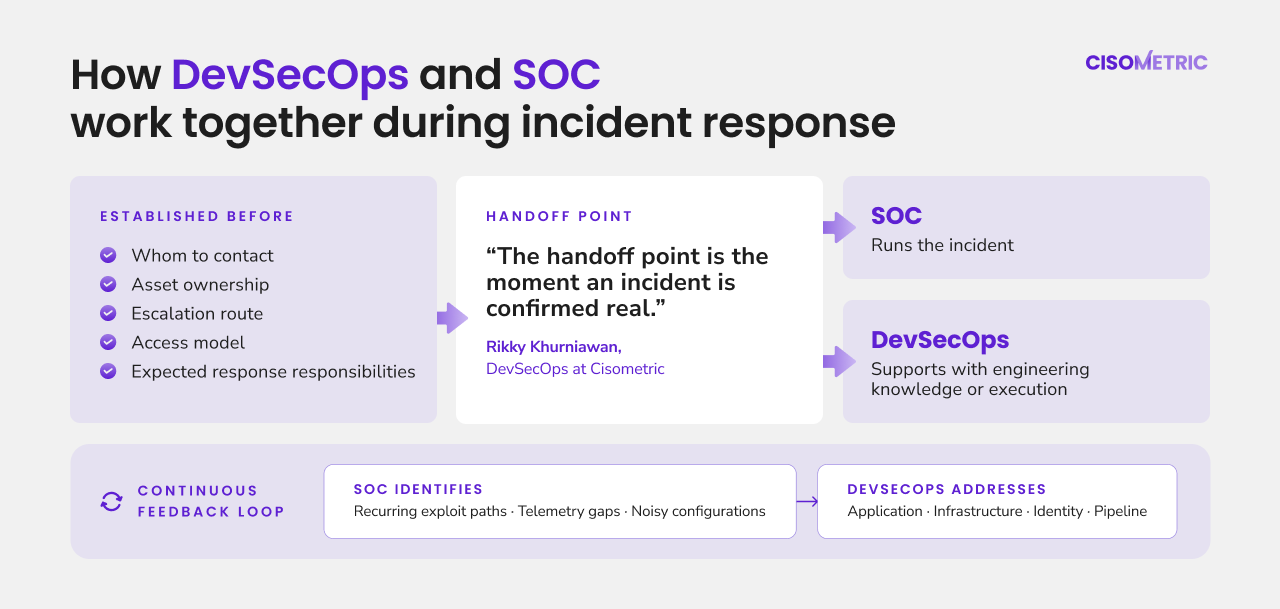
This is one reason the DevSecOps and SOC relationship works better as a continuous feedback loop rather than a one-directional handoff. During normal operations, the SOC can identify recurring exploit paths, telemetry gaps, or noisy configurations. DevSecOps can then address those conditions at the application, infrastructure, identity, or pipeline layer. DevSecOps and SOC can operate as separate functions while still sharing security context and improving one another’s controls.
Automation is often discussed as the mechanism for making incident response faster, but that is only part of the equation.
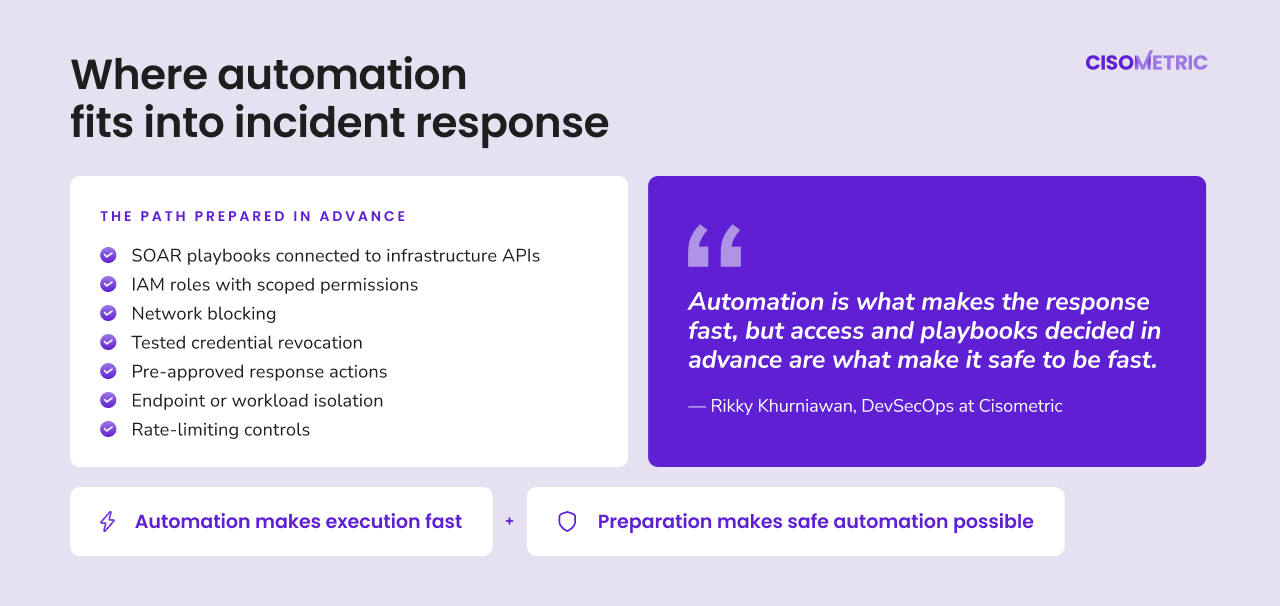
Consider an SOC analyst who confirms that a workload needs to be isolated immediately. An automated playbook can execute that action quickly, but only if the organization has already prepared the path required to perform it, that can include:
SOAR playbooks connected to infrastructure APIs
Pre-approved response actions for known scenarios
IAM roles with appropriately scoped permissions
Endpoint or workload isolation mechanisms
Network blocking capabilities
Rate-limiting controls
Tested credential-revocation processes
Without those foundations, the SOC may identify the correct response but still need to wait for access, engineering changes, approval, or manual provisioning before it can act.
Rikky makes an important distinction between execution and readiness. Automation performs the mechanical step consistently and quickly, but the access model and playbooks must already have been designed and tested. In his view, a trusted, well-scoped playbook that can be executed safely matters more than having a fast automated action nobody fully understands.
“Automation is what makes the response fast, but access and playbooks decided in advance are what make it safe to be fast.”
This is also why automation should not be treated as a substitute for analyst judgment. Security automation can help teams process events and execute response actions more efficiently, but it is designed to complement skilled analysts rather than remove the need to establish whether the evidence justifies an action.
The mechanical question may be “Can we isolate this workload immediately?” but the analytical questions remain, “Should we isolate it, what will that affect, and is this the appropriate response to the evidence we have?”
Automation makes execution fast, but preparation makes safe automation possible.
Rikky shared an example that demonstrates what happens when monitoring capability is introduced into an environment whose underlying security foundations remain inconsistent.
For example, an organization had a large, heterogeneous asset landscape. Different applications and technologies had been implemented by different vendors, with limited documentation, few common standards, and weak integration between systems.
Once these assets were onboarded into the SIEM, SOC began receiving security events. The monitoring capability was functioning, but it was exposing problems in the environment faster than those problems could be resolved.
One mail server configuration allowed unauthenticated SMTP access from certain network segments. This contributed to spam activity, poor IP reputation, and recurring brute-force attempts. Separately, a company website was running a CMS that had not been patched consistently, creating an RCE exposure without a WAF acting as a compensating control.
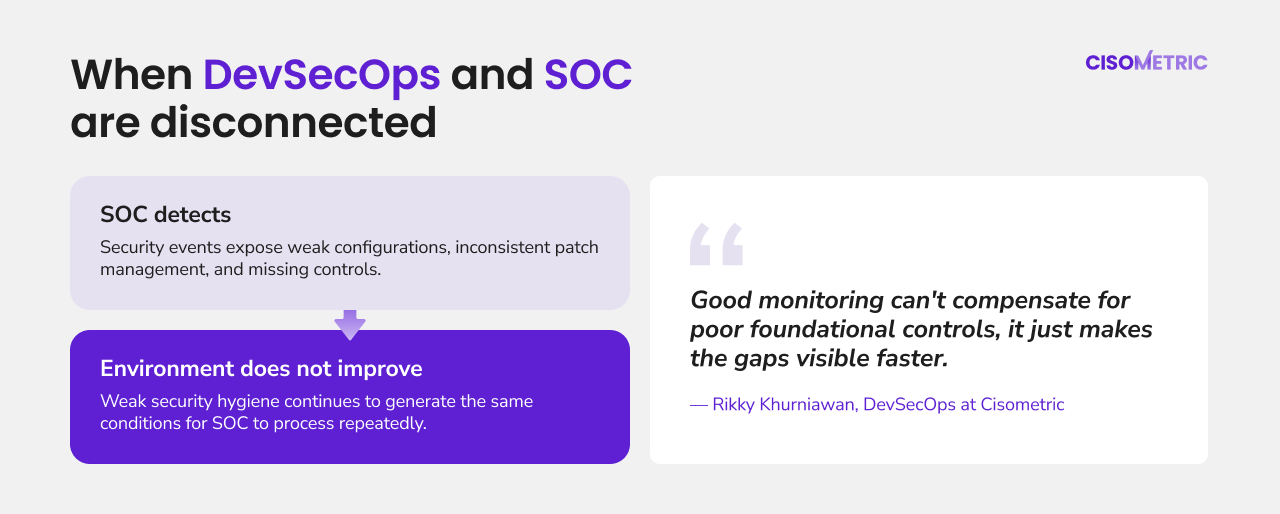
SOC could see the resulting events. The harder problem was that weak security hygiene continued to generate conditions the SOC had to process repeatedly. Unhardened configurations, inconsistent patch management, missing controls, and weak data-sharing practices increased noise and made triage less efficient.
Rikky summarizes this, “Good monitoring can't compensate for poor foundational controls, it just makes the gaps visible faster.”
This distinction matters because a detected event is not always evidence that monitoring needs improvement. Sometimes the detection is working exactly as intended, while the environment keeps reproducing the condition that generated the alert.
A recurring misconfiguration should eventually become a remediation problem, not a permanent SOC workload.
Based on Rikky’s experience, incident-response readiness can be assessed through six practical foundations:
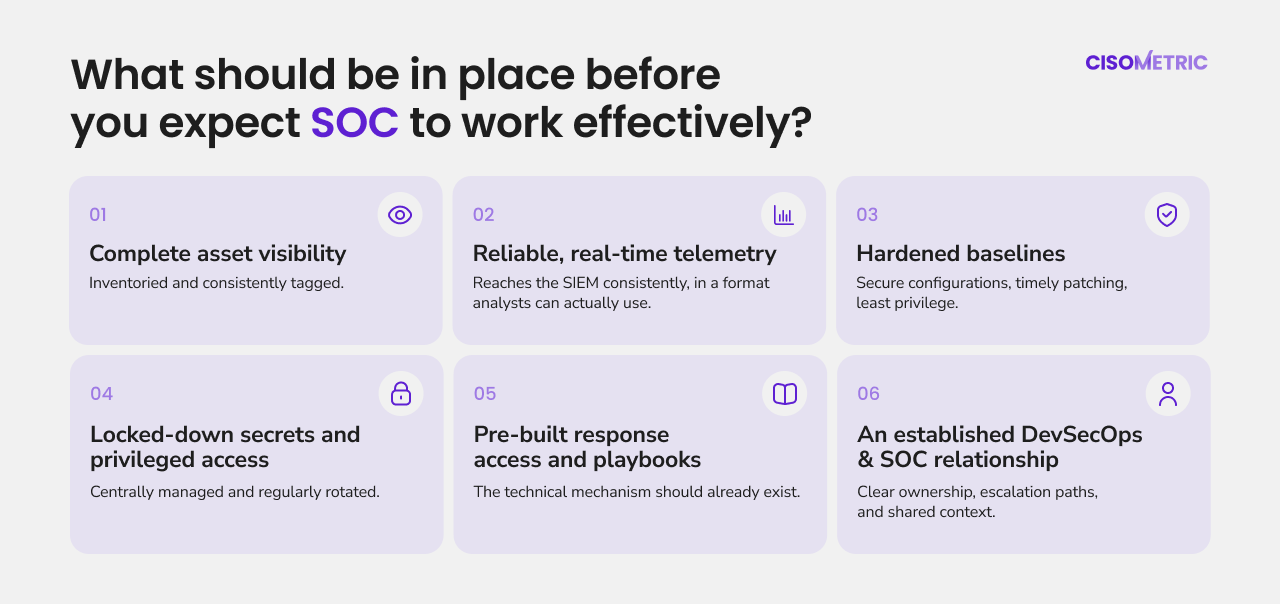
Applications, cloud resources, endpoints, and other relevant workloads should be inventoried and consistently tagged.
The purpose is not inventory for its own sake. During an investigation, analysts need to determine what generated an event, who owns the asset, whether it is production-facing or business-critical, what identities interact with it, and which other systems may fall within the investigation scope.
Logs and security telemetry should reach the SIEM consistently and in a format analysts can actually use.
That means the data needs enough structure and context to support correlation and investigation. Multiple data sources may need to be combined across network, endpoint, cloud, operating system, and application layers to understand an incident rather than viewing each event in isolation.
For Rikky, this is the most important prerequisite. If telemetry is incomplete, delayed, or unreliable, every downstream detection and investigation process starts with weaker evidence.
Secure configurations, timely patching, least privilege, and controlled infrastructure should be the expected operating state.
A defined baseline gives analysts a stronger reference point during investigation. When expected configuration and privilege levels are known, deviations become easier to interpret and remediate.
Credentials should be centrally managed, regularly rotated, and prevented from being exposed through source code or configuration.
Privileged identities also require appropriate governance because the same activity can carry very different risks depending on whether it involves a standard user or an identity capable of modifying production infrastructure.
If the expected response to a confirmed scenario may include isolating a workload, blocking traffic, revoking access, or applying rate limiting, the technical mechanism should already exist.
SOC should not discover during an incident that the necessary API integration, IAM role, approval, or execution path still needs to be created.
The connection between the teams should already include clear ownership, escalation paths, and shared context. This does not require collapsing DevSecOps and SOC into one function. DevSecOps can operate alongside the SOC while maintaining different responsibilities, with collaboration allowing security findings to move between development, operations, and monitoring teams.
The objective is simple. When an incident occurs, the SOC and DevSecOps should already know their roles, escalation paths, and how they are expected to work together.
SOC performance is often assessed through analyst capability, SIEM functionality, detection coverage, incident volume, MTTD, MTTR, and response speed. Those measures matter, but they do not operate independently from the environment the SOC is expected to defend.
As a result, an experienced analyst cannot reconstruct an activity that was never logged, a sophisticated SIEM cannot correlate an unmanaged asset that never produces usable telemetry, a well-designed playbook cannot isolate a workload if the SOC does not have an approved execution path.
Conversely, an environment with clear asset ownership, consistent telemetry, hardened configurations, governed access, and prepared response mechanisms gives SOC stronger evidence and more reliable options when an incident occurs.
This is not an argument that SOC capability matters less, it means SOC capability and environment readiness compound each other. Rikky puts the relationship more sharply, “You don't secure a company at the SOC. You secure it before the SOC ever needs to get involved, and what's left over is what the SOC deals with.”
SOC remains essential because preventive controls cannot eliminate every compromised credential, attack path, malicious action, or unexpected behaviour. DevSecOps also cannot replace continuous monitoring, threat detection, investigation, threat hunting, and incident response. External discussions of the DevSecOps and SOC relationship similarly position the two as complementary functions rather than substitutes.
At Cisometric, the goal is to connect these capabilities more deliberately. DevSecOps strengthens the applications, cloud environments, infrastructure, pipelines, identity controls, telemetry, and response mechanisms on which security operations depend. SOC provides the monitoring, detection, investigation, threat hunting, and incident-response capabilities required when suspicious activity appears in the operational environment.
The objective is therefore broader than making the SOC respond faster, but to give the SOC an environment that is more observable, better prepared for containment, and easier to investigate when every minute matters.
Explore Cisometric’s DevSecOps and Security Operations Center capabilities to strengthen incident-response readiness before an incident begins.
Stay connected with Cisometric for more insights on SOC, AI-powered threats, cyber resilience, and digital trust.
LinkedIn: Cisometric
Instagram: @cisometric
Youtube: @Cisometric
During an active incident, the SOC generally owns triage, investigation, containment, escalation, and incident coordination. DevSecOps can support the response by providing detailed knowledge of the affected application, workload, infrastructure, deployment process, expected configuration, dependencies, identity controls, and recent changes. This context can help the SOC understand the environment surrounding the evidence and accelerate root-cause remediation.
At Cisometric, DevSecOps and SOC capabilities are designed to work as connected security functions, helping organizations combine operational detection and response with the engineering context needed to resolve incidents more effectively.
No. DevSecOps and SOC address different parts of the security lifecycle. DevSecOps integrates security into software, infrastructure, cloud, identity, and delivery processes, while SOC continuously monitors the operational environment and investigates and responds to suspicious activity. Their effectiveness improves when findings and context can move between both functions.
Cisometric supports both sides of this relationship through DevSecOps and SOC capabilities that strengthen preventive controls, monitoring, investigation, and incident response across the same security environment.
DevSecOps can prepare the technical mechanisms required for response before an incident occurs. These may include SOAR integrations, infrastructure APIs, appropriately scoped IAM permissions, isolation mechanisms, traffic controls, and pre-approved playbooks. SOC can then execute an established response path instead of requesting new access or engineering work during the incident.
At Cisometric, this readiness is supported by connecting DevSecOps engineering with SOC operations, helping ensure that access paths, telemetry, and response mechanisms are prepared before they are needed during an active incident.
An SOC-ready environment should have complete asset visibility, reliable telemetry, hardened security baselines, governed secrets and privileged access, predefined response mechanisms, and established escalation paths between SOC and relevant engineering teams. These foundations give analysts both the evidence and the operational access required to investigate and respond effectively.
Cisometric can help organizations assess and strengthen these foundations through DevSecOps and SOC capabilities that address both environment readiness and operational security response.
During an incident, time can be lost if teams first need to identify asset owners, locate system context, request access, determine escalation routes, or establish who is responsible for remediation. Preparing these relationships in advance allows SOC and DevSecOps teams to work from a shared context once an incident is confirmed.
At Cisometric, DevSecOps and SOC are treated as connected parts of the security lifecycle, helping organizations establish clearer ownership, escalation paths, and response readiness before an incident occurs.
Kendalikan risiko shadow AI pada rantai pasok enterprise. Identifikasi celah token pihak ketiga dari insiden Vercel dan tata kelola akses ap...

Membandingkan model Bring Your Own SIEM (BYOS) dan platform managed SIEM: kapabilitas deteksi, TCO aktual, biaya migrasi, dan matriks keputu...

Perbandingan mendalam In-House SOC dan Managed SOC berdasarkan biaya operasional, kebutuhan analis 24/7, regulasi OJK dan BI, serta kesiapan...
Search Article by Category
We use cookies to enhance your browsing experience, analyse site traffic, and deliver relevant content. Choose which cookies you allow. Privacy Policy