
Evaluasi SLA SOC: Apa yang Perlu Diperiksa di Setiap Severity Level?
Pahami cara mengevaluasi SLA SOC berdasarkan severity tier, komitmen waktu respons, MTTD, MTTR, volume caps, dan sinyal Informational.

By Cisometric Marketing Team, Published on September 23, 2026
A Security Operations Center (SOC) cannot investigate an event that was never logged, correlate activity across an asset that was never inventoried, or reconstruct an incident when telemetry arrives late, malformed, or without enough context to determine what produced it. Long before an SOC analyst sees an alert, decisions made across application development, cloud infrastructure, identity, CI/CD pipelines, logging, and system configuration have already influenced how much of the environment will actually be visible to security operations.
Also read: SOC Analyst Tiers Explained: How L1, L2, and L3 Work Together to Support Security Investigations
This is where DevSecOps intersects with the SOC.
At Cisometric, Rikky Khurniawan works in DevSecOps, operating upstream of the SOC within the engineering and delivery pipeline. His technical background spans from security operations, ethical hacking, malware analysis and triage, network security, cloud architecture, cloud security, to adversary-focused security practices. His credentials include CCNA, Cisco Ethical Hacker, Fundamental Security Operations, Practical Ethical Hacking (PEH), Practical Malware Analysis & Triage (PMAT), Acronis Cloud Tech Professional, Fortinet Network Security Expert, CyberArk Certified Trustee, MITRE ATT&CK Defender, Google Cloud Professional Cloud Architect, and AWS Cloud Academy Foundations.
His role focuses on building security into how systems are designed, deployed, configured, and maintained before those systems generate the events a SOC will eventually need to investigate. This includes secure SDLC (Software Development Life Cycle), practices, infrastructure and cloud hardening, IAM (Identity and Access Management), pipeline security, supply-chain integrity, secrets management, and the observability foundations that make production activity detectable in the first place.
“SOC analysts can only detect what DevSecOps has already made detectable.”
That principle changes how SOC effectiveness should be evaluated. Analyst skill, detection logic, SIEM (Security Information and Event Management) capabilities, and incident response procedures remain critical, but all of them operate on top of an environment whose visibility, exposure, and telemetry quality were largely established upstream.
SOC visibility is partly engineered before monitoring begins
Asset inventory, instrumentation, logging, identity context, and telemetry architecture determine what analysts can observe and correlate.
DevSecOps and the SOC operate at different points in the security lifecycle
DevSecOps embeds controls into applications, infrastructure, and delivery pipelines, while the SOC detects, investigates, and responds to activity occurring in production.
Telemetry quality matters more than raw volume
Logs need to be reliable, structured, timely, attributable, and useful for a defined detection or investigation purpose.
Hardening changes downstream workload
Patching, least privilege, secrets governance, secure configuration, and pipeline controls can remove avoidable attack paths and reduce recurring low-value security events.
The relationship should work in both directions
SOC findings should feed back into infrastructure hardening, telemetry improvements, pipeline controls, and response preparation.
DevSecOps operates upstream of the SOC, within the engineering and delivery lifecycle. Their responsibility is to embed security into how applications and infrastructure are developed and operated rather than introducing security as a final review once the system is already approaching production.
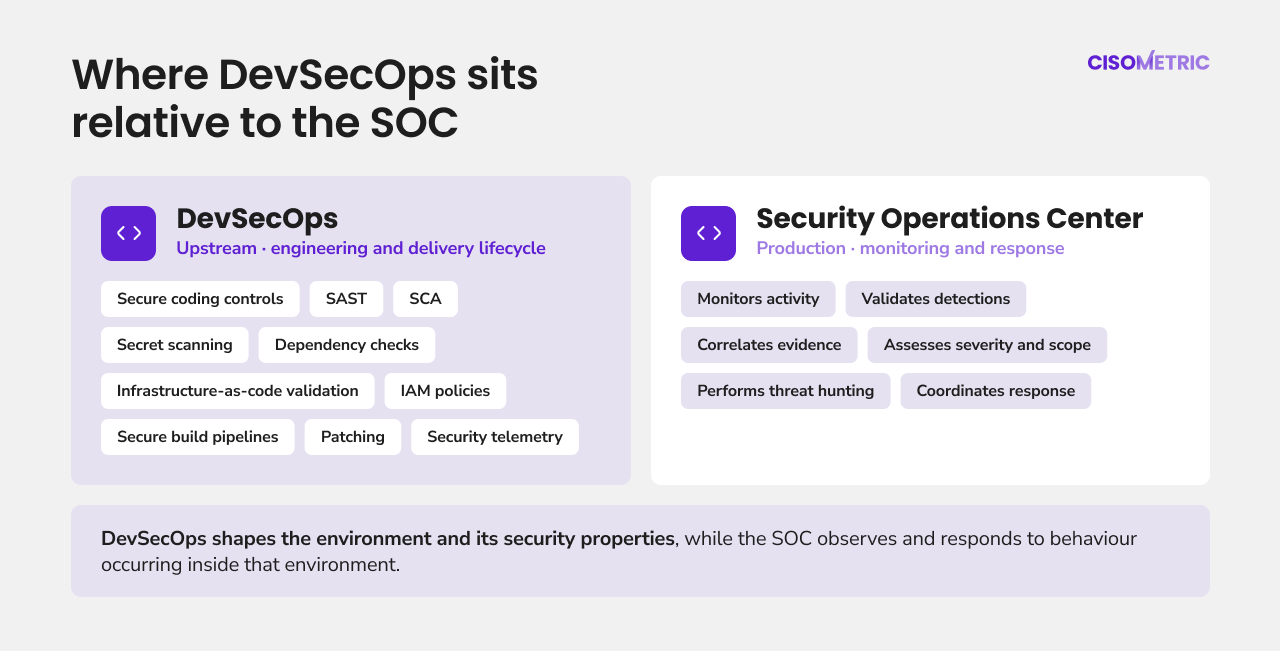
In practical terms, that can include secure coding controls, SAST, Software Composition Analysis (SCA), secret scanning, dependency checks, infrastructure-as-code validation, IAM policies, secure build pipelines, artifact integrity, cloud posture management, patching, configuration baselines, and security telemetry. Secure software development is seen as practices integrated into the SDLC to reduce vulnerabilities in released software, reducing their potential impact, and addressing recurring root causes.
SOC works at a different point in that lifecycle. Once applications, identities, workloads, endpoints, and infrastructure are operating in production, the SOC monitors their activity, validates detections, correlates evidence, assesses severity and scope, performs threat hunting, and coordinates response when suspicious activity becomes an incident.
The dividing line should therefore not be simplified into “DevSecOps prevents, SOC detects.” Security controls exist on both sides. A more useful distinction is that DevSecOps shapes the environment and its security properties, while the SOC observes and responds to behaviour occurring inside that environment.
This also explains why one function cannot replace the other. Secure development and hardened infrastructure cannot remove every attack path, compromised identity, zero-day, or malicious action. At the same time, a SOC cannot compensate indefinitely for exposed credentials, unmanaged assets, excessive privileges, or applications that fail to produce usable security telemetry.
A SOC analyst works from evidence. If an application does not record a security-relevant event, a cloud resource sits outside inventory, or a telemetry source disappears without warning, the detection problem is no longer simply about writing a better correlation rule.
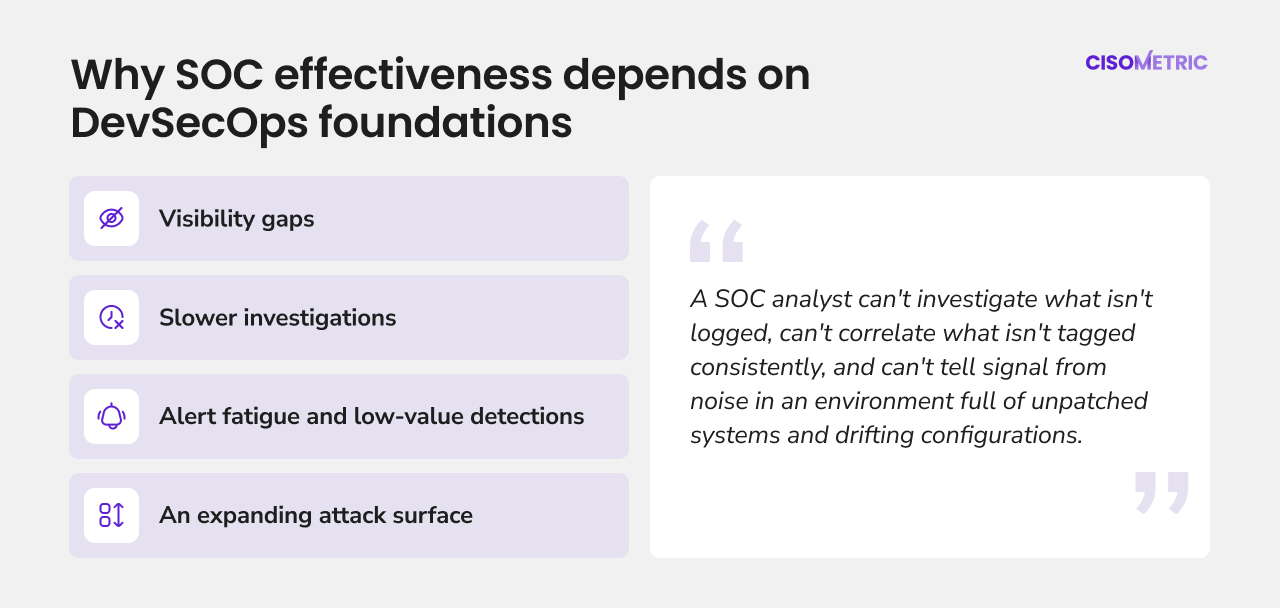
Rikky describes this dependency directly:
“A SOC analyst can't investigate what isn't logged, can't correlate what isn't tagged consistently, and can't tell signal from noise in an environment full of unpatched systems and drifting configurations.”
Without strong DevSecOps foundations, SOC detection, visibility, and incident investigation can become less effective:
Services may be deployed without adequate logging, cloud resources may never be consistently tagged or inventoried, and applications may omit security-relevant events from their audit trails. In dynamic cloud environments, visibility becomes particularly important because distributed workloads and changing infrastructure can create gaps in monitoring coverage.
The problem is not simply that the SOC has fewer logs. Missing telemetry can remove part of the incident sequence entirely. If the analyst can observe an anomalous login but cannot see the subsequent privilege change, application action, or cloud configuration event, correlation and scoping become less reliable.
Unpatched systems, excessive permissions, recurring misconfigurations, and unstable security baselines can also increase the volume of activity the SOC needs to assess. Alert overload becomes particularly difficult when detections lack sufficient context or prioritization, making it harder for analysts to distinguish events requiring investigation from lower-value activity. SOC triage depends on separating noise from impactful events so analysts can prioritize alerts according to severity and business impact.
Importantly, not every low-value alert is necessarily a false positive. A control may correctly detect a real policy violation or insecure state, but if the same unresolved weakness continuously generates alerts, the SOC is repeatedly spending time on a condition that should be remediated upstream.
The remedy therefore depends on the source of the problem. Poor detection logic requires tuning, and persistent security debt requires fixing the environment producing the signal.
Even when an alert is valid, investigations become slower when the surrounding context is incomplete. Analysts may need to determine which asset generated the event, who owns it, whether the identity involved is privileged, whether the workload is production-facing, and what related network, endpoint, application, or cloud activity occurred around the same period.
Knowing which assets matter and understanding which events can threaten business continuity when prioritizing security events is very important. Without that context, severity assessment becomes less precise and analysts may spend additional time rebuilding information that should already be attached to the event
Exposed secrets, vulnerable dependencies, permissive IAM, unpatched services, insecure configurations, and poorly governed cloud resources create additional attack paths that security operations must continuously monitor. Microsoft identifies identity abuse, vulnerable third-party packages, infrastructure misconfiguration, and secrets exposed in source repositories as risks that DevSecOps controls are designed to address earlier in the lifecycle.
The SOC still needs detection coverage for these conditions when they exist, but monitoring an exposure is not the same as removing it. Strong upstream controls reduce how much unnecessary risk enters production in the first place.
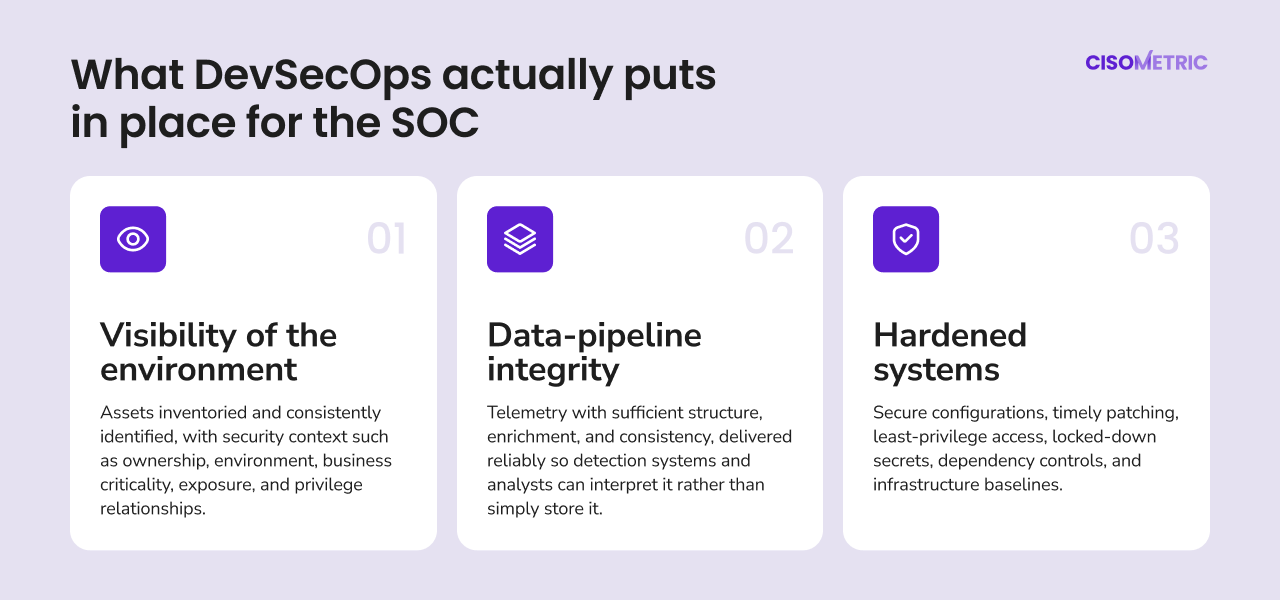
Rikky groups the DevSecOps contribution into three critical layers: visibility of the environment, data-pipeline integrity, and hardened systems.
The SOC first needs to know what it is expected to defend.
Applications, endpoints, cloud resources, network infrastructure, externally exposed services, service accounts, and other relevant assets should be inventoried and consistently identified. This inventory becomes more useful when it includes security context such as ownership, environment, business criticality, exposure, privilege relationships, and system purpose. A hostname or IP address tells an analyst where an event originated; it does not necessarily tell them how urgently that event should be treated.
Consider the same authentication anomaly occurring against two identities. One belongs to a standard test account, while the other is a privileged service account capable of making changes to production infrastructure. The event type may be identical, but severity and escalation decisions should not be.
Complete asset visibility therefore supports both coverage and prioritization. It allows detection logic and analysts to evaluate behaviour against the actual importance and exposure of the entity involved.
For Rikky, reliable data pipelines into the SIEM are the non-negotiable layer.
“A well-hardened environment with broken log pipelines still leaves the SOC blind during the moment it matters most.”
Applications, cloud platforms, endpoints, identity systems, network infrastructure, and security controls may all generate useful events, but those events still need to reach the monitoring stack reliably. Telemetry needs sufficient structure, enrichment, and consistency so detection systems and analysts can interpret it rather than simply store it.
The pipeline also has operational requirements of its own. Log sources can stop sending data, integrations can fail, schemas can change, or events can arrive too late to support timely detection. Rikky specifically notes that maintaining reliable telemetry as applications and cloud resources evolve is a continuous discipline rather than a one-time integration project.
That makes telemetry health part of security operations. A broken pipeline does not need to look like an attack to create security risk, as it can simply remove the evidence needed to identify one.
The third layer concerns the security state of the environment itself. Secure configurations, timely patching, least-privilege access, locked-down secrets, dependency controls, and infrastructure baselines reduce the number of weaknesses that can become exploitable production conditions.
This upstream model through practices such as shift-left testing, security as code, automated code and dependency scanning, infrastructure validation, secret scanning, and container security. Microsoft similarly highlights least privilege, policy-as-code, pipeline security, secrets management, and continuous cloud posture controls as core DevSecOps components.
Rikky connects these controls directly to downstream SOC workload:
“Every vulnerability caught in code review, every dependency patched before deployment, and every misconfiguration blocked before it reaches production is one less thing that can ever become an alert, an investigation, or an incident.”
Hardening does not remove the need for detection, it gives detection a cleaner baseline. When infrastructure is expected to follow defined configurations and privilege is deliberately constrained, deviations from those states become more meaningful.
Getting an environment ready for SOC operations is largely foundational engineering work. Relevant data sources need to be identified, configured to capture meaningful security activity, and connected to the monitoring stack in a way that preserves enough context for detection and investigation.
Rikky highlights application logs, cloud audit trails, network-flow data, and endpoint telemetry as examples of sources that may need to be prepared. Most platforms do not necessarily capture every detail required for a security investigation by default, so teams need to determine which events and fields are actually required for the threat scenarios they intend to detect.
Applications, cloud infrastructure, endpoints, and network systems each provide different pieces of the security picture. The challenge is ensuring those signals arrive in a form that can be used together.
If an application records a failed authentication but the event cannot be reliably linked to the user identity, workload, environment, or surrounding activity, the SOC receives the event without enough investigative context. A cloud audit event may be technically complete but still difficult to prioritize if the underlying resource lacks ownership or criticality information.
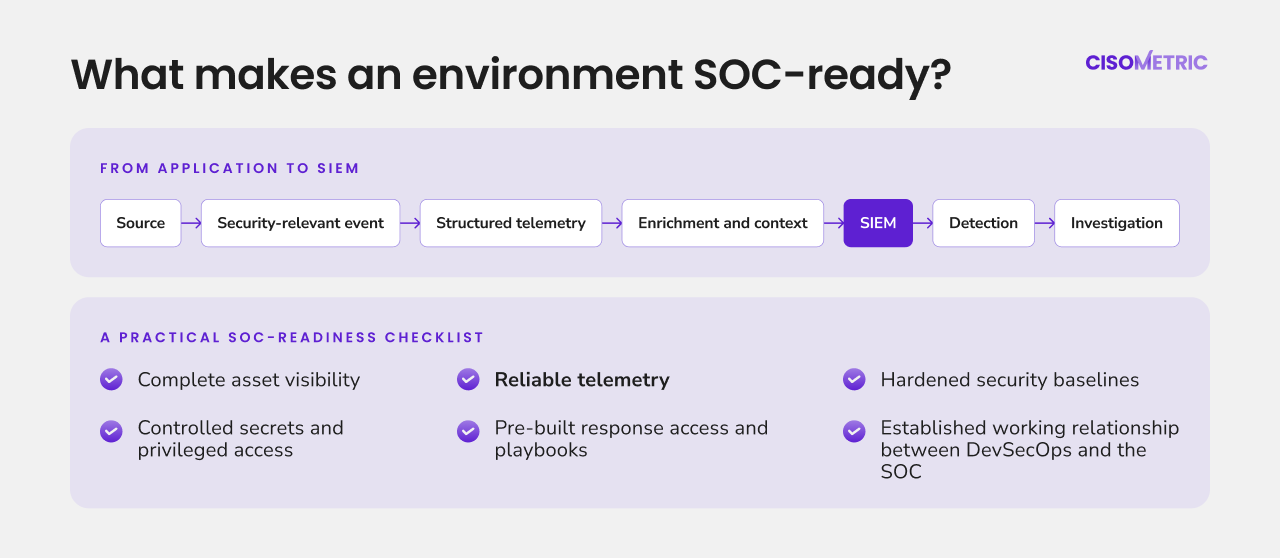
The flow therefore needs to extend beyond basic forwarding:
Source → security-relevant event → structured telemetry → enrichment and context → SIEM → detection → investigation
This is why Rikky emphasizes structured, enriched, and reliably delivered telemetry rather than log presence alone.
More telemetry does not automatically produce better visibility. Rikky notes that log volume can grow faster than teams expect, creating higher SIEM ingestion costs or leaving analysts with large quantities of noise that still need to be tuned and managed.
The objective should therefore be usable evidence, not maximum ingestion. A SOC-ready environment should collect enough information to support the detection and investigation scenarios relevant to that organization. Logs that are duplicated, inconsistently structured, missing important fields, or disconnected from asset context can add volume without providing proportional investigative value.
The more useful question is not “How much data are we sending to the SIEM?” It is “Can this data tell the SOC what happened, where it happened, who or what was involved, and whether the activity warrants escalation?”
Rikky identifies six upstream requirements organizations should establish before expecting an in-house or outsourced SOC to operate effectively:
Complete asset visibility
Reliable telemetry
Hardened security baselines
Controlled secrets and privileged access
Pre-built response access and playbooks
Established working relationship between DevSecOps and the SOC
If only one area can be prioritized first, he places reliable telemetry at the top. Asset visibility tells analysts where to look and hardening reduces how much exposure they need to monitor, but neither compensates for missing, delayed, or malformed evidence reaching the detection stack.
This is where DevSecOps directly changes the SOC's workload. A vulnerability caught during code review is one less weakness that may reach production, a vulnerable dependency blocked during the build process does not become another exploitable path, an exposed secret detected before deployment does not become a credential the SOC later needs to investigate.
DevSecOps creates an ongoing security feedback loop from development into production, with automated controls identifying vulnerabilities, exposed secrets, insecure configurations, and policy violations throughout CI/CD workflows.
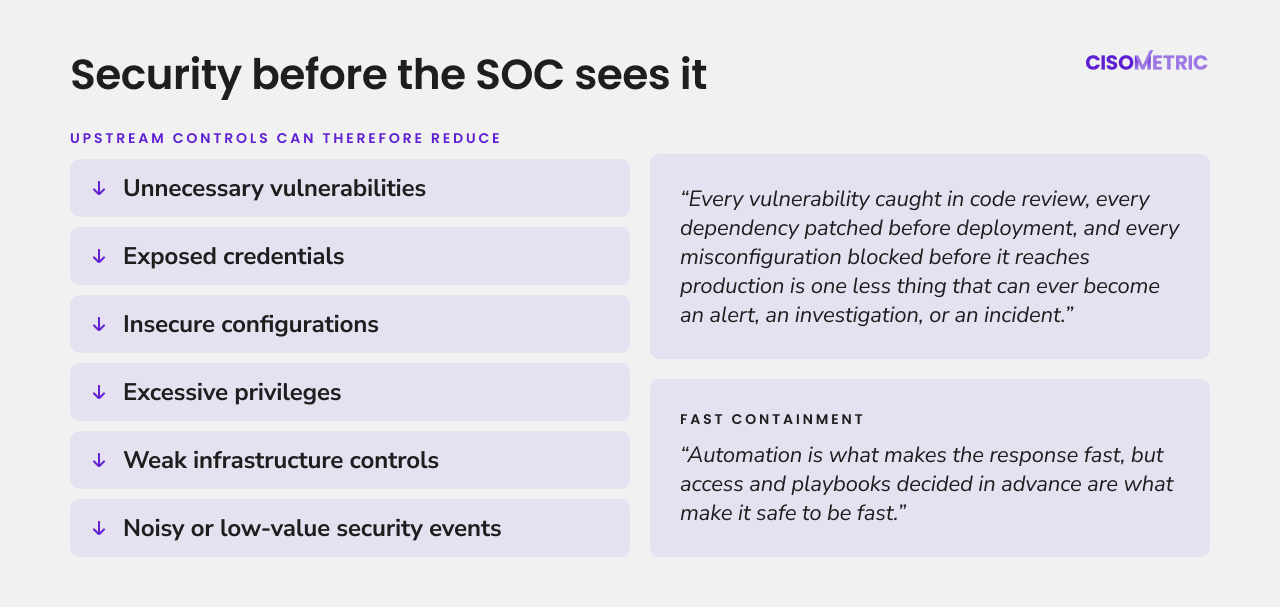
Upstream controls can therefore reduce:
Unnecessary vulnerabilities
Exposed credentials
Insecure configurations
Excessive privileges
Weak infrastructure controls
Noisy or low-value security events
Rikky connects those controls directly to downstream SOC workload:
“Every vulnerability caught in code review, every dependency patched before deployment, and every misconfiguration blocked before it reaches production is one less thing that can ever become an alert, an investigation, or an incident.”
The effect is not simply fewer alerts. Consistent baselines can improve the quality of the signal reaching analysts. In an environment where broad administrative privileges are normal, unusual privilege use may be difficult to separate from legitimate activity. In an environment designed around least privilege, the same deviation carries stronger investigative context.
Rikky describes the downstream effect directly:
“Environments with consistent baselines and locked-down configurations produce far fewer of the false positives and low-value alerts that come from things like unpatched systems, overly permissive access, or drifted infrastructure, so analysts spend less time chasing noise and more time on activity that's genuinely worth investigating.”
Upstream security also affects what happens after a threat is confirmed. The SOC may own triage, containment, communication, and incident coordination, but DevSecOps can support remediation through its knowledge of how the affected system was built and deployed.
Fast containment similarly depends on preparation completed before the incident. Isolation, traffic blocking, credential revocation, rate limiting, or other response actions become significantly easier when the required access, infrastructure APIs, approval paths, and playbooks already exist.
As Rikky explains:
“Automation is what makes the response fast, but access and playbooks decided in advance are what make it safe to be fast.”
The result is a SOC that can spend less time repeatedly processing preventable security debt and more time investigating activity that actually requires security judgment.
SOC performance is often evaluated from inside the SOC through analyst capability, detection coverage, alert quality, threat hunting, MTTD, MTTR, and incident response. Those measures remain important, but they do not describe the entire system.
The SOC inherits an environment shaped by application architecture, asset management, identity controls, software dependencies, infrastructure configuration, deployment pipelines, security baselines, and telemetry engineering. These upstream decisions influence what adversaries can exploit, what the SOC can observe, and how confidently analysts can interpret the evidence available to them.
The relationship can be summarized simply as followed:
DevSecOps strengthens the environment → the environment produces better telemetry → the SOC can detect and investigate with stronger evidence.
Rikky puts the central idea more directly, “You don't secure a company at the SOC. You secure it before the SOC ever needs to get involved, and what's left over is what the SOC deals with.”
At Cisometric, DevSecOps and Security Operations Center address different but connected parts of the security lifecycle. DevSecOps helps strengthen the applications, infrastructure, pipelines, access controls, and telemetry on which monitoring depends, while SOC combines security monitoring, detection engineering, skilled analysts, threat hunting, and incident response to identify and investigate activity across the production environment.
Explore Cisometric’s DevSecOps and Security Operations Center capabilities to strengthen the environment before detection begins and improve the evidence available when security incidents occur.
Stay connected with Cisometric for more insights on SOC, AI-powered threats, cyber resilience, and digital trust.
LinkedIn: Cisometric
Instagram: @cisometric
Youtube: @Cisometric
DevSecOps improves the conditions in which the SOC operates by strengthening asset visibility, telemetry coverage, infrastructure configuration, IAM, secrets management, and software-delivery controls. These foundations can reduce preventable attack paths and give SOC analysts more reliable evidence for detection, correlation, severity assessment, and investigation. Cisometric supports this connection between upstream security engineering and downstream SOC operations, helping organizations strengthen both the environment and the monitoring capabilities built around it.
A SOC-ready environment has clearly identified assets, reliable security telemetry, sufficient application and infrastructure logging, hardened configurations, governed identities, and known response paths. The goal is not to send every available event into a SIEM, but to ensure that the SOC receives the evidence required to detect and investigate relevant threat behaviours. Cisometric can help organizations assess these readiness requirements and address gaps in telemetry, infrastructure security, and monitoring coverage before they affect SOC performance.
No. DevSecOps can reduce vulnerabilities and build security controls into applications, infrastructure, and deployment workflows, but production systems still require continuous monitoring, detection, investigation, threat hunting, and incident response. DevSecOps and the SOC operate at different stages of the security lifecycle and are most effective when findings from each function improve the other. At Cisometric, DevSecOps and SOC capabilities support these different but connected stages, helping organizations strengthen both preventive controls and operational detection and response.
SOC detection and investigation depend on the data generated by applications, endpoints, cloud infrastructure, identities, networks, and security controls. Incomplete, delayed, malformed, or poorly contextualized telemetry can create blind spots, weaken correlation, and slow severity and scope assessment. Reliable telemetry pipelines therefore form part of the security architecture rather than serving only as a logging mechanism. Cisometric can support organizations in identifying telemetry gaps, improving data availability for security monitoring, and strengthening the evidence available to SOC analysts during investigation.
Cisometric’s Security Operations Center supports organizations through security monitoring, detection engineering, investigation, threat hunting, and incident response. Cisometric can also help identify visibility and operational gaps that affect detection effectiveness, including custom telemetry requirements, infrastructure security issues, and areas where monitoring coverage needs further improvement. By connecting these upstream and downstream security requirements, Cisometric helps organizations build an environment that is better prepared for effective detection and response.
Pahami cara mengevaluasi SLA SOC berdasarkan severity tier, komitmen waktu respons, MTTD, MTTR, volume caps, dan sinyal Informational.

Membandingkan model Bring Your Own SIEM (BYOS) dan platform managed SIEM: kapabilitas deteksi, TCO aktual, biaya migrasi, dan matriks keputu...

Perbandingan mendalam In-House SOC dan Managed SOC berdasarkan biaya operasional, kebutuhan analis 24/7, regulasi OJK dan BI, serta kesiapan...
Search Article by Category
We use cookies to enhance your browsing experience, analyse site traffic, and deliver relevant content. Choose which cookies you allow. Privacy Policy