
Metrik MTTD dan MTTR: Cara Mengukur Efektivitas Respons dan SLA SOC
Panduan teknis membedah batas ukur MTTD dan MTTR, blindspot validasi triage analis, risiko under-classification SLA, dan kapasitas respons a...
By Cisometric Marketing Team, Published on September 14, 2026
AI is changing how threat actors prepare, execute, and sustain cyber operations.
Reconnaissance can be accelerated, phishing lures can be adapted to individual targets, and malware development can involve considerably less manual effort. More recently, threat intelligence has also documented AI being used to support vulnerability exploitation and autonomous task execution.
For a Security Operations Center (SOC), the important question is what these developments change in practice. Does an AI-assisted intrusion require an entirely different detection architecture, or does it place greater pressure on the capabilities SOC teams already depend on?
AI is changing the operational characteristics of attacks, while many of the underlying techniques and investigative requirements remain familiar. Understanding that distinction helps security teams prioritize improvements based on actual detection and response gaps rather than the presence of AI alone.
AI is accelerating established attack techniques. Threat actors can use AI to reduce manual effort across reconnaissance, social engineering, malware development, and post-compromise activity, increasing the speed and scale of operations.
Autonomous capabilities are emerging, but their adoption remains uneven. Agentic AI can support iterative decision-making and tool execution, although reliability and operational constraints continue to limit large-scale autonomous attacks.
SOC detection architecture remains relevant, but coverage must be validated. Endpoint, identity, network, cloud, and application telemetry still provide opportunities to identify malicious activity. The priority is to address blind spots and ensure detection logic can identify relevant attack behaviour.
Investigative depth and response readiness become more critical. SOC teams need to maintain detection accuracy, correlate evidence, assess severity and scope, and execute appropriate containment within shorter decision windows.
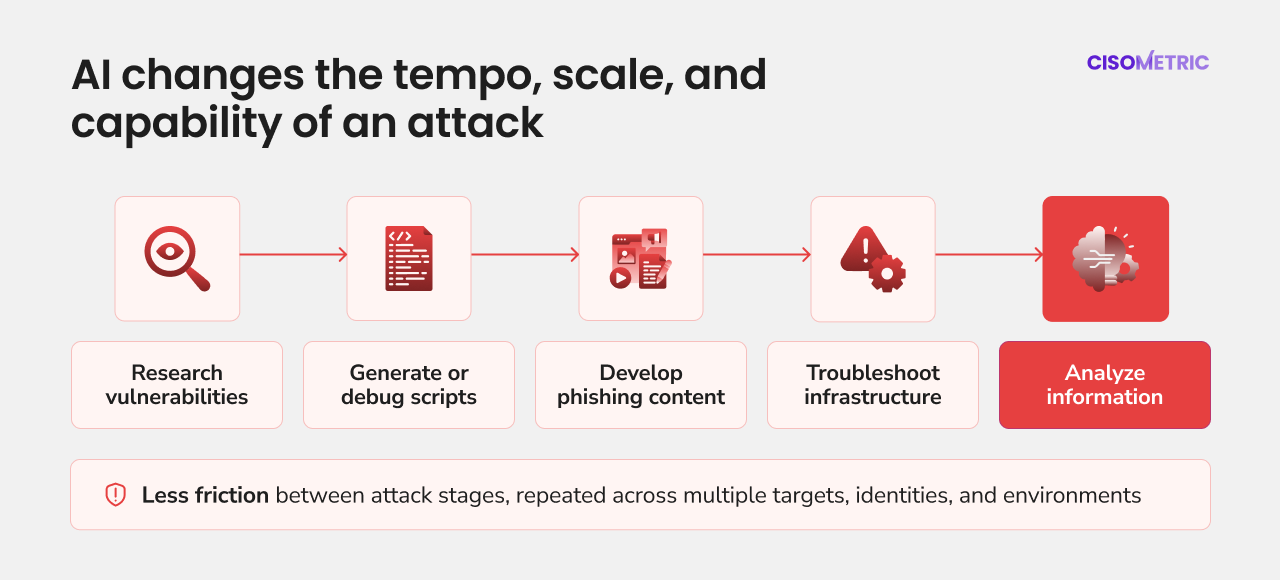
AI can reduce the manual effort required across multiple stages of the attack lifecycle. Threat actors can:
Use language models to research vulnerabilities
Generate or debug scripts
Develop phishing content
Troubleshoot infrastructure
Analyze information collected after compromise
These activities previously required varying levels of technical expertise and time. AI-assisted tooling can make them faster to perform and easier to repeat.
Microsoft Threat Intelligence has documented this pattern across reconnaissance, resource development, social engineering, malware development, and post-compromise operations. Its reporting on North Korean threat actors, including Jasper Sleet and Coral Sleet, illustrates how AI can support fraudulent identity development, targeted lures, technical troubleshooting, and the sustained misuse of legitimate access.
The operational consequence is a reduction in friction between attack stages. An attacker who can research a target, adapt a payload, and analyze the results more quickly may be able to progress before defenders have completed triage or escalation. AI also makes it easier to repeat workflows across multiple targets, identities, and environments, increasing the amount of activity a SOC may need to distinguish from legitimate behaviour.
The capability shift is becoming more significant in vulnerability research.
In its AI Threat Tracker, Google Threat Intelligence Group (GTIG) reported identifying a zero-day exploit that it assessed with high confidence had been developed with AI assistance. The vulnerability involved a two-factor authentication bypass in a web-based system administration tool, although valid credentials were still required. GTIG worked with the vendor to disclose the vulnerability and disrupt the planned mass exploitation activity.
This does not mean AI makes every threat actor an expert or that AI-generated exploits are consistently reliable. It does, however, demonstrate that AI can augment specialized technical work, including the identification of logic flaws that may be difficult for conventional scanners to detect.
For defenders, the relevant concern is how quickly an attacker can move from vulnerability discovery to a working exploit, particularly when the affected asset is internet-facing or provides access to critical systems.
Traditional automation executes predefined instructions. Agentic AI introduces the ability to pursue an objective through iterative steps, invoke tools, evaluate results, and adjust subsequent actions. In an offensive context, this can reduce the need for a human operator to direct every stage of an intrusion.
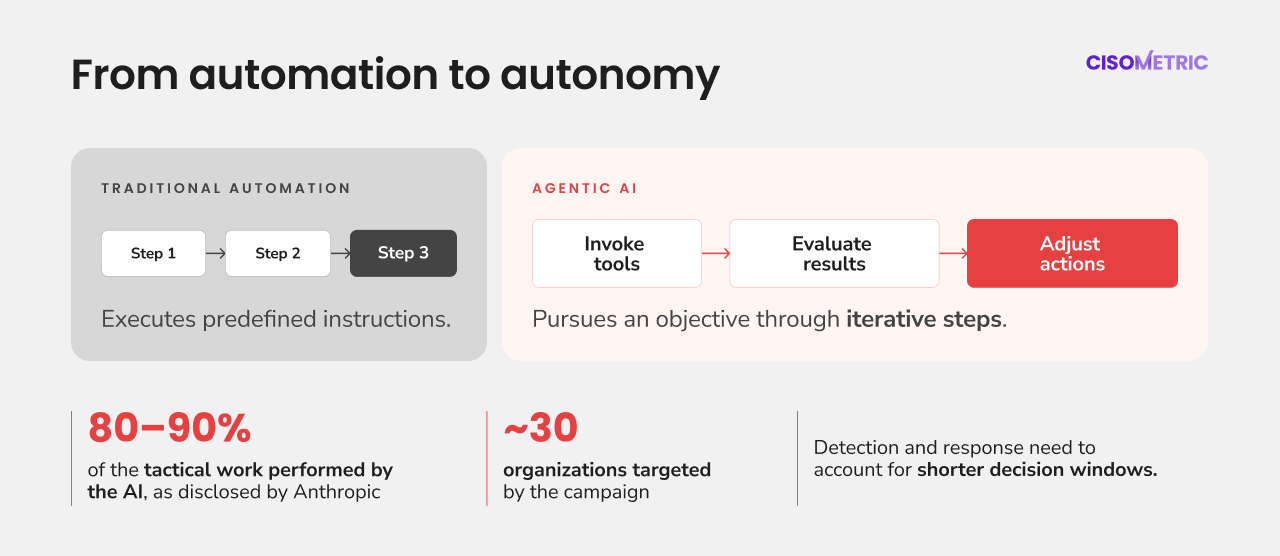
A significant example was disclosed by Anthropic, where the company reported disrupting a China-nexus espionage campaign in which an attacker used a jailbroken AI coding agent to conduct reconnaissance, identify and test vulnerabilities, harvest credentials, and extract data. Anthropic estimated that the AI performed 80–90% of the tactical work, while human operators retained control over targeting and selected decision points. The campaign targeted approximately 30 organizations.
The case illustrates a meaningful development, but it should not be interpreted as evidence that fully autonomous attacks have become the standard operating model.
For SOC teams, the implication is that some adversaries may be able to execute and adapt parts of an attack with fewer pauses for human intervention. Detection and response procedures therefore need to account for shorter decision windows, while recognizing that the actual level of autonomy varies considerably between campaigns.
The response to AI-powered threats should begin with the SOC’s existing operational capabilities. The question is whether those capabilities can maintain sufficient visibility, detection accuracy, and investigative continuity as adversaries become faster and more adaptive.
AI-assisted attacks can still generate recognizable activity across endpoint, identity, network, cloud, and application telemetry.
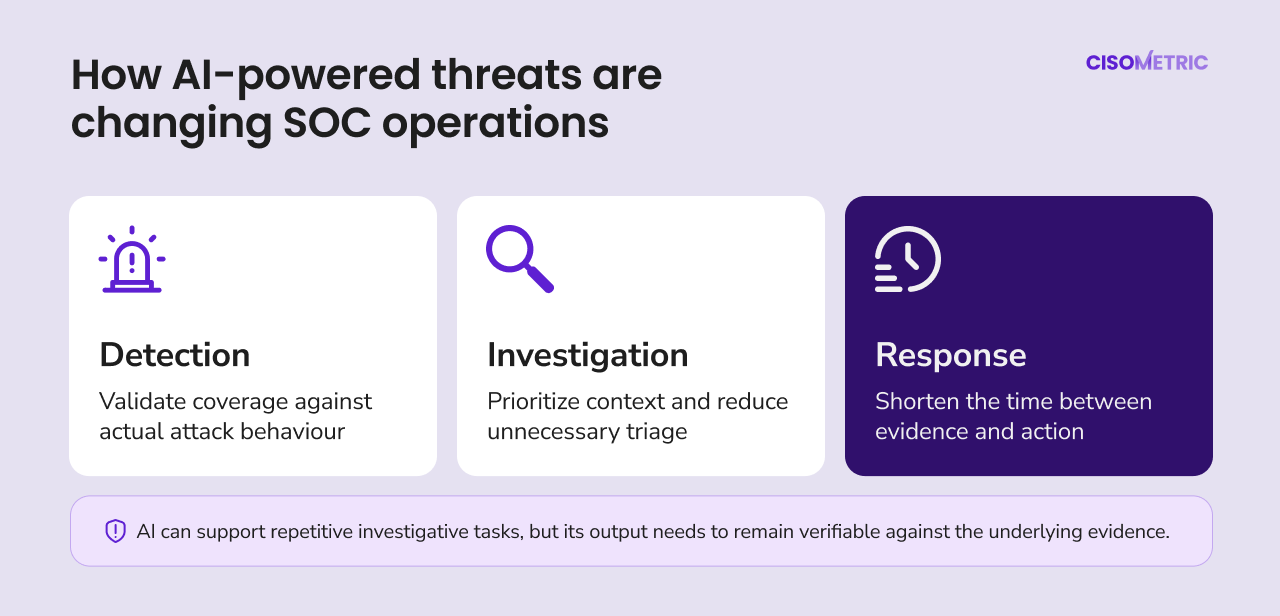
Vulnerability exploitation, credential access, suspicious process execution, lateral movement, and data exfiltration remain relevant detection opportunities. However, coverage needs to be validated against the environment rather than assumed from the presence of a SIEM, EDR, or a set of ATT&CK-mapped rules.
This is particularly important for custom applications, privileged identities, and internet-facing assets that may not be adequately represented in existing monitoring. Detection engineering should assess whether the required telemetry is available, whether rules can identify the relevant behaviour, and whether the resulting alerts provide enough context for investigation. Static indicators remain useful, but behavioural detections and correlation become increasingly important when payloads, infrastructure, or execution patterns change rapidly.
Higher attack volume does not automatically translate into a proportional increase in actionable incidents. A SOC still needs to distinguish true positives from false positives, assess detection confidence, and prioritize cases according to severity, asset criticality, privilege level, and potential impact.
For example, an unusual authentication event involving a standard user may require a different investigation from the same event involving a privileged identity with access to production infrastructure. Correlation with endpoint activity, session history, privilege changes, and network connections may reveal whether the activity is isolated or part of a broader compromise.
AI can support repetitive investigative tasks such as enrichment, telemetry summarization, query generation, and correlation. However, its output needs to remain verifiable against the underlying evidence. An AI-generated incident summary should not become the sole basis for severity assessment or containment when the supporting telemetry is incomplete or contradictory.
A SOC can detect an intrusion early and still lose valuable time if containment decisions are delayed. Response procedures should define which actions can be executed through established playbooks, which require additional approval, and how analysts should escalate when the incident exceeds the current investigation scope.
For well-understood scenarios, automation can support evidence collection, endpoint isolation, account disabling, or session revocation. The appropriate level of automation should depend on detection confidence, asset criticality, and the potential operational impact of the action. Isolating a standard user endpoint, for example, may be appropriate under a predefined playbook, while disabling a privileged service account or interrupting a production system may require additional validation and approval.
Escalation should also preserve the evidence and context already collected, allowing the next SOC analyst to continue the investigation without restarting it. Detection tuning, analyst recommendations, custom telemetry integration, and the use of AI for enrichment and correlation while retaining human judgment for consequential decisions.
Also read: SOC Analyst Tiers Explained: How L1, L2, and L3 Work Together to Support Security Investigations
AI may change how an intrusion is prepared and executed, but it does not remove the need to establish what happened inside the environment.
Many AI-assisted attacks continue to exploit vulnerabilities, abuse credentials, and move through existing trust relationships. The underlying security principles therefore remain relevant, although their implementation and effectiveness need to be continuously validated.
Core SOC capabilities | Why they remain critical against AI-powered threats |
Detection architecture | SIEM, EDR, NDR, and identity monitoring remain relevant because AI-assisted attacks still generate observable activity across endpoint, network, identity, cloud, and application telemetry. |
Evidence-based investigation | Alerts still require validation, correlation, severity assessment, and scoping. AI-generated summaries or recommendations need to be supported by the underlying telemetry before they inform consequential response decisions. |
Security controls | Patching, least privilege, MFA, segmentation, and access controls continue to reduce exposure and limit an attacker’s ability to progress through the environment. |
Incident response procedures | Containment and remediation still require defined playbooks, escalation criteria, approval authority, and an understanding of the potential operational impact. |
Continuous improvement | Investigation findings, false positives, and missed detections should feed back into detection tuning, telemetry coverage, threat hunting, and response procedures. |
The question for security teams is therefore whether these capabilities are working effectively in their own environment. Detection coverage should be validated against relevant attack behaviours, response procedures should be tested, and recurring investigation gaps should lead to measurable improvements rather than remaining unresolved.
AI is increasing the operational pressure on security teams, but the appropriate response is not necessarily to replace existing security architecture with a new set of AI-labelled tools.
Organizations should first understand where their current operation is constrained, such as incomplete telemetry, insufficient detection coverage, excessive false positives, slow escalation, limited threat-hunting capacity, or response procedures that cannot keep pace with the incident.
At Cisometric, our SOC combines security monitoring, detection engineering, skilled analysts, threat hunting, and incident response to support investigations across evolving threat scenarios. Our approach also includes custom integrations for in-house applications and continuous detection improvement, helping organizations address visibility and operational gaps that may otherwise remain outside standard monitoring.
Explore how Cisometric’s Security Operations Center can help your organization strengthen detection coverage, improve investigative capability, and respond to evolving cyber threats.
Stay connected with Cisometric for more insights on SOC, AI-powered threats, cyber resilience, and digital trust.
LinkedIn: Cisometric
Instagram: @cisometric
Youtube: @Cisometric
AI can accelerate reconnaissance, social engineering, malware development, and post-compromise analysis, potentially reducing the time available for defenders to investigate and contain an intrusion. SOC teams therefore need reliable telemetry, effective correlation, risk-based prioritization, and response procedures that can operate within shorter decision windows. Cisometric’s SOC supports these requirements through security monitoring, detection engineering, investigation, and incident response capabilities.
Not necessarily. Many AI-assisted attacks continue to use established techniques such as vulnerability exploitation, credential abuse, lateral movement, and exfiltration. Organizations should validate their existing detection coverage and address gaps before assuming that new tooling is required. Cisometric can support this process through security monitoring, custom telemetry integration, and continuous improvement of detection and response capabilities.
AI can assist with enrichment, summarization, query generation, and other repetitive investigative tasks, but its output still requires appropriate validation. Analysts remain responsible for interpreting evidence, assessing severity and scope, and making response decisions that account for technical and operational impact. Cisometric combines technology with security expertise to support these activities throughout the investigation process.
Cisometric can help organizations evaluate their security monitoring and response capabilities, identify visibility and detection gaps, and strengthen the processes used to investigate and respond to incidents. Through our SOC and broader security expertise, Cisometric supports a more structured approach to detection engineering, threat hunting, incident response, and continuous security improvement. Learn more about our Security Operations Center.
Panduan teknis membedah batas ukur MTTD dan MTTR, blindspot validasi triage analis, risiko under-classification SLA, dan kapasitas respons a...

Panduan audit kepatuhan SOC enterprise membedah klausul PBI 23/6/2021, jam pelaporan POJK 11/2022, PCI DSS v4.0.1 Req 12.10.5, dan TIKMI.
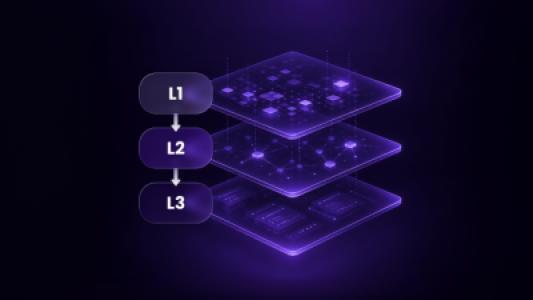
Learn how L1, L2, and L3 SOC analysts work together across security investigations, from alert validation and triage to advanced analysis, t...
Search Article by Category
We use cookies to enhance your browsing experience, analyse site traffic, and deliver relevant content. Choose which cookies you allow. Privacy Policy